
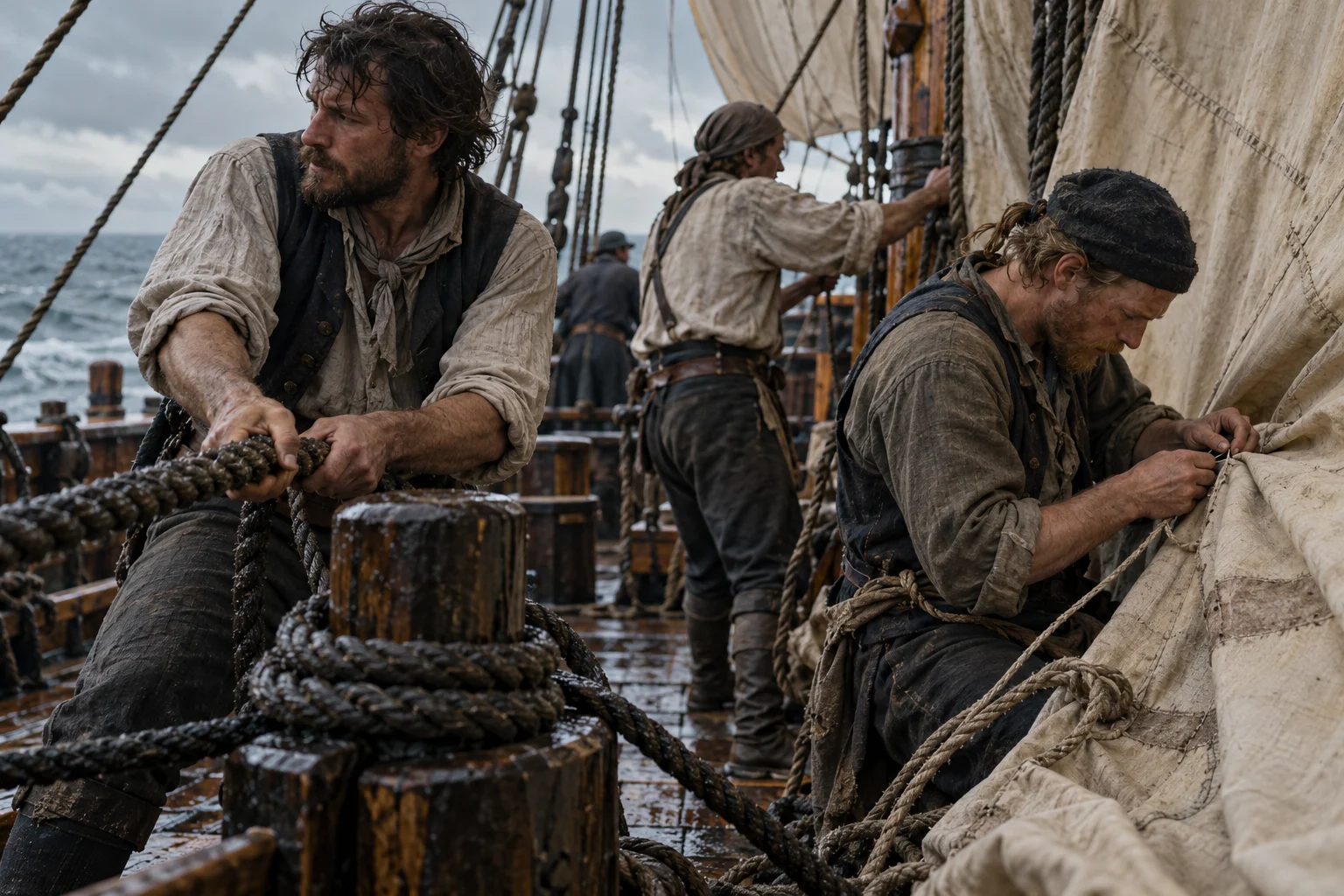
 AI-generated interpretation · not an archival image

People, not silhouettes.
A famous name is an entry into a larger world. Follow the companies around a captain, the work they depended on and the lives altered by their actions. A reported conversation and an official proceeding carry different kinds of weight.
Guides in this topic.
33 guidesNo matching guide. Try another word or clear the search.
Blackbeard: ships, raids and reputation
A short, violent career connected a French slave ship, a colonial port and the shallow waters of North Carolina.
Stede Bonnet: owning a ship was not commanding it
The so-called gentleman pirate makes a sharp distinction between money, authority and seamanship.
Jack Rackham and the company behind the name
A change of command, a stolen sloop and the fatal ambiguity of being aboard.
Anne Bonny: a life with an unfinished ending
The important distinction is between a reported pirate life and a later story that supplies every missing detail.
Mary Read: the account and the woman it describes
Military disguise, piracy and a Jamaican prosecution appear in one influential narrative—but they are not all the same kind of evidence.
Charles Vane: a captain whose crew chose someone else
Resistance to a governor was only one danger. Disagreement inside a pirate company could also end a command.
Bartholomew Roberts: a company that crossed the Atlantic
His career connects West African slave-trading ports, Brazilian shipping and the contested authority of a pirate captain.
Edward England and the cost of protecting a captive
The Cassandra encounter shows how a commander’s preference could fail to bind his own company.
Howell Davis: deception, access and a fatal invitation
A ship could carry a convincing flag. A captain could carry a convincing explanation. Neither made a harbor safe.
George Lowther: a mutiny inside a trading company’s world
A grievance over authority and provisions became a seizure of the ship itself.
Thomas Anstis: leaving a larger pirate company
Separation promised independence. It also meant finding ships, food, safety and a tolerable government again.
John Phillips: rules, forced men and a company overthrown
A surviving printed set of articles is only the beginning of the story. Ask who was allowed to leave.
William Kidd: the commissions and the conduct
His case turns on what he was empowered to do, the ships he took and the evidence brought against him.
Henry Every: the missing captain in a very public case
The voyage reached the courts through captured companions, proclamations and the commercial consequences of an Indian Ocean raid.
Woodes Rogers: privateer, author and governor
A voyage organized for profit preceded the attempt to govern the very maritime world that supplied pirate companies.
Alexander Selkirk: the islander who joined the working voyage
The rescued sailor supplied local knowledge and practical help, not merely an extraordinary story.
Benjamin Hornigold: experience turned against former associates
Rogers’s dispatches show a pardoned captain being tested through reconnaissance and capture.
Michel de Grammont: raiding after the fleet was wrecked
From the Aves disaster to Campeche, a buccaneer commander operated between royal service and unauthorized war.
Laurens de Graff: a raider inside a changing colonial order
A captain associated with Veracruz and Campeche later held titles in French service.
Nicholas van Hoorn: a merchant venture turns toward Veracruz
The movements of one ship connect European merchants, Atlantic slavery and a Caribbean raiding coalition.
Christopher Myngs: naval command at the edge of buccaneering
A commissioned officer’s Caribbean campaigns created disputes over trade, prizes and the authority ashore.
Henry Morgan: raider, commander and colonial official
Three campaigns and a government appointment expose the unstable boundary between private violence and imperial policy.
John Coxon and the decision to go back
The 1680 Pacific expedition was never one company with an unchanging leader or a single agreed destination.
Bartholomew Sharp: command that had to be won again
A Pacific cruise joined changing leadership, repairs, captured information and a difficult return.
Richard Sawkins: a commander lost at the river defenses
A prominent part in the Panama sea fight was followed by a fatal attack on a prepared town.
John Watling and a short-lived change of command
An election at Juan Fernández changed the leader without resolving the company’s deeper disagreement.
Basil Ringrose: the participant with a pen and a coastal view
His journal records weather, approaches and daily work alongside the violence of the Pacific cruise.
William Dampier: a voyage made from work, robbery and observation
The traveler’s route connects Jamaican commerce, the Pacific company and a book written for curious land readers.
Lionel Wafer: when the surgeon could no longer march
Dampier’s account of the 1681 crossing makes one injury a problem for the whole returning party.
Edward Low: a divided company and the limits of a fearsome name
The early account’s portrait of cruelty sits beside a maritime history of changing vessels, storm damage and a consort abandoned.
Spriggs: a company formed by a quarrel over punishment
A reported break with Low did not create a harmless alternative company.
John Evans: the command ended before the vessel did
A short Caribbean career ended with a killing aboard and a navigator who refused the captaincy.
Martel: the repair anchorage became a blockade
A successful sequence of captures ended with vessels concentrated in a place they could not readily leave.