
A reputation made in company
Sawkins appears among the commanders of the expedition that crossed Darién. At the fight with Spanish vessels near Panama, Ringrose gives him a conspicuous role and later credits him with much of the company’s success. The praise belongs to a participant who admired him. [1]
The encounter involved canoes, small craft and larger armed vessels. Command in that setting meant coordinating men who had not all arrived together, rather than directing one neat line of battleships.
A chief chosen after a departure
Coxon’s return toward the Caribbean left a different company in the Pacific. The narratives describe Sawkins being chosen to command it. His standing therefore emerged through both reputation and the company’s need for a leader after a split. [1][2]
The choice did not remove other captains. Sharp remained an important partner, and particular attacks could still involve different vessels and parties.
The river approach had been prepared against them
In May 1680, Sawkins and Sharp took a party toward Puebla Nueva. Ringrose describes a captive acting as pilot, trees obstructing the river and several defensive works near the settlement. The defenders had shaped the approach before the attackers reached them. [1]
This reverses the familiar pattern of a surprised and helpless coast. The town’s preparations narrowed the attackers’ options and turned an expected opportunity into a dangerous assault.
The author tells us where he was
Ringrose says he had been chosen for the operation but was ordered to remain aboard Captain Cook’s ship. He therefore did not personally witness every movement ashore. His narrative reports Sawkins running toward the defenses and being killed, followed by a withdrawal to the canoes. [1]
That explicit position is useful evidence. It lets the reader distinguish the author’s own shipboard experience from what he learned about the land party afterward.
Death forced another decision
The loss led to Sharp’s selection and further departures from the company. Sawkins’s career in this expedition ended at the point where his surviving companions had to decide whether to continue at all. [1][2]
Follow the earlier sea fight, Coxon’s departure and Sharp’s command. Together they show a sequence of changing leadership rather than one captain’s fixed voyage.
Questions, answered.
Was Sawkins killed in the fight off Panama?
No. He survived that encounter and was killed during the later attack on Puebla Nueva.
Did Ringrose witness Sawkins’s death from the land party?
Ringrose says he remained aboard during the assault. His narrative’s report must be read with that position in mind.
Sources & reading notes
Source checks distinguish an artifact, a reported account and a modern interpretation. They do not constitute independent historian review.
- Bucaniers of America, the second volume (1685)Open the keyboarded source transcriptionBasil Ringrose; printed for William Crooke; EEBO–TCP transcription · Participant voyage narrative, published 1685; CC0 keyboarded transcription
Chapters VII–IX, the fight near Panama, Sawkins’s selection and the attack on Puebla Nueva. Ringrose remained aboard during the last assault and reports its result. The published journal is a mediated participant account. Its nationalist praise, judgments about peoples and claims about motives are not adopted as neutral fact. The XML marks damaged and missing text; page images are not the CC0 transcription.
- History of the Buccaneers of America (1816)James Burney; Project Gutenberg transcription · Nineteenth-century historical compilation; public domain in the USA
The first Pacific expedition after the Darién crossing, including the change from Coxon to Sawkins and the latter’s death. Later than the events. Burney selects and compares earlier voyage narratives; his reconstruction is not an eyewitness record of every episode. Period ethnographic and colonial judgments require critical reading.
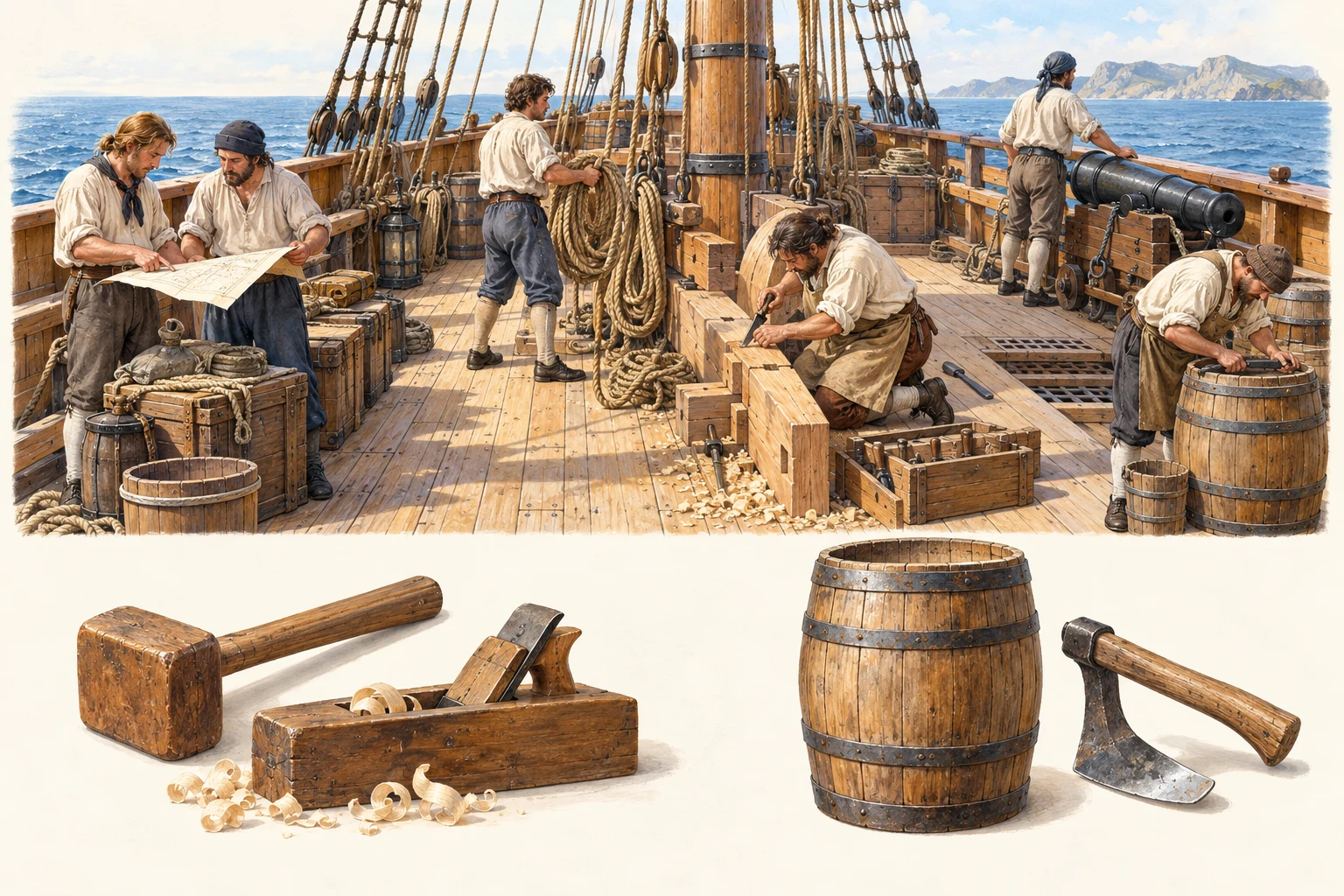 See the details.Pirate ranks and crew duties.Explore the illustrated guide