
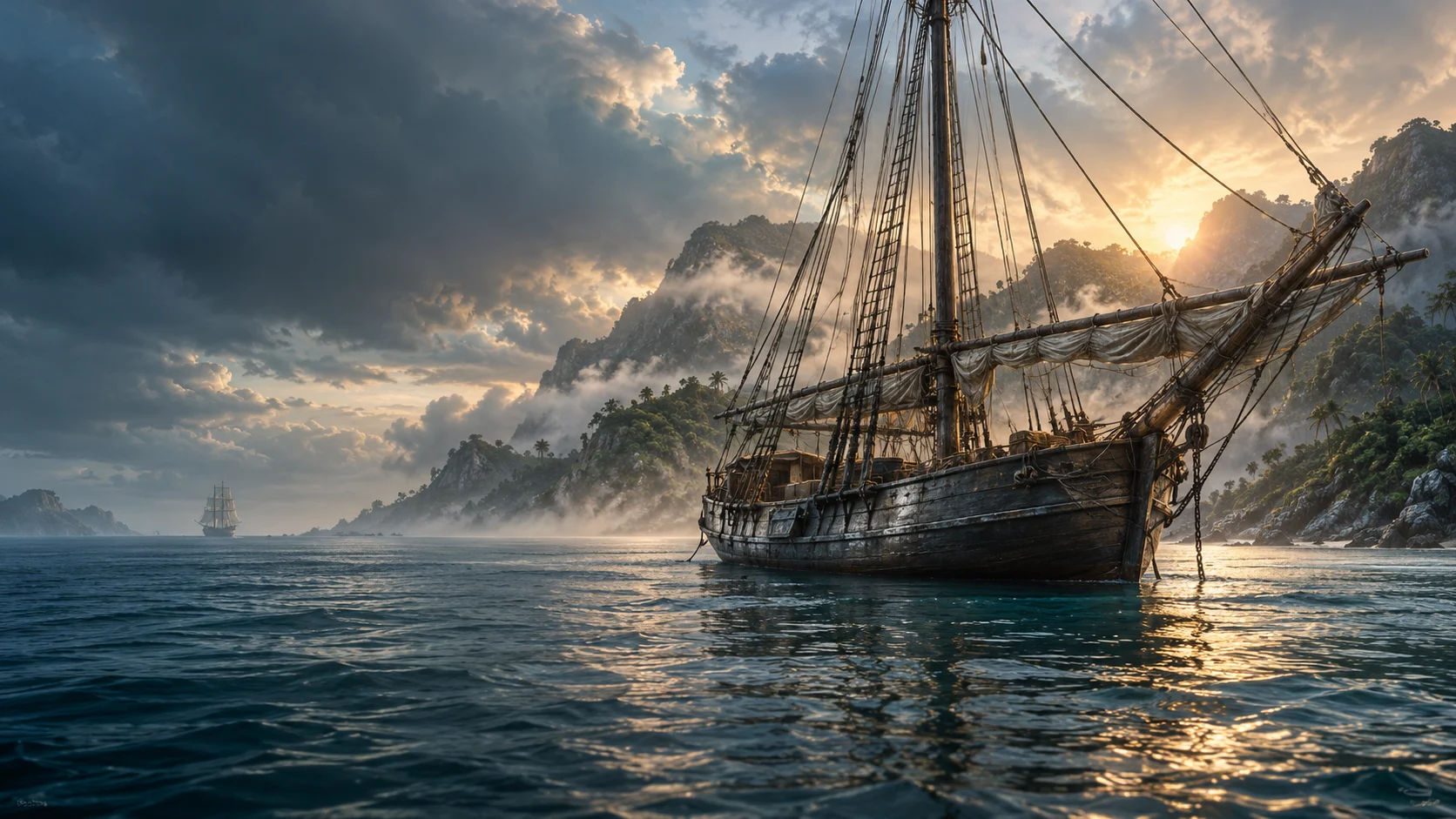
 AI-generated interpretation · not an archival image
A vessel was a working world.
Start with the vessel’s identity and date. Names could change; names could also be reused. The arrangement of sails, the work performed aboard and the story of a particular hull answer different questions.
Guides in this topic.
13 guidesNo matching guide. Try another word or clear the search.
Pirate ship types, explained.
A ship was a tool, not a uniform. Start with its rig, its purpose and the evidence for who used it.
Inside a pirate-era ship.
Hull, rig, steering and storage: a working vessel understood as connected systems.
Adventure Galley: a commissioned ship that could not stay sound
The documents identify a working vessel, its obligations and the condition that eventually made it unusable.
Quedagh Merchant: whose ship, whose goods, whose protection?
One captured vessel exposed the limits of treating a flag, a pass, a master and a cargo owner as the same thing.
Charles the Second and Fancy: the ship under Every’s command
A contemporary trial and wanted notices connect the names without inventing a separate hull for each spelling.
Duke and Dutchess: a partnership at sea
Two vessels could share a venture while facing different weather, sickness and decisions.
Oxford: the explosion before Morgan’s next campaign
The loss of an assembled force shows how quickly a fleet’s plan could change before reaching its target.
Queen Anne’s Revenge: a name did not create a new hull
The flagship’s earlier life and short pirate career belong to one vessel history.
Revenge and Royal James: following Bonnet’s sloop
Ownership, changing command and a new name can obscure one vessel’s route through the records.
Trinidad, called Trinity: a captured vessel altered along the way
Sharp’s company inherited a merchant hull and repeatedly worked on it to continue the Pacific cruise.
Royal Fortune was a recurring name, not one unchanging ship
Roberts’s successive choices show why a name must be attached to a date and a previous identity.
Gambia Castle becomes Delivery—and a company loses its main ship
The vessel’s route joins a trading company, a garrison dispute, a mutiny and vulnerable maintenance.
The damaged Fancy that carried Macrae away
A vessel useful to a survivor was a vessel the pirate company no longer wanted to keep.