

A haven under pressure
The General History places Vane at Providence when Woodes Rogers arrived as governor. The new administration offered a choice between submission under the pardon and continued resistance. Vane chose to leave rather than accept the new order. [1]
This was not a clash between an entirely lawless ocean and an entirely orderly shore. Providence was a place where raiders, traders, settlers and an arriving administration had competing interests. A governor’s arrival changed the practical value of the haven.
A partner leaves the partnership
The narrative gives Vane an associate named Yeats, commanding a smaller vessel. It explains their separation through resentment over Vane’s assumed superiority. Yeats eventually went to the South Carolina authorities and obtained the benefit of the pardon. [1]
The episode also involved enslaved people taken from a captured vessel and then returned to the owners claiming them. A story told only as an argument between pirate captains conceals the people whose freedom was denied throughout the transaction.
When caution became grounds for removal
Later, a disagreement over attacking a vessel divided the company. Vane judged the opponent too strong; Rackham and others wanted to engage. In the printed account, the company displaced Vane and elected Rackham. Vane was left with a smaller vessel and the men who supported him. [1]
It is tempting to use hindsight to label one side brave and the other cowardly. The more interesting point is institutional. A commander’s tactical judgment could collide with a company’s expectations, and the resulting decision could redistribute the ship itself.
Command did not equal security
The account follows Vane into a more precarious period after the split, including shipwreck and eventual capture. The trajectory moves from a busy haven and a substantial company to dependence on circumstances and other sailors. It undermines the idea of a pirate captain as a permanent sovereign who simply keeps a title until death. [1]
Compare this career with Bonnet’s loss of authority and the division of power aboard. The details differ, but ownership, reputation, seamanship and support from the company repeatedly pull apart.
Questions, answered.
Did Rackham replace Vane?
Yes, in the early account Rackham succeeds him after a dispute about engaging another vessel. The episode is attributed to that narrative.
Did all pirate captains have absolute power?
No single rule fits every company. Vane’s reported displacement is one example of a crew challenging its commander.
Sources & reading notes
Source checks distinguish an artifact, a reported account and a modern interpretation. They do not constitute independent historian review.
- A General History of the Pyrates (1724)Published under the name Captain Charles Johnson · Early printed account; public-domain text
Chapter VI, “Captain Charles Vane,” and opening of Chapter VII. Covers Providence, Yeats’s departure, the disputed engagement, Rackham’s succession and Vane’s later capture. Interpret the author’s moral judgments and reconstructed motives as such. Authorship is disputed. A near-contemporary compilation, not a surviving signed pirate code or a neutral transcript. Cite its claims as reported claims.
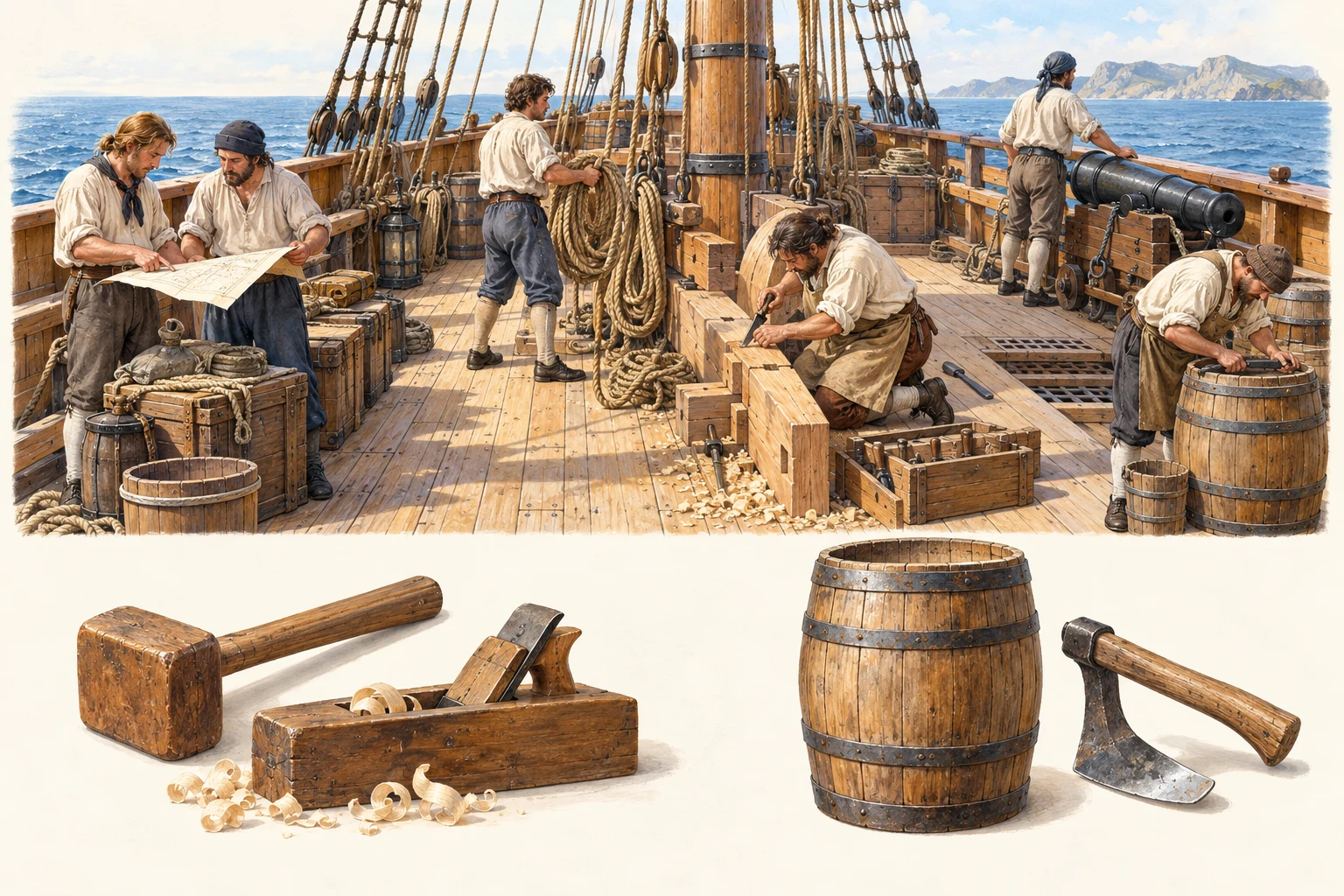 See the details.Pirate ranks and crew duties.Explore the illustrated guide