
A company wanted a different course
Sharp’s leadership became the focus of dissatisfaction during the stop at Juan Fernández. Ringrose reports a new election on 6 January and describes Watling as an experienced privateer and seaman. The transfer was a response to an existing dispute, not the beginning of a fresh voyage with a new crew. [1]
The vessel, stores, recent disappointments and disagreements all remained. Replacing the commander could change a decision without removing the conditions that made the decision difficult.
Signed articles did not prove universal enthusiasm
The narrative says articles were made with Watling and signed. It also says the rest were forced to assent to the election. Both details belong in an account of the transfer. A signed agreement can record a company’s organization while leaving questions about each person’s freedom to refuse. [1]
This is a concrete example of the limits of treating every shipboard election as a modern democratic ideal. The procedure and the pressure surrounding it must be read together.
Arica became the new prospect
The company left Juan Fernández and headed back toward the continental coast. Ringrose describes the decision to attempt Arica again in the hope of making their fortunes. Rigging and sails were altered as expectations changed from immediate return toward another attack. [1]
The promised reward was therefore part of command. A leader had to offer a course that men were willing to follow, while the coastline and the defenders determined what that course would actually allow.
The attack ended his command
At Arica, the attackers divided between the fort and the town. The encounter became a costly struggle, and Watling was killed. Ringrose’s chapter then describes Sharp being chosen again and leading the survivors back toward their boats. [1]
The new selection occurred in an emergency. It was less a tidy constitutional reversal than an urgent need for direction after the plan failed and the commander died.
The disagreement outlasted him
Some companions later separated from Sharp’s company rather than continue its cruise. Watling’s brief command thus sits within a longer argument over risk, reward and getting home. [2]
Compare Sharp’s changing authority with the evidence for company agreements. The history becomes clearer when an election is treated as one event in a working company, rather than an answer to every question about its power.
Questions, answered.
Did Watling found a separate expedition from England?
In this episode he was selected from the company already cruising the Pacific.
Did Sharp remain permanently deposed?
No. The narrative describes his restoration after Watling was killed at Arica.
Sources & reading notes
Source checks distinguish an artifact, a reported account and a modern interpretation. They do not constitute independent historian review.
- Bucaniers of America, the second volume (1685)Open the keyboarded source transcriptionBasil Ringrose; printed for William Crooke; EEBO–TCP transcription · Participant voyage narrative, published 1685; CC0 keyboarded transcription
Chapters XV–XVI, the January election, articles, departure and Arica attack. The journal’s January year style should not be read without the surrounding sequence. The published journal is a mediated participant account. Its nationalist praise, judgments about peoples and claims about motives are not adopted as neutral fact. The XML marks damaged and missing text; page images are not the CC0 transcription.
- History of the Buccaneers of America (1816)James Burney; Project Gutenberg transcription · Nineteenth-century historical compilation; public domain in the USA
The Juan Fernández command dispute and the second attempt on Arica. Later than the events. Burney selects and compares earlier voyage narratives; his reconstruction is not an eyewitness record of every episode. Period ethnographic and colonial judgments require critical reading.
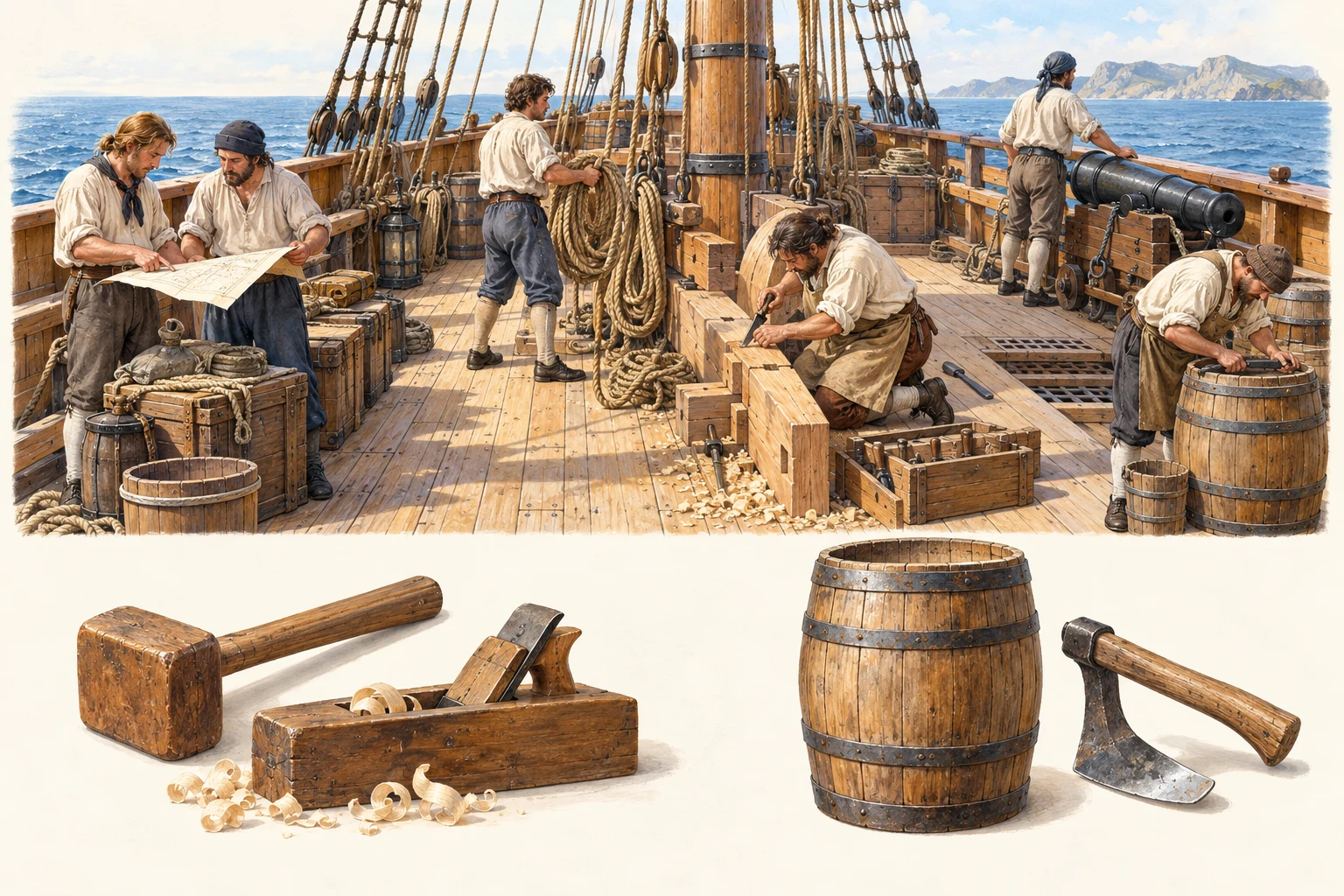 See the details.Pirate ranks and crew duties.Explore the illustrated guide