
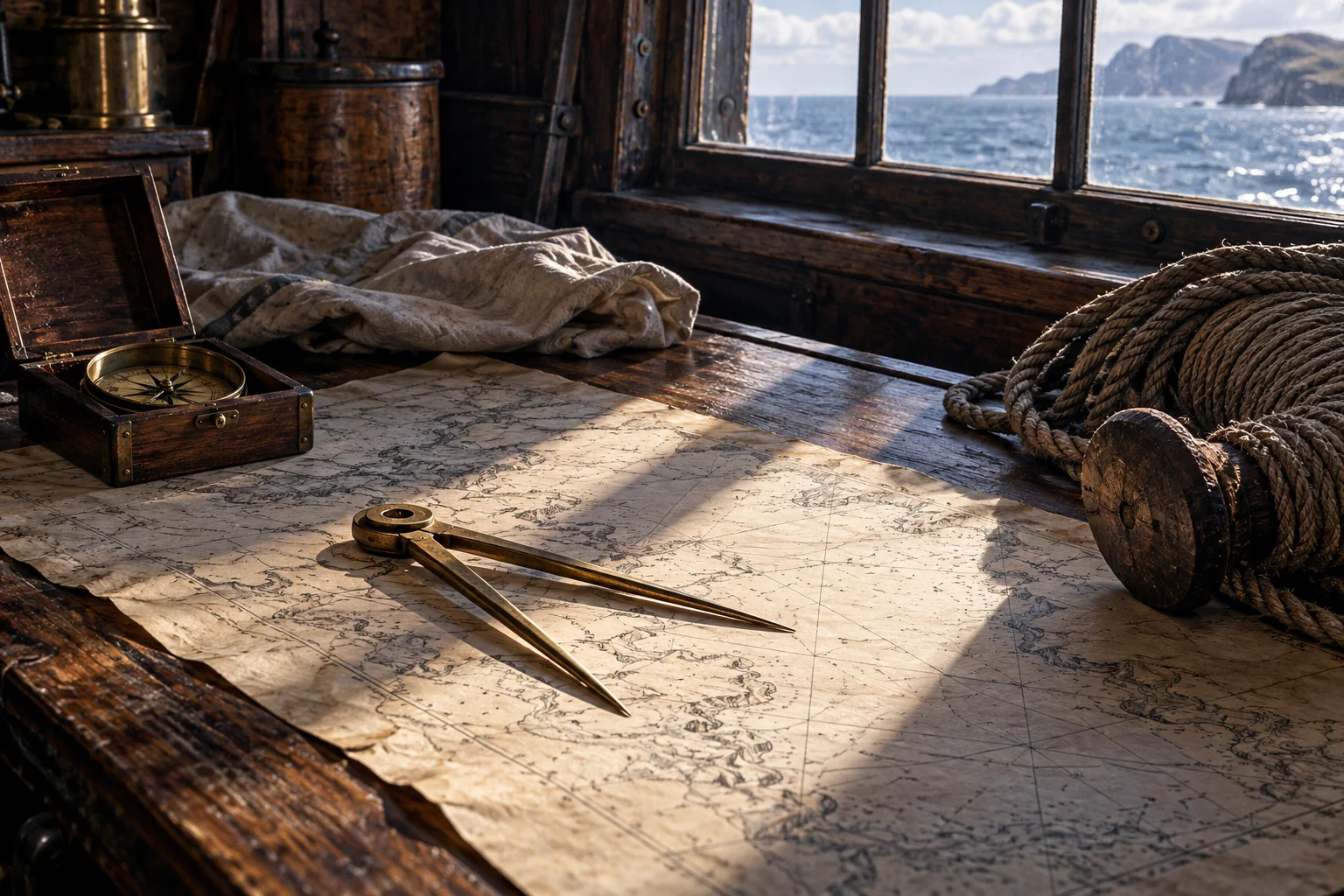
 AI-generated interpretation · not an archival image
Read the things that made a voyage.
Ask what an object could do, where it was found and which details are reconstructed. A surviving fragment can reveal practical work without supplying a complete scene of life aboard.
Guides in this topic.
22 guidesNo matching guide. Try another word or clear the search.
How sailors found their way.
Direction, distance, depth and position were different problems.
Rigging: which lines held the mast, and which did the work?
A web of ropes becomes easier to read when each part has a job.
The ship’s boats: the small craft behind the voyage
A longboat or skiff connected a large vessel to anchors, supplies and the shore.
Ship pumps: removing water was continuing labor
A working pump and a repaired leak solved different parts of the same emergency.
Anchors and cables: a vessel held by a whole system
The iron object, its cable, the ground and the people handling them all mattered.
The compass: direction was only one part of the position problem
A card could help a helmsman hold a course without telling the navigator exactly where the ship had arrived.
Dividers: the small gap between a chart and a distance
A surviving hinge can reveal a tool without preserving every part that made it work.
The sounding lead: depth, ground and a point in the water
One cast answered a local question that a distant view could not.
The log and the sandglass: measuring movement together
The line meant little without the interval, and the interval meant little without a usable line.
Latitude and longitude: two questions, different difficulties
Knowing how far north you were did not settle how far east you had traveled.
The backstaff: a name in a manual, an object with its own date
The history becomes clearer when a type of instrument is not confused with one surviving example.
Charts and pilots: the coast was more than a line on paper
Written, drawn and local knowledge met when a vessel approached land.
Dead reckoning: carrying an estimate forward
Direction, distance and allowances produced a position to test—not a location detected automatically.
Ballast and trim: weight changed the way a ship behaved
Where the load sat mattered as well as how much it weighed.
Capstan or windlass: how a crew applied its strength
The difference lies in the machine’s axis and the way people worked around it.
Helm, tiller and rudder: follow the steering connection
The person giving a course and the mechanism turning the vessel were parts of one working chain.
Keel, frames and beams: the structure beneath the silhouette
A wooden hull joined longitudinal, transverse and curved members into a working shell.
Blocks and tackles: why the ropes ran through wheels
A block could change a rope’s direction; a tackle could trade movement for a greater hauling advantage.
Caulking and oakum: the work in the seams
A wooden hull’s watertightness depended on joints, material and repeated skilled attention.
Pirate flags: a threat was more useful than a logo
Black cloth, skeletons and changing colors appear in early accounts, but not as one official design for every captain.
Pieces of eight: real money behind the pirate phrase
A silver denomination, a literary refrain and an accounting figure need to be read differently.
Cacao and chocolate: a valuable cargo that could also feed a traveler
Dampier’s account connects plantations, shipping, personal preference and provisions carried across the isthmus.