
A skill the company expected to need
Burney identifies Wafer as a surgeon engaged for the expedition. Dampier’s return narrative makes clear how much depended on having someone who could care for injured and sick companions. That dependence was practical, not merely an item in an officer list. [1][2]
The company’s own movement could put the surgeon in danger. Medical skill did not make its holder immune to weather, accident or exhaustion.
An accident at a stop
Dampier reports that Wafer was drying powder when another person passed with a lighted pipe. The resulting ignition burned his knee and left him unable to march normally. This is the narrator’s explanation of the incident; the source does not supply a modern diagnosis. [2]
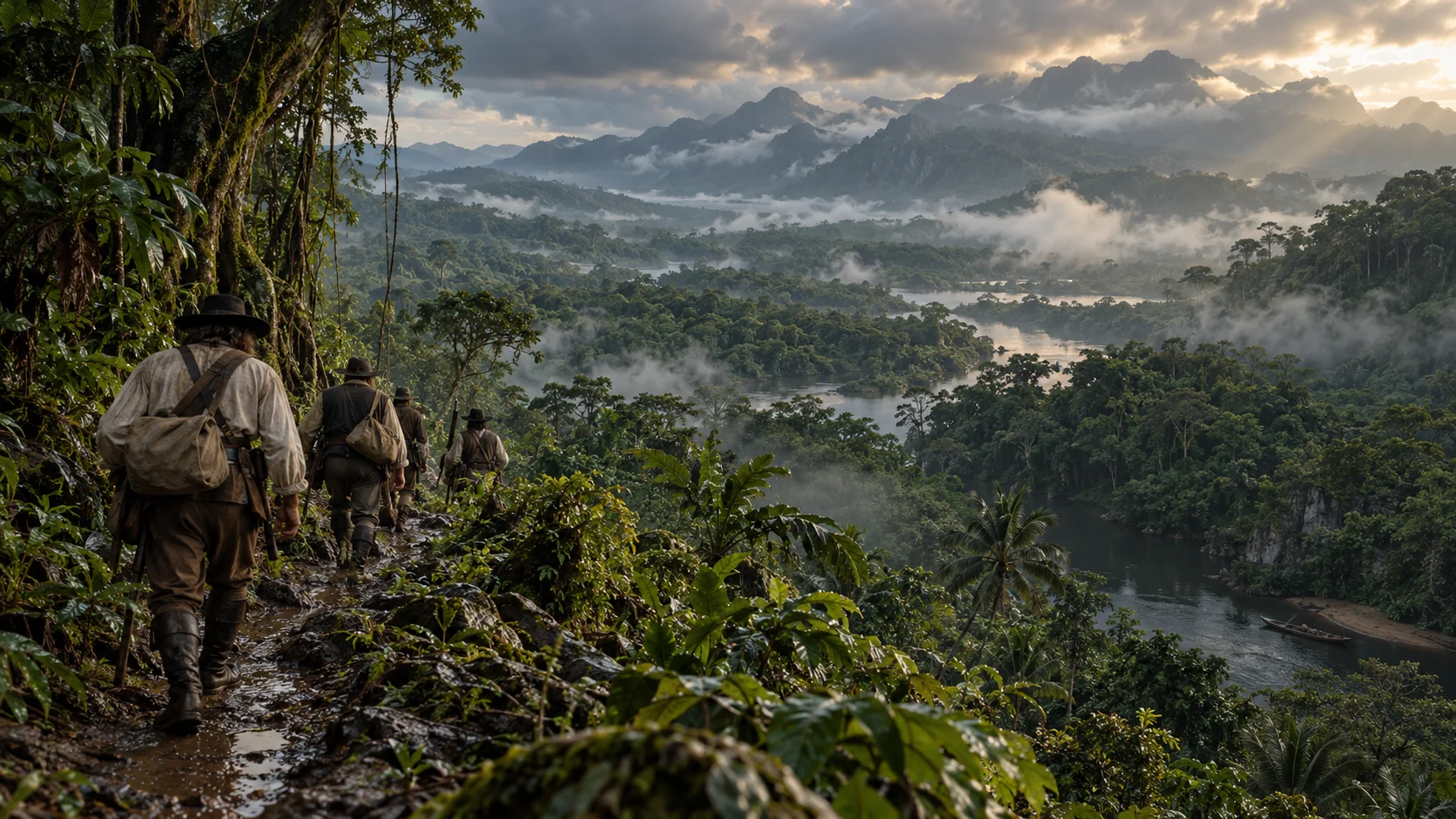
The timing made it a collective problem. The party was crossing difficult country with limited supplies and feared pursuit. Delay, carrying equipment and caring for a casualty now had to be reconciled.
Help did not rest on free labor alone
The narrative says an enslaved person was assigned to carry Wafer’s things. It also describes hiring another guide and repeated river crossings. The return depended on local knowledge and on labor whose conditions differed sharply from those of the armed travelers. [2]
Listing “the crew” as one freely cooperating body would conceal those differences. The account of an injured European needs to preserve the people compelled to help him move.
The rivers could separate companions
Dampier describes taller men assisting others across deep water and a rising river preventing companions behind from crossing at the same place. An injury’s consequences therefore depended on the changing route as much as the wound itself. [2]
The scene also shows the limits of a modern-looking line on a map. A path across the isthmus was a succession of decisions about water, shelter, guides and the speed of the people traveling.
What this episode can—and cannot—tell us
This guide follows a documented episode in Wafer’s traveling life. It does not reconstruct his entire career or turn historical treatments into medical instructions. A fuller biographical account requires his own published description and other records to be read alongside Dampier.
The immediate connection is to the surgeon’s work, Dampier’s position as narrator and the unequal labor that made the voyage possible.
Questions, answered.
Was Wafer injured during a ship-to-ship battle in this episode?
Dampier describes an accident while powder was being dried during the land journey.
Does this account establish a modern diagnosis or treatment?
No. It is a period narrative of injury and movement, not present-day medical guidance.
Sources & reading notes
Source checks distinguish an artifact, a reported account and a modern interpretation. They do not constitute independent historian review.
- History of the Buccaneers of America (1816)James Burney; Project Gutenberg transcription · Nineteenth-century historical compilation; public domain in the USA
The 1680 crossing identifies Wafer as engaged surgeon before the later return episode. Later than the events. Burney selects and compares earlier voyage narratives; his reconstruction is not an eyewitness record of every episode. Period ethnographic and colonial judgments require critical reading.
- A New Voyage Round the World (1697), with collected voyage textsOpen the keyboarded source transcriptionWilliam Dampier; James Knapton; EEBO–TCP transcription · Voyage writing and later collected parts; CC0 keyboarded transcription
Chapter II, the River Congo stop, powder accident, hired guides, river crossings and care for those unable to keep up. The cause is Dampier’s report; it is not a modern medical case file. Dampier writes as an involved traveler, not an impartial observer. His racial, colonial and medical judgments are not present-day facts. The catalogue describes a multi-volume set; individual parts and dates must be distinguished. Volume 3 is absent from this transcription.
 See the details.Pirate ranks and crew duties.Explore the illustrated guide