
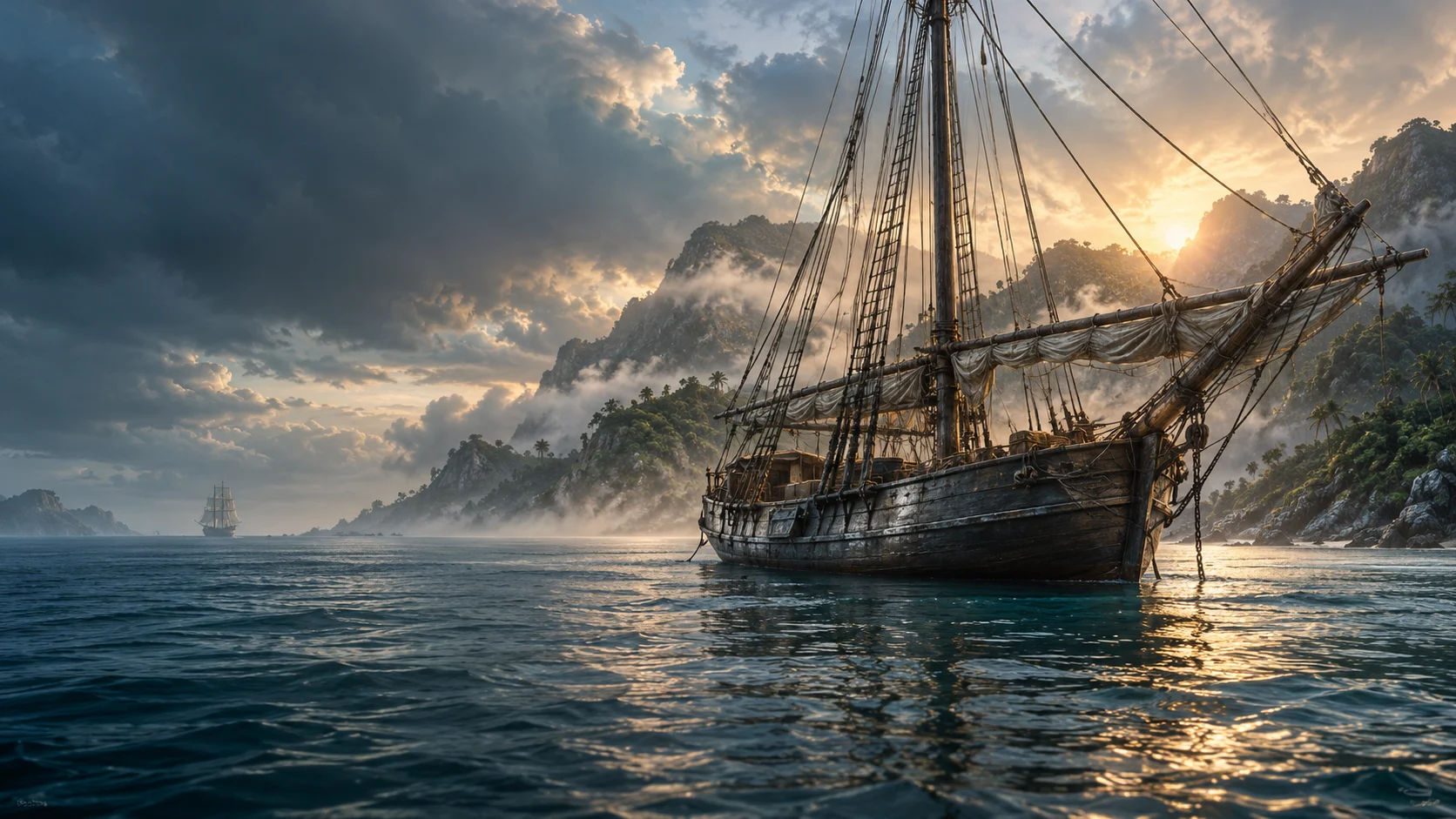
His ship belonged to naval service
Haring traces Myngs’s command of Marston Moor and his service in the West Indies. In 1659 he commanded vessels attacking the South American coast and returned to Jamaica with captured wealth. [1]
Calling him a pirate without qualification would erase the official commission and institutions around his operation. Calling every action unquestionably lawful because he was an officer would be equally misleading.
The first argument followed the return
The 1659 proceeds produced conflict with Governor Doyley and other officials over accounting and the state’s share. Myngs was sent home suspended; complaints and counter-complaints followed. [1]
The dispute illustrates the distance between taking property at sea and settling who could distribute it. A commander could have support from his men while facing accusations from the government he served.
A campaign against Santiago answered Jamaican concerns
In 1662 Myngs commanded the expedition against Santiago de Cuba. Wind prevented the intended direct approach into the harbor, so the attackers landed elsewhere and marched over difficult ground before taking the town. [1]
The operation joined official colonial policy to raiding. It was explained in Jamaica through trade and security claims, while the people attacked experienced destruction and removal of property.
Campeche was a separate operation
The following year he led another force to Campeche. Haring describes losses and separation in a storm, an approach by land and Myngs being wounded during the attack. Damage to the town and disruption of trade followed. [1]
This is the 1663 campaign, not the later 1685 attack by Grammont and de Graff. Distinguishing them is essential when matching commanders and dates.
Official service could still create an international crisis
Spain demanded explanations, and the movements of the treasure fleet were affected by the reported danger. The English government had to address actions carried out under authority claimed from its own colonial administration. [1]
Read the conquest of Jamaica, commissions and the later peace settlement. Myngs’s Caribbean service belongs in the story of states making maritime violence useful and then struggling to contain its effects.
Questions, answered.
Was Myngs only a captain in an uncommissioned pirate company?
No. He held naval commands, although his operations and the distribution of their proceeds generated serious disputes.
Did he command the 1685 Campeche expedition?
No. The Campeche operation discussed in his career occurred in 1663.
Sources & reading notes
Source checks distinguish an artifact, a reported account and a modern interpretation. They do not constitute independent historian review.
- The Buccaneers in the West Indies in the XVII Century (1910)Clarence Henry Haring; Project Gutenberg transcription · Early twentieth-century historical study; public domain in the USA
Chapter III, pp.98–109, including notes on Marston Moor, the 1659 dispute, Santiago 1662 and Campeche 1663. Reported plunder values and casualty figures are not used as audited totals. An older secondary study drawing on colonial records and earlier narratives. Its imperial framing, racial generalizations and claims about national character are not adopted as fact. Not a substitute for current scholarship.
 See the details.Pirate ranks and crew duties.Explore the illustrated guide