

An earlier company connects him to Teach
The General History places Teach in a captured sloop under Hornigold’s direction and describes the two operating together before their paths separated. These are attributed claims in the early compilation, rather than a complete record of Hornigold’s youth and career. [1]
The connection explains why his subsequent allegiance mattered to people who knew the pirate networks.
Pardon created a new possibility
Rogers’s December dispatch explicitly identifies Hornigold and Cockram as men who had been pirates and accepted the act of grace. Their behavior after his arrival gave him confidence to employ them. [2]
The change was practical as well as reputational. They could command vessels and recognize people whose movements the governor wanted to understand.
Reconnaissance tested that confidence
In October, Rogers reported fitting a sloop under Hornigold to examine Vane’s position. A long absence made the governor fear capture or renewed piracy. Hornigold returned after watching the opposing company and brought a vessel accused of trading with it. [2]
The outcome mattered partly because it answered the immediate suspicion. Trust was being made through a reported action, not assumed simply from a certificate.
Another operation supplied a stronger public demonstration
The later dispatch reports Hornigold and Cockram apprehending a group of pirates, some of whom died of wounds. Rogers welcomed this as evidence that Hornigold was trying to remove the infamy of his earlier name. [2]
That praise is the governor’s judgment. It is evidence of how the new administration presented a useful former pirate, not a finding that every action in his past had become harmless.
Follow the network across the change
Vane, Teach, pardoned sailors, traders and government officers belonged to overlapping maritime networks. Hornigold’s history shows those relationships being redirected rather than a wholly new government appearing with no local knowledge.
Read the establishment of government, the pardon policy and Vane’s continuing company. The cited dispatches provide concrete episodes without inventing an exact final scene for Hornigold.
Questions, answered.
Was Hornigold’s pirate-hunting role only a later legend?
Rogers’s 1718 dispatches explicitly describe employing him and report his actions.
Did Rogers trust him without concern?
The October dispatch records suspicion during his absence before describing his return.
Sources & reading notes
Source checks distinguish an artifact, a reported account and a modern interpretation. They do not constitute independent historian review.
- A General History of the Pyrates (1724)Published under the name Captain Charles Johnson · Early printed account; public-domain text
Chapter III, the attributed association with Teach and captures; introduction for pardon context. The compiler’s dates and motives are not all independently established. Authorship is disputed. A near-contemporary compilation, not a surviving signed pirate code or a neutral transcript. Cite its claims as reported claims.
- Calendar of State Papers Colonial, America and West Indies,1717–1718 (1930)Edited by Cecil Headlam; HMSO1930; 1964 facsimile reprint · Calendar of early-eighteenth-century state papers; public-domain historical text
Entry 737,31 October 1718, Hornigold’s scouting, absence and return;807,24 December 1718, the operation with Cockram and Rogers’s assessment. These are Rogers’s reports, not complete independent biographies. The inspected copy is a later reprint and imperfect OCR of the calendar, not every original manuscript. A governor’s dispatch is an interested report. Distinguish reported arrival, landing, writing and receipt dates; period disease theories are not modern diagnoses.
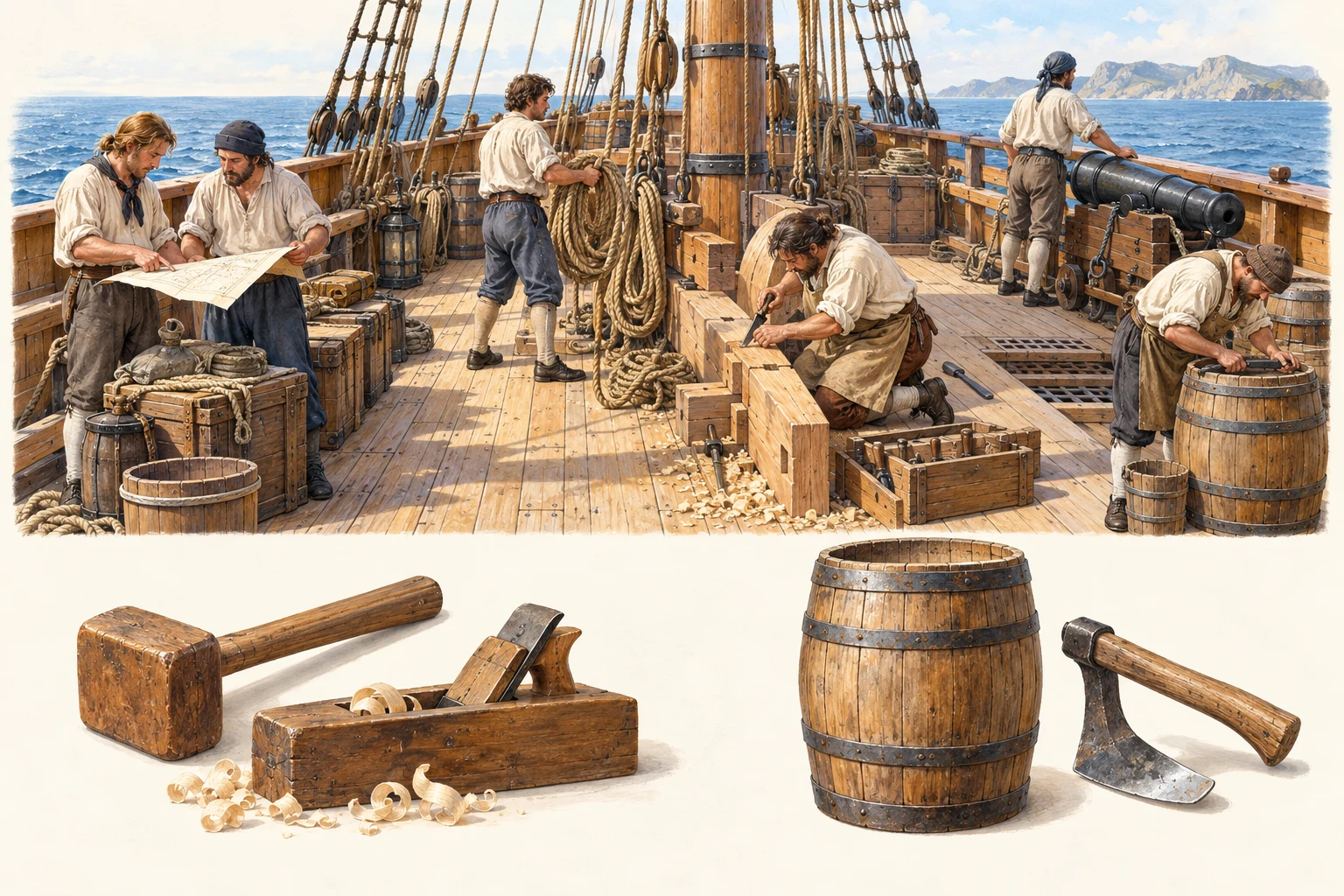 See the details.Pirate ranks and crew duties.Explore the illustrated guide