
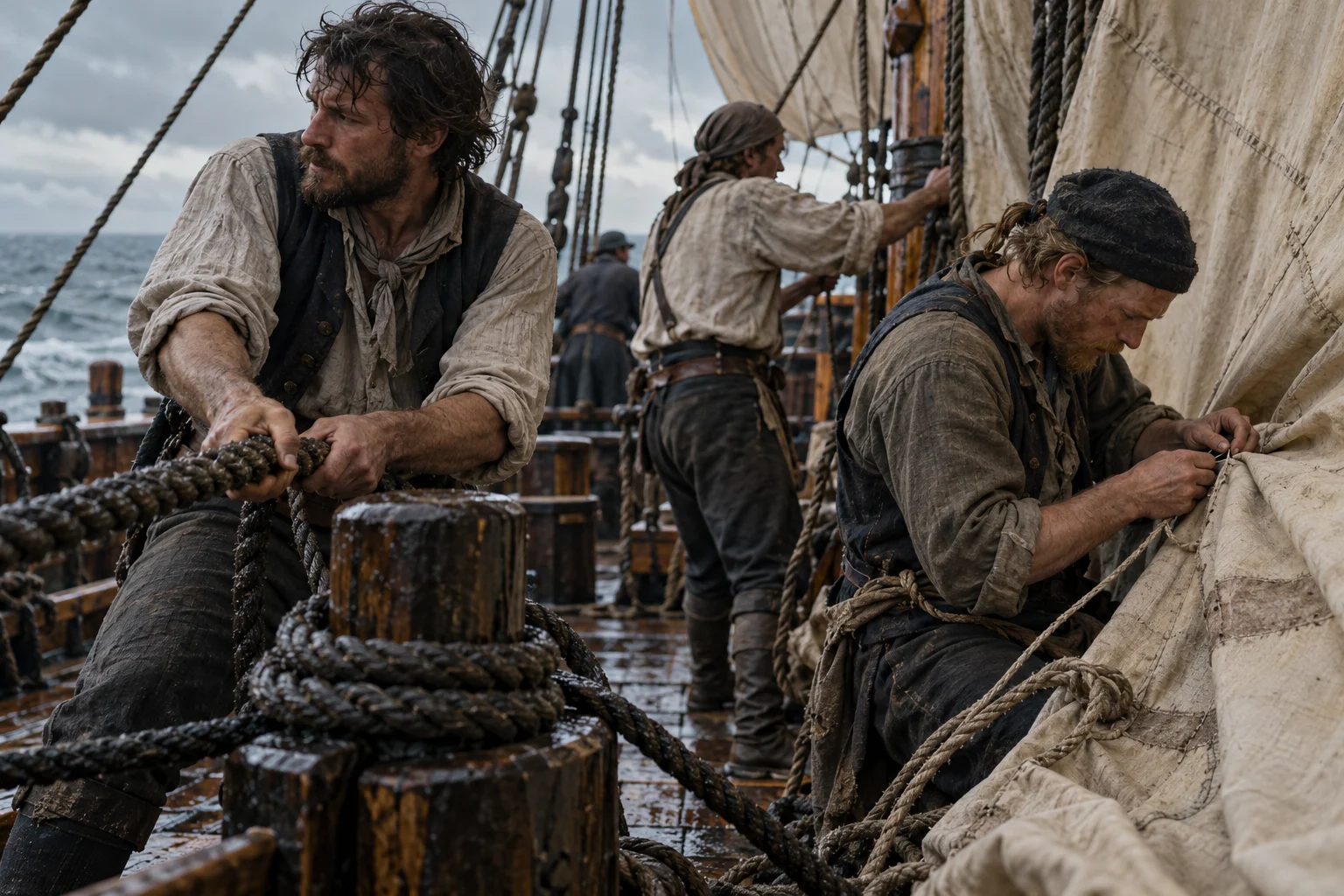
Leadership after a failed attack
After Sawkins was killed at Puebla Nueva in May 1680, the surviving company chose Sharp as leader. Ringrose explicitly says he had remained aboard rather than joining that assault. The loss of a commander therefore reached the account through survivors as well as the author’s own observation. [1]
Sharp inherited a company already altered by Coxon’s departure. His command was a stage in an unstable expedition, not the fulfillment of an uninterrupted master plan.
The company could replace its commander
At Juan Fernández, dissatisfaction led to Sharp’s removal and the selection of John Watling. Ringrose reports an election, signed articles and pressure on others to assent. That combination is more complicated than an uncomplicated image of unanimous shipboard freedom. [1]
After the disastrous attack on Arica and Watling’s death, Sharp returned to command. Some men subsequently left the company rather than continue the cruise. Authority aboard was repeatedly tested against the prospect of profit, danger and return. [2][1]
The vessel was part of the argument
Ringrose records work on the captured vessel called Trinity: cleaning, careening and alterations to the upper works. These jobs consumed time and changed what the company thought the ship could do. They belong beside command changes because every strategic choice depended on a vessel capable of carrying it out. [1]
The voyage also relied on smaller craft. Sailing, landing, taking prizes and carrying messages did not all require the same kind of boat.
A captured book could have value
The company captured Rosario in July 1681. The narrative describes taking goods and money and retaining a man who claimed to be an experienced pilot. The Royal Museums Greenwich catalogue connects the seizure with a Spanish coastal pilot book used for later English chart work. [1][3]
This was another kind of acquisition: organized knowledge of coasts, anchorages and approaches. It connects maritime robbery to the production of maps, without making the robbery a benevolent scientific expedition.
Returning was a voyage in its own right
The final chapters follow a long passage around southern South America and back into the Atlantic. Entries about winds, observations, food and water show how much of the return consisted of ordinary navigation and scarcity. Ringrose’s narrative ends with dispersal in the Caribbean and his own arrival in England. [1]
Sharp’s story is strongest when read through these linked tasks: maintaining a ship, holding a divided company together, finding information and surviving the passage home. Continue with the chart and pilot-book trail and the work beneath the waterline.
Questions, answered.
Was Sharp always the commander?
No. The narrative records earlier leaders, his removal in favor of Watling and his later restoration.
Was the captured Spanish chart book a treasure map?
It was coastal navigational information, not a guide to buried treasure. Its later copying is part of the history of maritime knowledge.
Sources & reading notes
Source checks distinguish an artifact, a reported account and a modern interpretation. They do not constitute independent historian review.
- Bucaniers of America, the second volume (1685)Open the keyboarded source transcriptionBasil Ringrose; printed for William Crooke; EEBO–TCP transcription · Participant voyage narrative, published 1685; CC0 keyboarded transcription
Chapters IX, XV–XVII, XX–XXI and XXIV–XXV, for command changes, the capture of Rosario and the return voyage. Participant narrative, not an independent biography. The published journal is a mediated participant account. Its nationalist praise, judgments about peoples and claims about motives are not adopted as neutral fact. The XML marks damaged and missing text; page images are not the CC0 transcription.
- History of the Buccaneers of America (1816)James Burney; Project Gutenberg transcription · Nineteenth-century historical compilation; public domain in the USA
The Pacific cruise after Sawkins’s death, the disagreements at Juan Fernández and Arica, and the return to the Caribbean. Later than the events. Burney selects and compares earlier voyage narratives; his reconstruction is not an eyewitness record of every episode. Period ethnographic and colonial judgments require critical reading.
- Archipielago de las Perlas, from Ringrose’s South Sea WaggonerRoyal Museums Greenwich, National Maritime Museum · Museum manuscript catalogue; item P/32(43)
RMG manuscript P/32(43), catalogue explanation of the captured Spanish derrotero and subsequent chart copying. The record describes this manuscript and the captured Spanish source behind it. It does not make every later drawing a direct eyewitness survey or license reuse of the catalogue photographs.
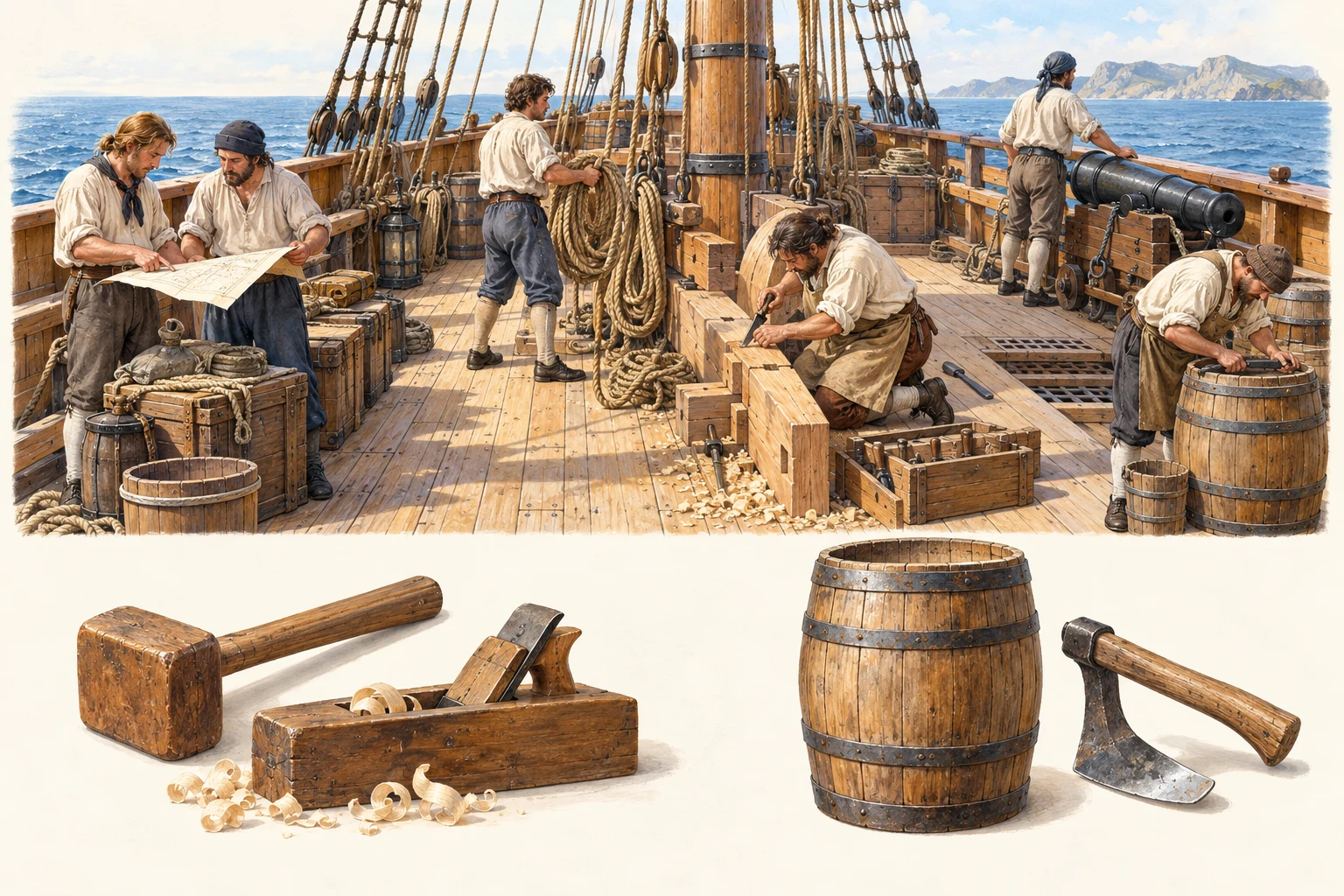 See the details.Pirate ranks and crew duties.Explore the illustrated guide