
A prize needed a place to become wealth
Before the Veracruz expedition, Haring records de Graff capturing a Spanish vessel carrying money for military pay. The account gives a substantial dividend to the men and describes an arrangement with the French governor after the prize reached Petit-Goâve. [1]
Capture was one step in a longer transaction. A captain needed a place to dispose of goods, settle claims and prepare another voyage. His relationship with people ashore could matter almost as much as the strength of his ship.
Veracruz brought commanders together
De Graff and Nicholas van Hoorn were leading figures in the 1683 coalition. Their companies used information obtained from prisoners and the expectation of arriving merchant vessels to approach the town. The occupation involved theft, threats against civilians and the removal of enslaved people. [1]
A successful surprise attack for the raiders was a violent catastrophe for its inhabitants. Both belong in the history of the expedition.
Division of the proceeds could divide the leaders
Haring describes a quarrel between de Graff and van Hoorn over the division after Veracruz. Van Hoorn was wounded and died afterward. The narrative is not evidence that all disagreements between buccaneers ended in a ritual duel or that one universal code settled every prize. [1]
Large coalitions increased the available manpower while creating more claims on the resulting property.
Campeche shows the association continuing
In 1685 de Graff and Grammont assembled at Île-à-Vache before attacking Campeche. A failed attempt toward Mérida preceded the occupation of the coastal town. This was a separate campaign, not another name for Veracruz. [1]
The distinction matters on a map as well as in a chronology: different ports had their own defenses, trading functions and communities.
French service offered another kind of authority
Haring records de Graff receiving the title of major and taking part in later war against the English. His notes also preserve subsequent French titles. These appointments show a government finding uses for an experienced maritime fighter. They do not retroactively legalize every earlier seizure. [1]
Read the Veracruz campaign, Campeche and the powers of a commission. The career is most intelligible through changing patrons, ports and conflicts.
Questions, answered.
Were Veracruz and Campeche the same expedition?
No. They were separate attacks in 1683 and 1685.
Did later French titles prove that all earlier prizes were lawful?
No. An appointment and the legality of a particular capture are different questions.
Sources & reading notes
Source checks distinguish an artifact, a reported account and a modern interpretation. They do not constitute independent historian review.
- The Buccaneers in the West Indies in the XVII Century (1910)Clarence Henry Haring; Project Gutenberg transcription · Early twentieth-century historical study; public domain in the USA
Chapter VII, pp.241–248 and note 454. The early-career story and dramatic marriage anecdote are attributed by Haring to later writers; neither is used here as a complete verified biography. An older secondary study drawing on colonial records and earlier narratives. Its imperial framing, racial generalizations and claims about national character are not adopted as fact. Not a substitute for current scholarship.
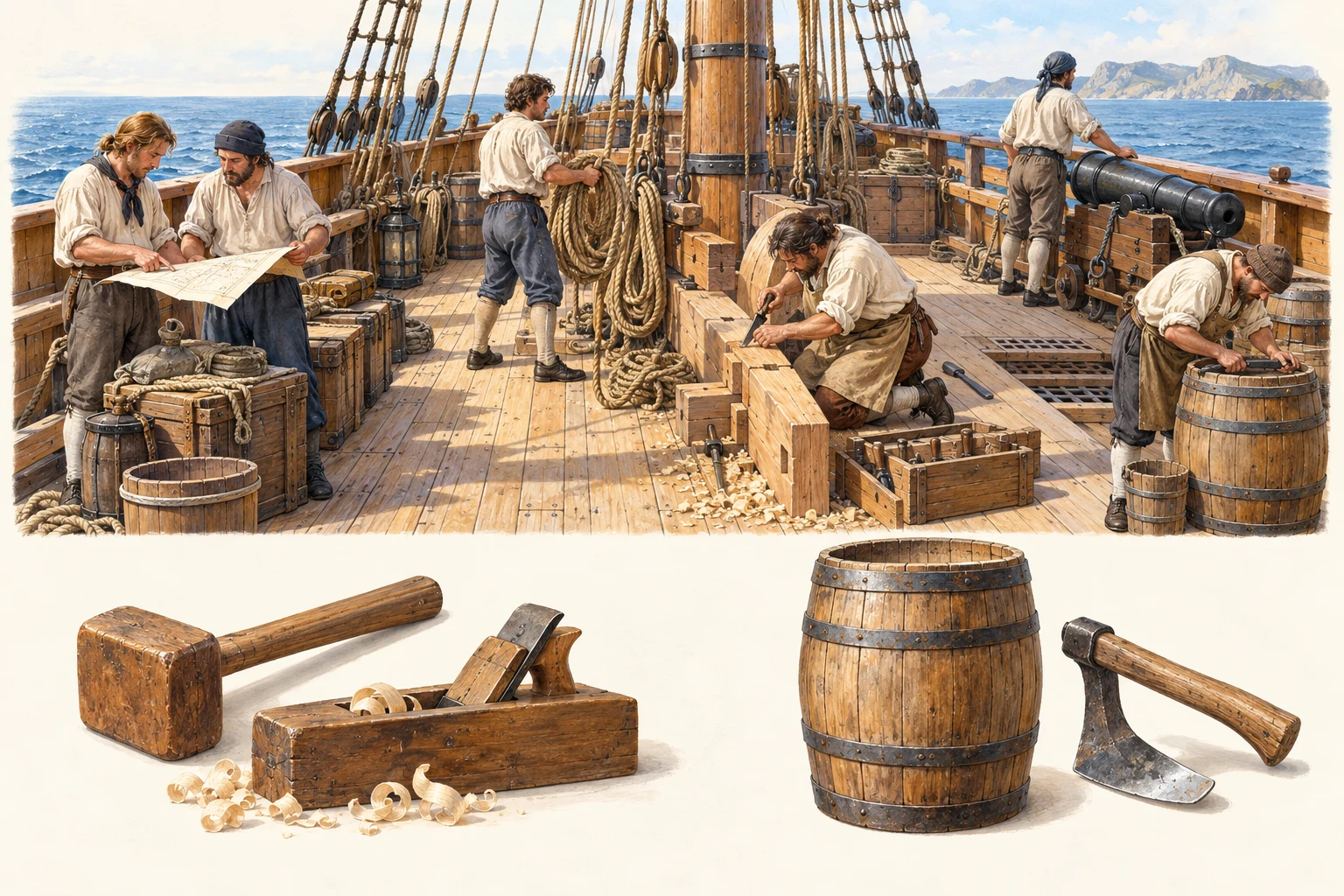 See the details.Pirate ranks and crew duties.Explore the illustrated guide