

A useful prize displaced an existing vessel
The narrative describes a French ship taken during an Atlantic passage and judged better suited to the company than its existing vessel. The men transferred, and the author calls this their first Royal Fortune. The phrase itself warns that the name would recur. [1]
Capturing a more useful ship could change the company’s platform without changing its leader or immediately ending the previous cruise.
A consort was not simply the flagship by another name
The account also follows other craft, including a vessel called Good Fortune and later Ranger. These worked in company but had their own commanders and roles. Their names should not be collapsed into an all-purpose pirate flagship. [1]
Separating the vessels helps explain departures, the distribution of people and what happened when the company encountered an opponent.
Onslow supplied another hull
On the West African coast, the company took Onslow, commanded by Gee and associated with the Royal African Company. The narrative places some of its men ashore when the pirates arrived and describes sailors and soldiers joining the new company. Those explanations and motives remain the author’s telling. [1]
The capture connects the flagship directly to the infrastructure of British commerce and the slave-trading coast.
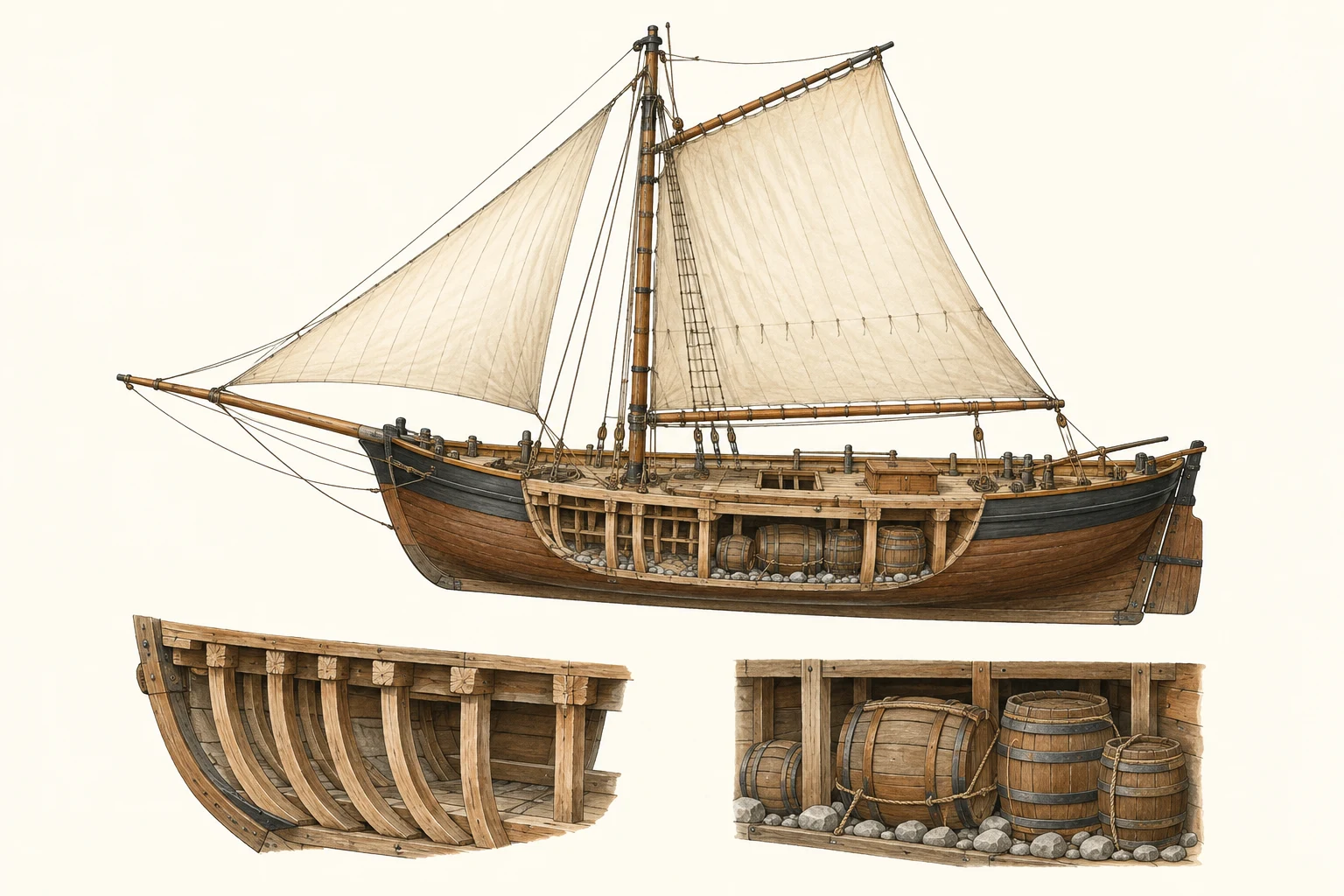
Alteration made the replacement serve the company
The account says the buccaneers removed bulkheads, made the vessel flush and continued the name Royal Fortune. It reports a battery of forty guns for this stage. That figure belongs to the newly altered Onslow, not automatically to every earlier ship carrying the name. [1]
A reconstruction must therefore choose a particular hull and date before making claims about dimensions, armament or internal arrangement.
The final name reached the aftermath
The narrative follows the last Royal Fortune through Roberts’s death and the removal of prisoners. A recurring name gave continuity to the company’s image, while capture and alteration changed the material ship beneath it. [1]
Read Roberts’s career, vessel terminology and the broad working parts of a ship. Keep a name, a hull and an organization as three connected questions.
Questions, answered.
Can every Royal Fortune gun count be combined into one specification?
No. The name was used for successive hulls and needs a date and prior identity.
Was Onslow built as a pirate flagship?
The account describes a commercial vessel captured and altered for the company’s use.
Sources & reading notes
Source checks distinguish an artifact, a reported account and a modern interpretation. They do not constitute independent historian review.
- A General History of the Pyrates (1724)Published under the name Captain Charles Johnson · Early printed account; public-domain text
Chapter IX, the first French Royal Fortune, subsequent Atlantic movements, the capture of Onslow at Sestos, alterations and the final confrontation. The narrative’s exact dates and retrospective name uses require care. Authorship is disputed. A near-contemporary compilation, not a surviving signed pirate code or a neutral transcript. Cite its claims as reported claims.
 See the details.Inside a pirate-era ship.Explore the illustrated guide