
A royal vessel in a private expedition
Haring identifies Oxford as a royal frigate of thirty-four guns under Captain Edward Collier, arriving at Port Royal in October 1668. Its later participation in Morgan’s gathering makes the expedition difficult to describe as a world entirely separate from government resources. [1]
The vessel’s institutional identity matters as much as its gun count. A royal ship could become involved in a venture whose participants and expected rewards differed from an ordinary naval deployment.
The gathering was vulnerable
Ships and captains assembled near Cow Island, or Île-à-Vache, off Hispaniola. Haring’s reconstruction describes a meeting and dinner aboard Oxford before the explosion. Exquemelin’s translated narrative supplies another account of the gathering and destruction. [1][2]
A concentration of commanders aboard one vessel created a concentration of risk. A force might lose leadership and experienced men before ever meeting an opponent.
Keep the cause separate from the outcome
The sources agree on a catastrophic explosion, but explanations of how it began are less secure. Haring offers a probable explanation involving the gunner; the early narrative also advances a conjecture. Neither is a modern technical investigation. [1][2]
It is reasonable to describe the destructive loss without converting an author’s guess into a proven chain of ignition. The page provides no operational account of powder handling or a recipe for reproducing the event.
The losses changed the available campaign
Haring reports a very large death toll, including several captains, and describes Morgan among the survivors. The precise number remains the reconstruction’s reported estimate. What follows is clearer at the level of the expedition: fewer men and fewer available resources altered its options. [1]
The company proceeded toward Maracaibo rather than carrying out the earlier projected attack on Cartagena. The later lake campaign therefore began with a disrupted coalition, not an untouched fleet.
A ship can explain more than its dimensions
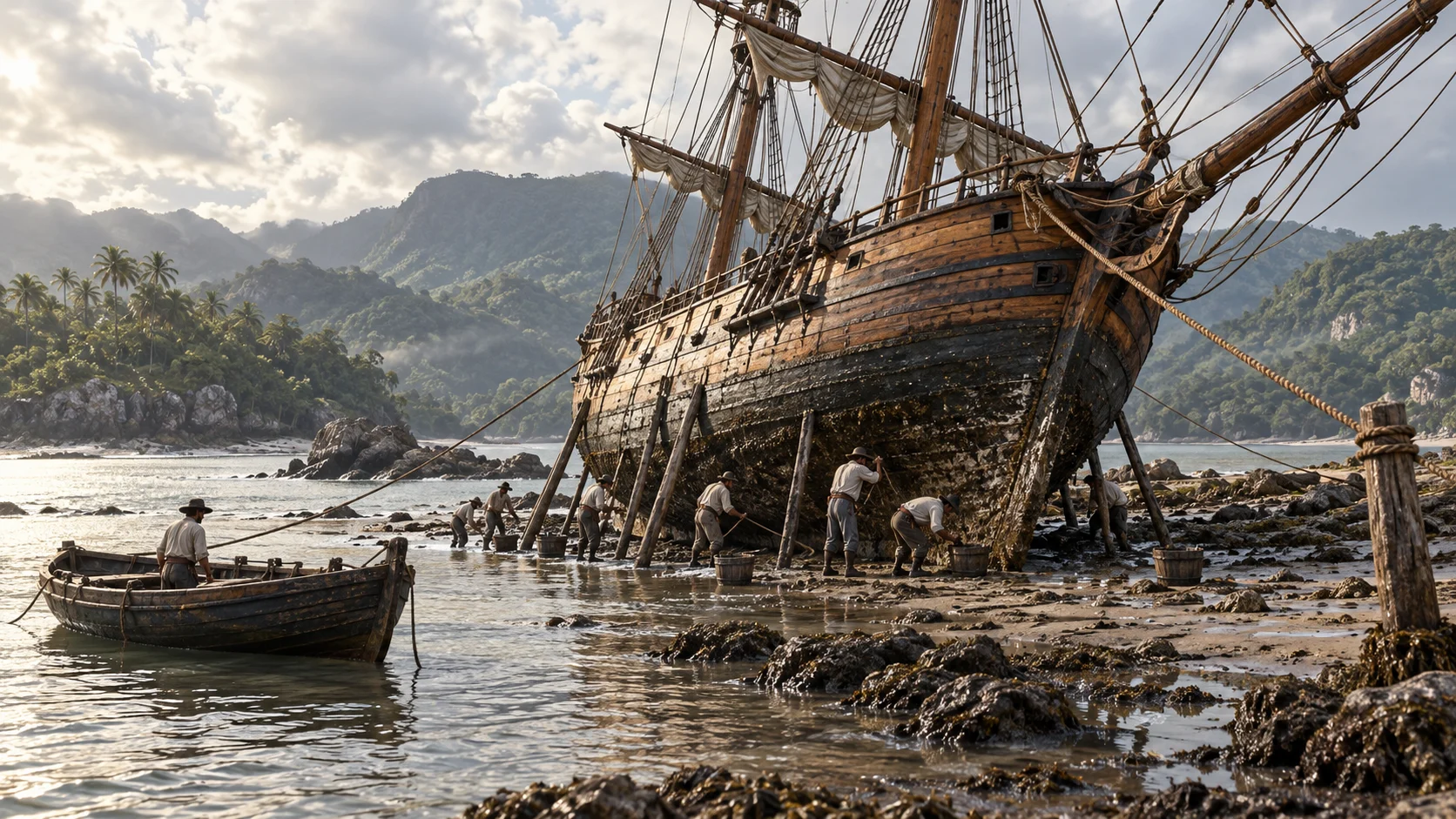
No measured arrangement of Oxford is reconstructed here. The generic scene artwork does not depict its explosion or claim to show its exact hull. The useful history is the vessel’s relationship to naval authority, expedition assembly and the consequences of a sudden loss.
Read what the company attempted next, Morgan’s changing career and why a vessel’s role cannot be inferred from a pirate label.
Questions, answered.
Was Oxford destroyed during the battle at Maracaibo?
No. Its destruction occurred during the preceding gathering, before that campaign.
Is the exact cause of the explosion known from these sources?
These texts offer explanations, but they do not establish a modern forensic determination.
Sources & reading notes
Source checks distinguish an artifact, a reported account and a modern interpretation. They do not constitute independent historian review.
- The Buccaneers in the West Indies in the XVII Century (1910)Clarence Henry Haring; Project Gutenberg transcription · Early twentieth-century historical study; public domain in the USA
Morgan chapter, paragraph beginning “In the beginning of 1668”; discussion of Oxford’s arrival in October, Collier, the January gathering, surgeon Richard Browne’s report and the reduced company’s change of destination. An older secondary study drawing on colonial records and earlier narratives. Its imperial framing, racial generalizations and claims about national character are not adopted as fact. Not a substitute for current scholarship.
- Bucaniers of America (1684 English edition)Open the keyboarded source transcriptionAlexandre Olivier Exquemelin; printed for William Crooke; EEBO/TCP transcription · Early English translation through a Spanish version; TCP transcription released under CC0
Part II, Chapter VII, opening preparations, the English and French vessels and the explosion. The conjectured ignition mechanism is not established as a forensic finding. This 1684 English edition is not the 1678 Dutch original. Translation, selection, authorial position and transcription gaps remain part of the evidence. Attribution to a participant does not make every anecdote independently verified.
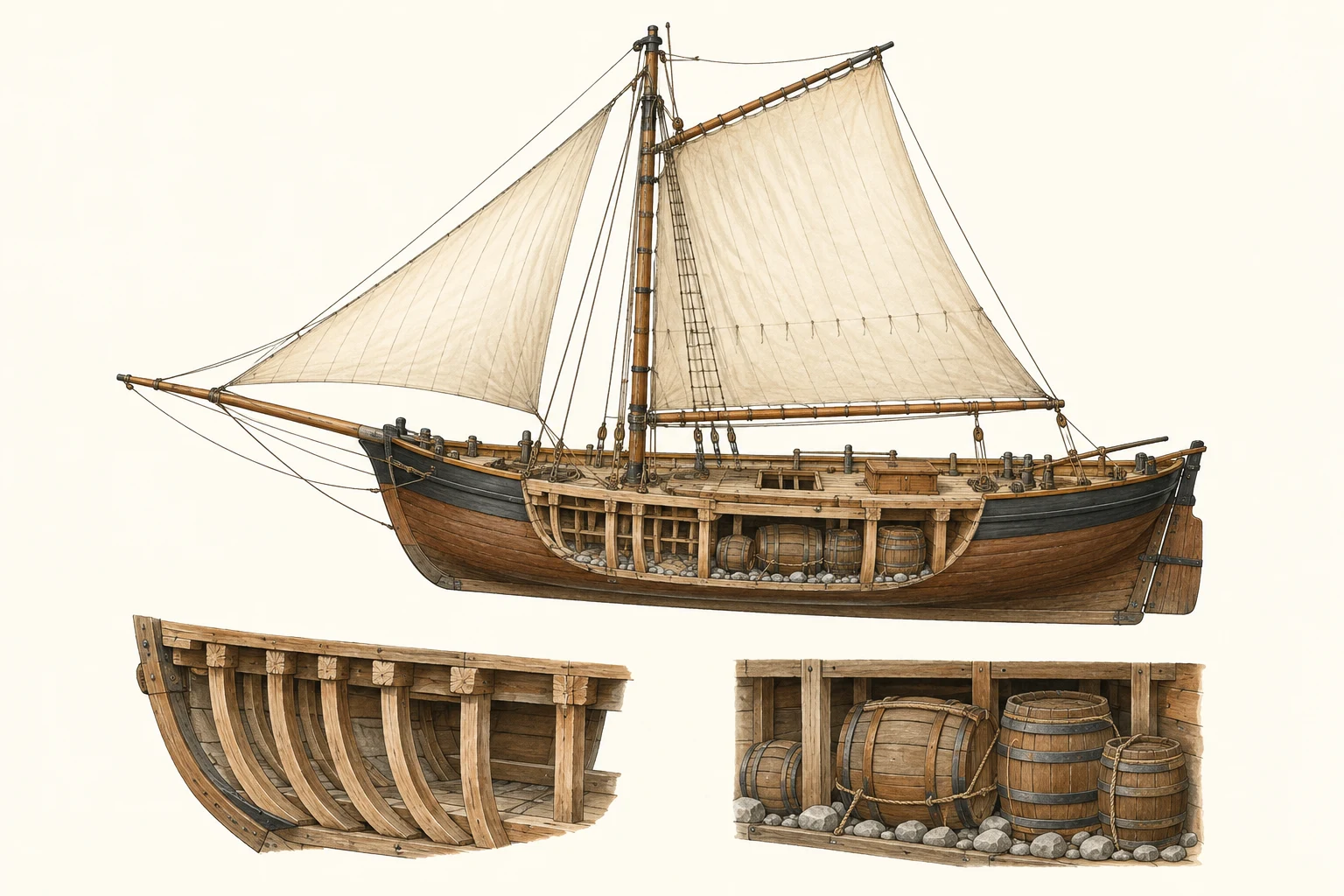 See the details.Inside a pirate-era ship.Explore the illustrated guide