

A name attached to a particular grant
The commission for reprisals names Adventure Galley, Kidd as commander and a burden of about 287 tons. It describes a ship equipped and victualled for an armed undertaking. This is a contemporary documentary description, rather than a specification reconstructed from a modern illustration. [1]
The number should retain its unit and purpose. A period estimate of carrying burden cannot simply be relabeled as the weight of the complete vessel.
The ship carried obligations as well as weapons
The reprisal authority required an exact journal of proceedings and the recording of prizes, dates, locations and estimated values. It directed captured property toward an authorized admiralty court before disposal. The anti-piracy commission likewise demanded records and legal trial of those apprehended. [1]
The vessel was a platform within a reporting and judicial system. Its mission was more specific than roaming freely in search of anything valuable.
A workplace became a crime scene
The murder indictment identifies the galley as the place where Kidd struck William Moore. The testimony discusses work, a disputed earlier opportunity to seize another vessel and the conduct of the crew. [1]
The same deck could therefore be described as an organized workplace, a site of discipline and the location of an alleged killing. Understanding one function does not remove the others.
Pumping was not the same as recovery
Bradinham described the ship as so leaky that two pumps were working. He said it was left at shore because it could not go to sea again. Palmer also described Kidd leaving the leaking vessel. These are witness reports about its final condition in their account. [1]
Continuously removing incoming water can preserve a vessel temporarily without solving the underlying failure. The state of the hull could force a change even when the company still possessed sails, equipment and arms.
The replacement was a different ship
The witnesses place Kidd aboard Quedagh Merchant afterward. Moving people and equipment did not turn the captured merchant hull into the original galley. Keep the vessel identities separate even where a captain’s story passes directly from one to the other. [1]
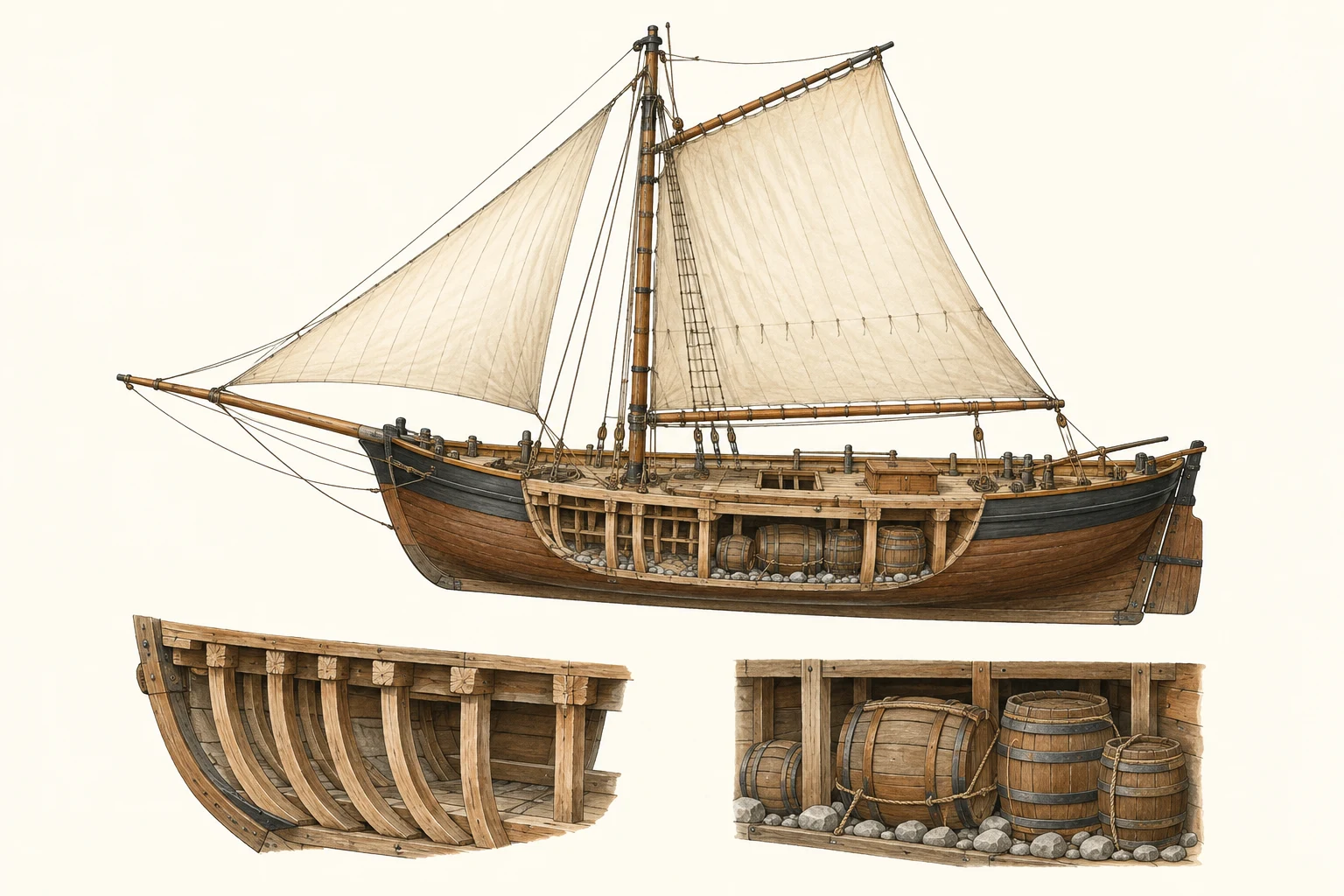
Read pumps, the carpenter’s work and the captured replacement. The generated scene artwork supplies atmosphere, not a measured plan of Adventure Galley.
Questions, answered.
Does the 287-ton figure give the ship’s modern displacement?
No. It is the burden stated in the period commission and should not be relabeled.
Did keeping pumps working prove the galley was repaired?
No. The witnesses described continued leaking and a vessel judged unfit for another passage.
Sources & reading notes
Source checks distinguish an artifact, a reported account and a modern interpretation. They do not constitute independent historian review.
- The Arraignment, Tryal, and Condemnation of Captain William Kidd (1701)Printed for J. Nutt, London; Library of Congress Law Library digitization · Public-domain printed trial account,1701
Printed pages 26–28, the two commissions; printed page 21/PDF27 and page 25/PDF31, testimony about leaking and transfer. The stated tonnage is period burden, not a modern displacement measurement. Read as a published account of allegations, testimony, judicial directions and verdicts. OCR is defective and is not a modern critical transcript. The trial verdict does not make every witness assertion independently established; this site does not claim to have inspected the lost or separately held French passes.
 See the details.Inside a pirate-era ship.Explore the illustrated guide