

Read the rig before the label
Imagine two vessels of similar length. One carries a single mast with a sail running mainly along the vessel’s length. Another has several masts with broad sails hung across them. Their outlines tell you something about how their sails are arranged. They do not tell you whether the crews are merchants, privateers or pirates.
The comparison below separates rig, service and the history of an individual vessel. It is a vocabulary aid, not a set of measured plans. It deliberately does not assign a universal length, speed or number of guns to each name. Historical usage changed, and a vessel could be altered after capture.
A museum example makes the problem concrete: a Royal Navy model from around 1740 is described as a sloop rigged as a brigantine. That is later than our main pirate setting, and it is not a pirate ship. Its value here is linguistic: a service description and a rig description can coexist. [1]
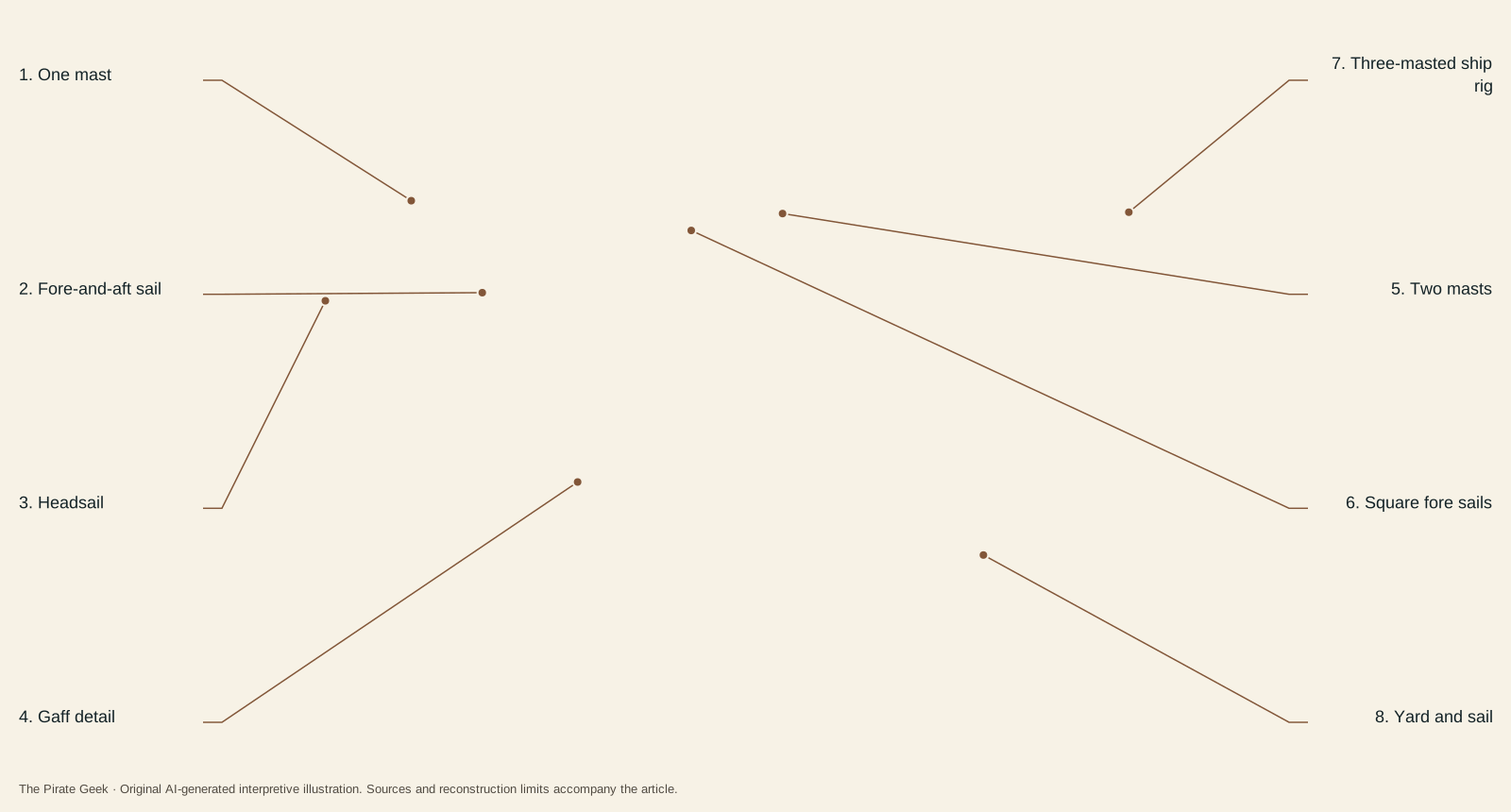
Compare the gaff, boom and canvas as a connected arrangement. A hull’s trade, owner or later captured identity does not by itself determine this rig.
UK Sailmakers · William FalconerTwo useful meanings to recognize
In modern rig vocabulary, a sloop usually has one mast with a mainsail behind it and a headsail ahead. UK Sailmakers describes that arrangement in its technical glossary. This is useful modern rig vocabulary, not a claim that the word always meant exactly the same thing in earlier sources. [2]
“Ship” can be a general word for a vessel or a more specific rig term. The National Park Service explains the latter as three or more masts carrying square sails on each mast. Its example is a replica of a 1797 merchant vessel, later than this chapter’s main setting. We borrow the vocabulary explanation, not the vessel as a pirate portrait. [3]
Mixed sail arrangements combine different kinds of sails rather than fitting a single familiar silhouette. Keep the observation specific: number of masts and arrangement of sails are observable features; a fixed speed, standardized size or pirate identity is not implied by them.
Sloops, brigantines and larger prizes
In Johnson’s account of Bartholomew Roberts, the crew continues in a small, poorly supplied sloop, captures other sloops and then takes a Rhode Island brigantine. The narrative moves between vessels rather than describing a standardized pirate class. The specific captures are claims in the early printed account, not a fleet census. [4]
| Ask | What it tells you | What it does not establish |
|---|---|---|
| How is it rigged? | The arrangement of masts and sails | An exact speed or carrying capacity |
| What job does it serve? | Trade, naval service, raiding or another use | A unique hull shape |
| Which vessel is documented? | A particular history and evidence trail | What every pirate vessel looked like |
The horizontal yard makes the alternative arrangement easier to read. These enlarged details explain vocabulary; they do not establish comparative speed or a standard pirate fleet.
US National Park Service, Salem Maritime · William FalconerQueen Anne’s Revenge was not built as an icon
Before Blackbeard’s flagship was called Queen Anne’s Revenge, it was La Concorde, a French vessel used in the transatlantic slave trade. The project’s history draws on French officers’ depositions for its final voyage and capture in 1717. That earlier identity matters: the famous pirate name can obscure the forced movement of enslaved people in the same vessel. [5]
This is a better starting point than a generic black-sailed silhouette. Ask what is known about a named vessel before assigning its appearance, armament or dimensions. A later painting, film model and archaeological assemblage are different kinds of evidence.
Why “bigger” is not a complete answer
A useful comparison has to name the task. Capacity, water depth, maintenance, available crew and the condition of a captured vessel are separate considerations. Without those conditions, a ranking of the “best pirate ships” hides more than it explains.
Johnson describes Roberts escaping pursuers by throwing guns and other heavy goods overboard. Treat that as an episode in his narrative, not an experiment proving a fixed speed advantage. It does show why a ship’s load and condition belong in the story alongside its type. [4]
When a source gives a number of guns, check whether it means weapons reported aboard, weapons mounted at a particular moment or objects recovered from a wreck. Those counts need not be identical. Our cannon guide makes that distinction explicit.
Use this comparison carefully
For a historical illustration, start with a named place and period, identify the rig as far as the evidence allows, and mark any reconstructed details. For a general explanation, keep the drawings schematic. Do not stretch one well-known flagship into a picture of all piracy.
Next, explore the parts of a sailing vessel. Rig describes one system; hull, steering, storage and workspaces explain how the ship functioned as a whole.
Questions, answered.
Were all pirate ships galleons?
No. The early account used here describes sloops, brigantines and larger captured ships. A familiar film silhouette is not a complete historical fleet.
Is a sloop always a particular size?
No. Specify the period and whether the source means a rig or a service classification before comparing dimensions.
Sources & reading notes
Source checks distinguish an artifact, a reported account and a modern interpretation. They do not constitute independent historian review.
- A sloop rigged as a brigantine, circa 1740 (SLR0229)National Maritime Museum, Greenwich · Collection record
Catalogue example of the c.1740 naval model described as a sloop rigged as a brigantine; later linguistic comparison only. A Royal Navy example after the chapter’s main period, used only to show overlapping terms, not a pirate vessel.
- Sloop: single-masted rigUK Sailmakers · Sailmaker’s modern technical glossary
Modern glossary, opening definition and rig anatomy; not a universal historical usage. Modern vocabulary aid, not proof that every historical vessel called a sloop had this arrangement.
- Friendship’s rigging and ship-rig terminologyUS National Park Service, Salem Maritime · Archived technical explanation of a replica
July 2007 account of the later Friendship replica, definition of the square-rigged ship. Explains terminology using a replica of a 1797 merchant vessel; not a pirate-ship reconstruction.
- A General History of the Pyrates (1724)Published under the name Captain Charles Johnson · Early printed account; public-domain text
Roberts chapter, early small-vessel captures and the pursuit in which heavy goods were jettisoned. Authorship is disputed. A near-contemporary compilation, not a surviving signed pirate code or a neutral transcript. Cite its claims as reported claims.
- The pirate ship’s journeyNorth Carolina Queen Anne’s Revenge Project · Archaeological project / historical synthesis
La Concorde history, officers’ depositions and 1717 capture; earlier slave-trading identity. Voyage dates may use different calendars; this chapter avoids an exact capture day.