

Trade brought several identities aboard
The prosecution described the vessel as trading from Bengal toward Surat, commanded by an Englishman, Wright, with Armenian merchants among those owning the goods. A ship’s captain, the owners of its cargo and the protection claimed by documents were not necessarily of one nationality. [1]
This is why identifying a single flag does not settle the entire history of a capture.
The witnesses described a deceptive approach
Bradinham testified that Kidd chased under French colors. He said a Frenchman first came aboard but was not the master, and that Wright was subsequently brought over and treated as a prisoner. These are details in the witness’s account, not a surviving film of the encounter. [1]
The sequence makes information central to the capture. Who appeared first, what he said and which papers were produced became consequential questions afterward.
The merchants tried to recover the vessel
The trial records an offer of 20,000 rupees to redeem the ship and Kidd’s refusal of it as inadequate. Palmer and Kidd disputed who was responsible for retaining the vessel. The Armenian merchants’ efforts to recover their property belong inside that argument. [1]
The captured people were not merely a source of a treasure total. They had commercial claims and attempted to negotiate a return.
Property was sold and divided
Witnesses described goods sold on the coast and money distributed among the company. At trial, questions about whether particular defendants received shares connected the vessel’s commercial contents to individual participation. [1]
A distribution can be evidence of involvement, but it still needs its context: who received what, under which agreement and with what freedom to refuse.
The hull took on another use
After the galley’s failure, witnesses placed Kidd aboard the captured merchant ship with an intention to use it as an armed vessel. Its change of use followed the removal of goods and the loss of his earlier platform. [1]
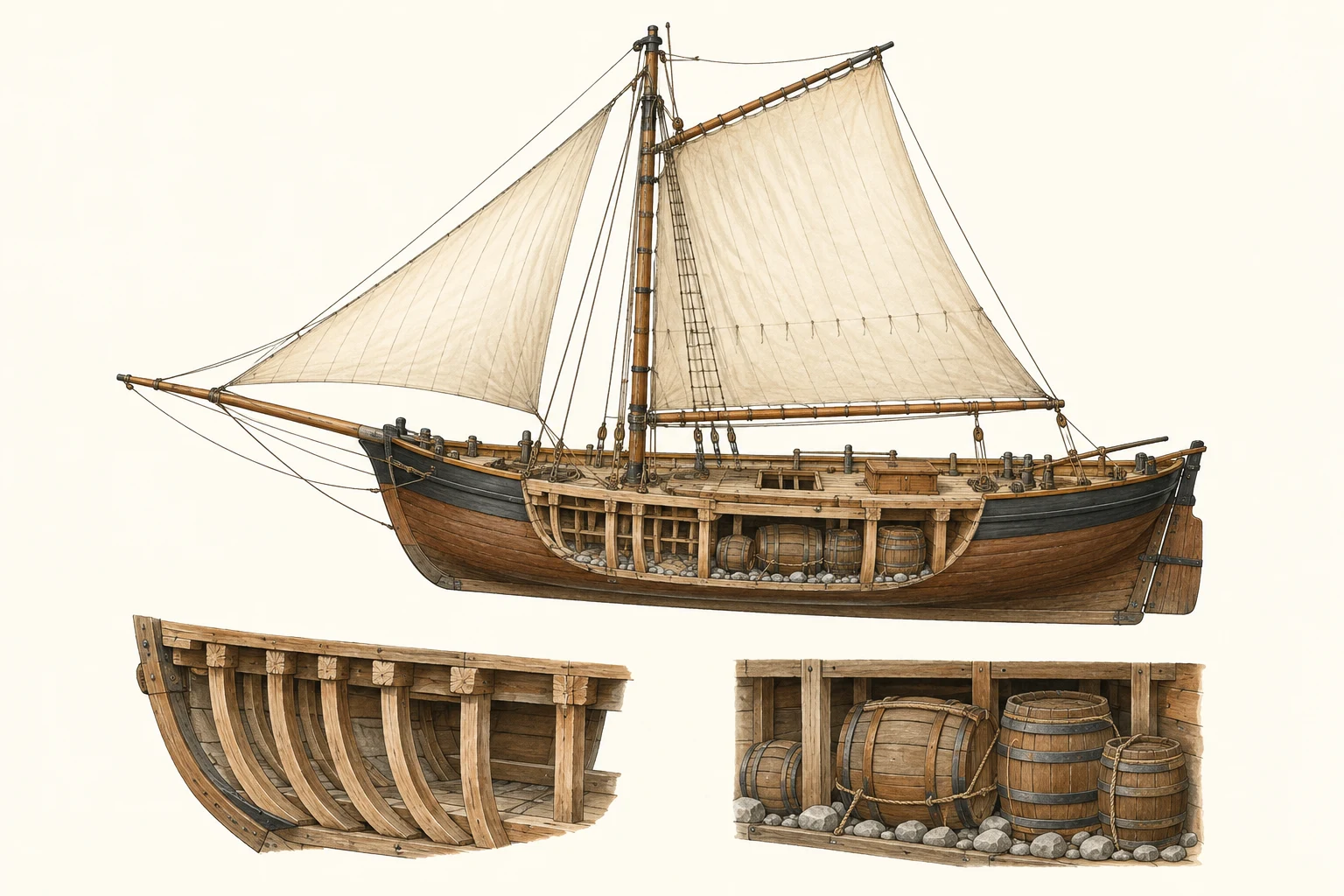
Read the damaged galley and the requirement for adjudication beside the proceeding. This guide follows the identity established in the cited trial and does not invent an exact rig, gun plan or every later name.
Questions, answered.
Does an English master mean all the cargo was English-owned?
No. The trial describes different people and interests aboard, including Armenian merchants.
Did Kidd’s French-pass claim end the dispute?
No. The court questioned both the supporting evidence and the lack of proper prize adjudication.
Sources & reading notes
Source checks distinguish an artifact, a reported account and a modern interpretation. They do not constitute independent historian review.
- The Arraignment, Tryal, and Condemnation of Captain William Kidd (1701)Printed for J. Nutt, London; Library of Congress Law Library digitization · Public-domain printed trial account,1701
Printed pages 14–28/PDF20–34, Quedagh indictment, Bradinham and Palmer testimony, French-pass dispute, merchants’ redemption offer and the reproduced commissions. The trial print does not establish every later alias or exact shipbuilding detail. Read as a published account of allegations, testimony, judicial directions and verdicts. OCR is defective and is not a modern critical transcript. The trial verdict does not make every witness assertion independently established; this site does not claim to have inspected the lost or separately held French passes.
 See the details.Inside a pirate-era ship.Explore the illustrated guide