

A diagram is not a recovered deck plan
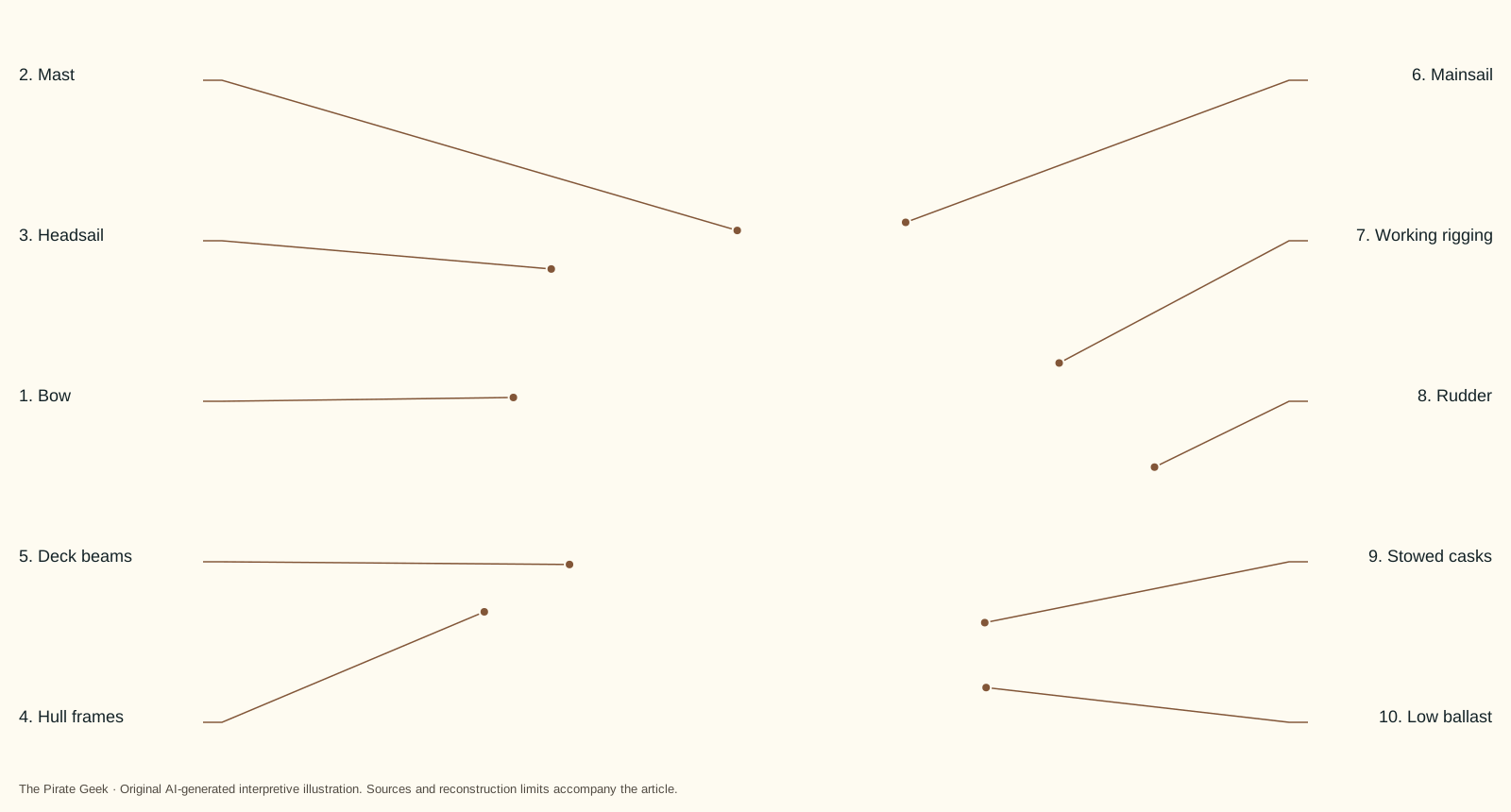
There is an important gap between knowing the parts of a wooden sailing vessel and knowing exactly where everything stood aboard one particular pirate ship. This plate explains functions. Its compartments and proportions are editorial choices for clarity, not archaeological measurements.
The Queen Anne’s Revenge project records only a small surviving portion of articulated hull structure, together with fixtures and fittings. Recovered frames, planks and fastenings help researchers understand construction; they do not give us an intact ship with every room preserved. [1]
Read the plate from the outside inward: first the hull and rig, then the deck where people worked, then the lower spaces where load and water mattered. The explanatory illustration and article remain available when JavaScript is unavailable.
Find your bearings on the drawing
The bow is the front; the stern is the back. In modern usage, port is the left side and starboard the right when you face forward toward the bow. The sides stay fixed even when you turn around. NOAA explains this advantage over the observer-dependent words left and right. [2]
These are orientation labels for reading the diagram, not a claim that an early-eighteenth-century English crew used every modern term in the same way. Earlier sources can use larboard for the side now called port. Read the source’s date before silently modernizing its vocabulary.
Now separate direction from height. A mast rises above the deck; lower spaces sit within the hull. A side view can show the relationship clearly while concealing how wide the vessel is. That is why a broadside schematic cannot establish a complete compartment layout.
Frames rise across the hull; deck beams span it. Smith’s 1627 manual names keel, floor timbers and beams. The QAR assemblage preserves only part of a hull, not this complete arrangement.
John Smith · NC Office of State ArchaeologyHull: the structure everything depends on
The hull carries people, equipment and supplies. In the archaeological collection, timber fragments sit alongside iron fittings and smaller structural evidence. An object that looks ordinary can be more useful than an imagined captain’s cabin because its material and context can be examined. [1]
The distinction between surviving material and reconstruction matters most where a drawing becomes visually convincing. A complete-looking illustration can create certainty the record does not support. Our schematic therefore avoids dimensions, a claimed cabin layout or a statement that a specific barrel sat beneath a specific hatch.
To read a reconstructed ship elsewhere, look for the same boundary: which lines follow excavated material, which follow a comparable vessel, and which fill a gap for the viewer?
Rig and deck: a shared workspace
Masts support the sail arrangement; rigging supports and controls it. The deck is also a place where people move supplies, handle equipment and perform repairs. The systems overlap rather than occupying tidy museum cases.
Johnson’s reported testimony about the plundering of the King Solomon names a boatswain taking cables and rope, a sailmaker selecting sails and canvas, a cooper taking casks and tools, and a carpenter taking stores. That passage connects specialist work to the material a crew needed to keep operating. It is a reported courtroom narrative, not a complete duty roster. [3]
For readers, this is a more useful model than “everyone fights.” A vessel continues to need maintenance even while its crew uses it for robbery.
Casks and low stone weight explain two different uses of the hold. The illustration does not establish what a particular cask contained or where an individual crew stowed it.
NC Office of State Archaeology · NC Office of State Archaeology · Published under the name Captain Charles JohnsonBelow deck: supplies are part of the story
Where supplies were kept affects how we imagine daily life, but a recovered container does not automatically identify a storeroom. It may have held provisions, belonged to a person or traveled as cargo. Context, association and wear matter.
The QAR tools collection spans navigation, carpentry, sailmaking, gunnery and medicine, and the project notes that some objects still lack a known function. That uncertainty is part of the evidence, not a flaw to conceal. [4]
Use the lower section of our plate as a reminder of tasks: stow, maintain, repair and keep the vessel working. Do not use it as an exact excavation map. The provisions guide examines what containers and bones can actually tell us.
What to ask of a ship illustration
Check its date, vessel and purpose. A naval model from a later century can explain a mechanism while still being unsuitable as a literal portrait of an earlier pirate vessel. A modern artist’s reconstruction can be helpful if the inference is identified.
Finally, connect the drawing to people. The crew guide explains who might handle the work, while the navigation guide distinguishes a tool found aboard from a method proven to have been used on a particular voyage.
Questions, answered.
Is this a plan of Queen Anne’s Revenge?
No. It is an original functional schematic. The archaeological project reports only partial surviving hull structure.
Why are there no exact dimensions?
The drawing explains relationships and tasks. Exact dimensions would imply a vessel-specific reconstruction that this plate does not establish.
Sources & reading notes
Source checks distinguish an artifact, a reported account and a modern interpretation. They do not constitute independent historian review.
- Ship componentsNC Office of State Archaeology · Archaeological collection
Hull structure and fixtures entries: surviving articulated structure and associated timber/fittings. A small surviving portion cannot establish a complete deck plan.
- Port and starboardNOAA National Ocean Service · Modern terminology reference
Vessel-relative orientation, with the observer facing the bow; modern teaching terminology. Modern explanatory labels; earlier English sources may use larboard instead of port.
- A General History of the Pyrates (1724)Published under the name Captain Charles Johnson · Early printed account; public-domain text
Roberts chapter, reproduced King Solomon proceedings naming the material taken by specialist officers. Authorship is disputed. A near-contemporary compilation, not a surviving signed pirate code or a neutral transcript. Cite its claims as reported claims.
- Tools and instrumentsNC Office of State Archaeology · Archaeological collection
Tools and instruments collection, range of work and unresolved identifications. Some artifact functions remain unidentified.