
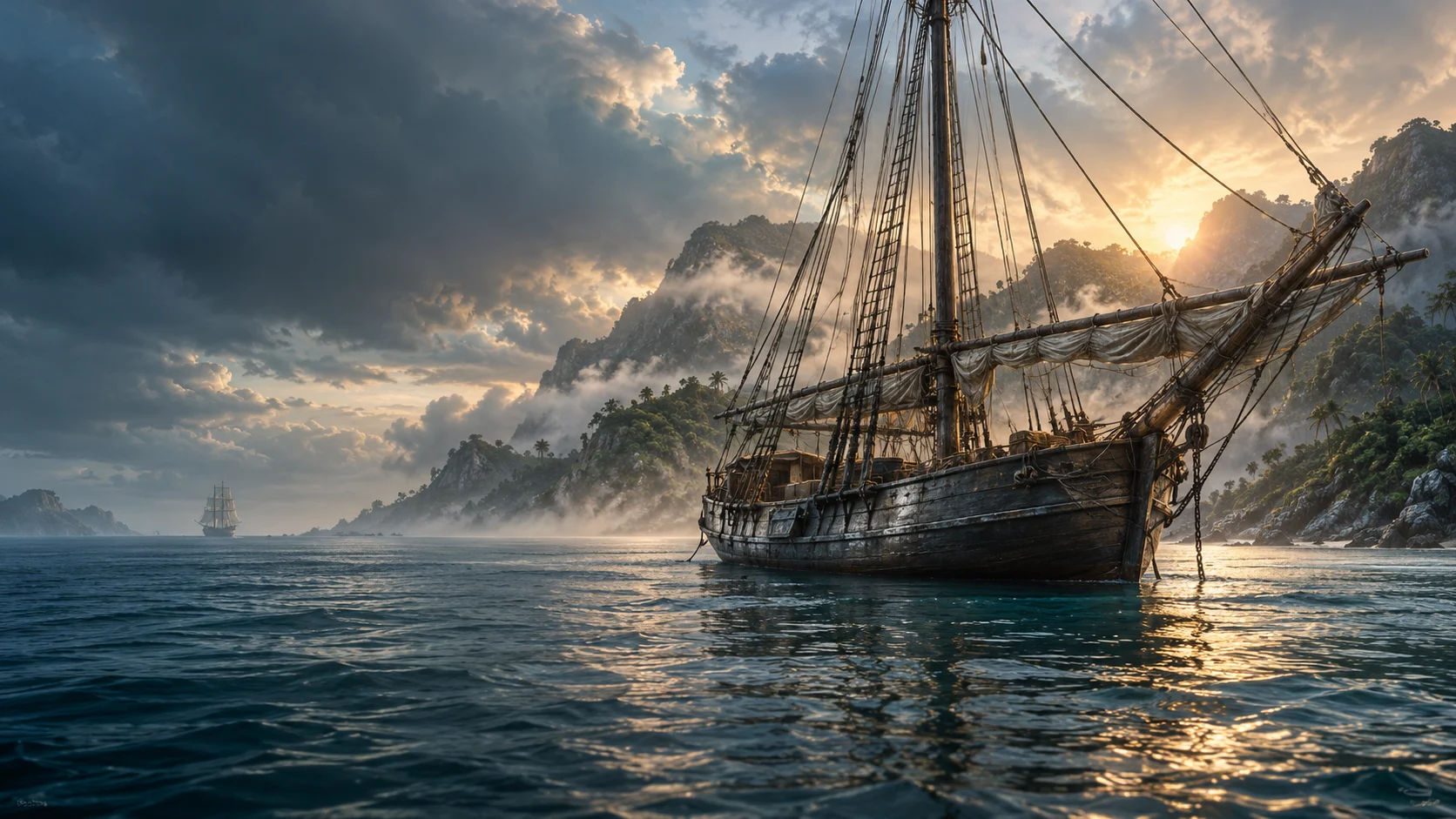
A merchant cargo before a new command
Ringrose lists Trinidad among the ships taken near Perico after the sea fight at Panama. He calls it the largest of the prizes and describes wine, sugar, preserves, skins and soap among its cargo. The vessel belonged to an existing transport economy before it carried the raiders. [1]
Other captured hulls met different fates: some were burned, another assigned to a commander and another taken away by Coxon. A prize list was not a permanent fleet list.
The high stern was an object of work
At Gorgona the company removed the roundhouse and high carved work at the stern. Ringrose explains that the captured ship had been high-built. The changes made it more suitable to what the company wanted to do. [1]
These were alterations to an acquired vessel. They should not be redrawn as the original layout of a purpose-built pirate warship.
The upper decks changed again
After the April 1681 separation, the journal records taking down an upper deck and lowering the quarterdeck. The work was intended to improve sailing. The condition of the vessel at one stage therefore cannot simply be carried unchanged across every illustration of the voyage. [1]
A ship’s biography includes repair history. The same hull could present a different working arrangement after months of use and alteration.
A clean hull did not guarantee the fastest passage
The company careened again at Golfo Dulce. In the subsequent cruise, Ringrose calls the principal vessel Trinity and notes that a smaller bark still sailed better, despite the cleaning and tallowing. [1]
This comparison is valuable because it resists an easy assumption that larger, freshly repaired or more heavily armed meant faster. Craft served different tasks and had different limits.
Follow the hull through the company’s divisions
The ship survived changes of command, departures and the long return. Burney and Ringrose describe the dispersal at the end rather than a permanent roving fleet under Sharp. The exact later fate is not invented here. [2][1]
Continue through Gorgona, Nicoya and Golfo Dulce. Those stops explain why the vessel that left the Pacific had already been remade by its voyage.
Questions, answered.
Are Trinity and Trinidad counted here as separate ships?
No. The article follows the linked names and voyage sequence of the captured hull in the cited narratives.
Is there an exact cutaway of this ship on the site?
No. The general explanatory illustration is not represented as a measured plan of this vessel.
Sources & reading notes
Source checks distinguish an artifact, a reported account and a modern interpretation. They do not constitute independent historian review.
- Bucaniers of America, the second volume (1685)Open the keyboarded source transcriptionBasil Ringrose; printed for William Crooke; EEBO–TCP transcription · Participant voyage narrative, published 1685; CC0 keyboarded transcription
Chapters VIII and X for Trinidad’s capture and stern alterations; XVIII–XX for upper-work changes, careening and use of the name Trinity; XXV for the final dispersal. The published journal is a mediated participant account. Its nationalist praise, judgments about peoples and claims about motives are not adopted as neutral fact. The XML marks damaged and missing text; page images are not the CC0 transcription.
- History of the Buccaneers of America (1816)James Burney; Project Gutenberg transcription · Nineteenth-century historical compilation; public domain in the USA
The account of the Panama prizes and the end of Sharp’s cruise follows the captured hull through the voyage. Reported tonnage is a period estimate, not a modern measured displacement. Later than the events. Burney selects and compares earlier voyage narratives; his reconstruction is not an eyewitness record of every episode. Period ethnographic and colonial judgments require critical reading.
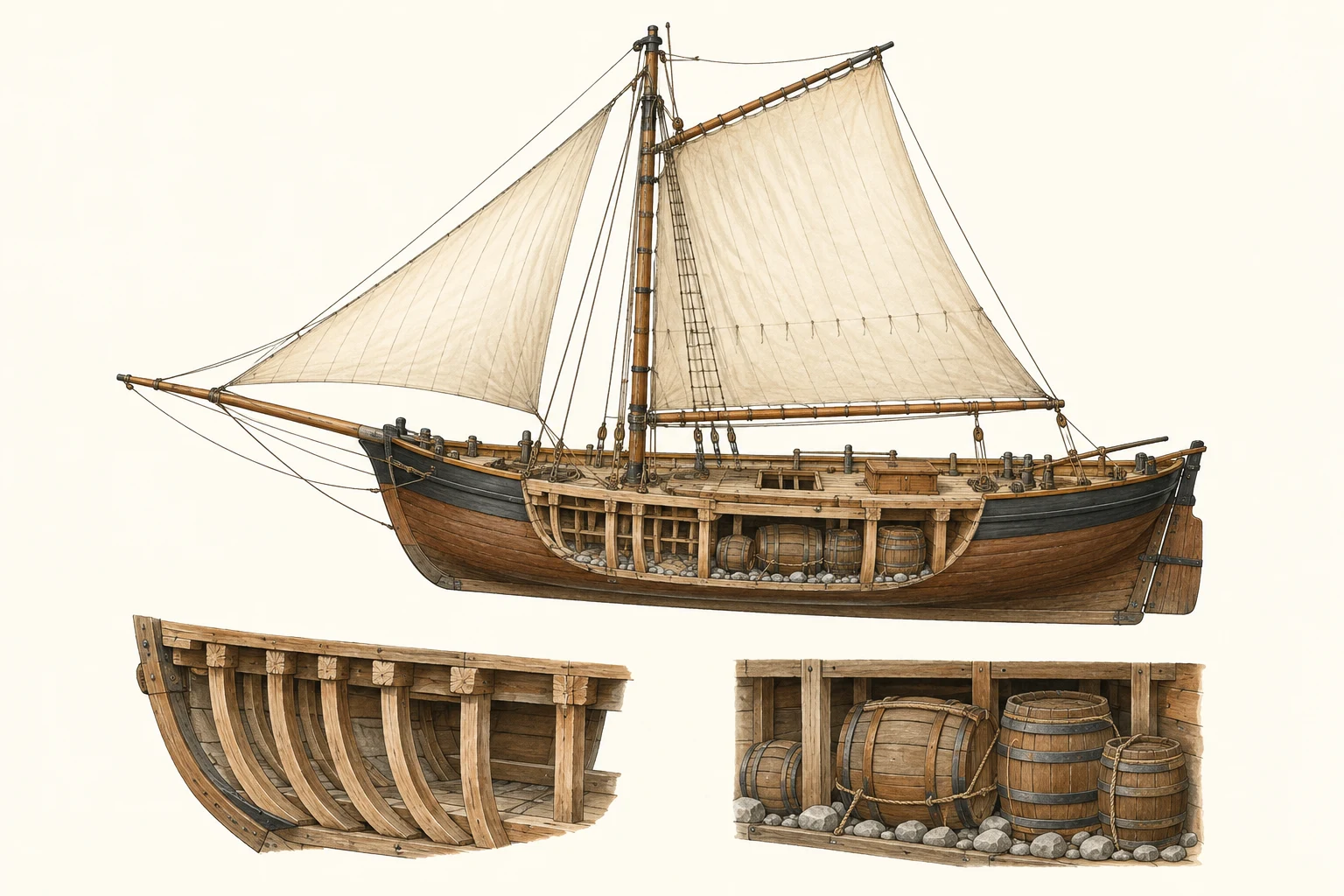 See the details.Inside a pirate-era ship.Explore the illustrated guide