
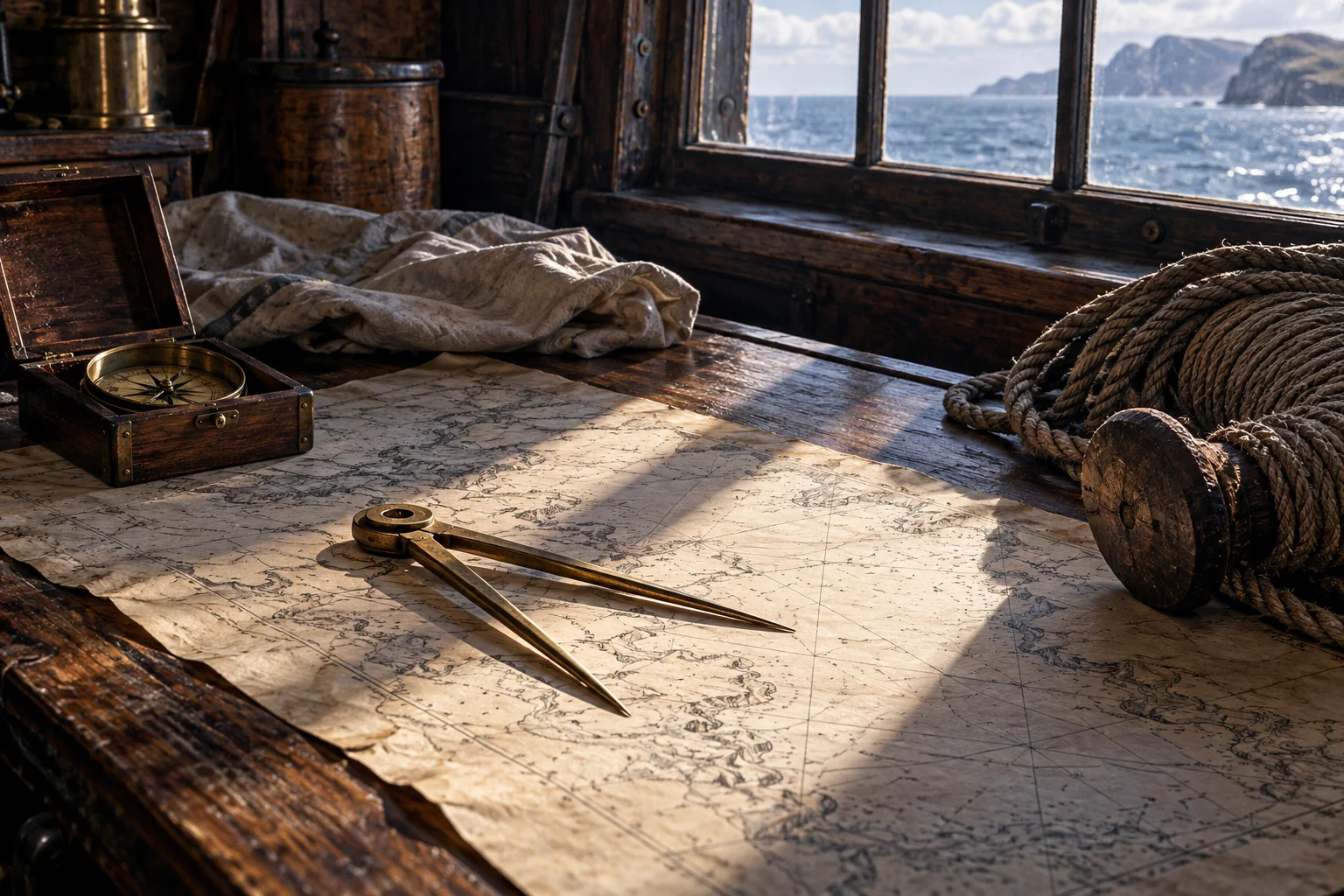
A reference for steering
The practical question at the helm was not always “where are we?” It could be “are we maintaining the direction ordered?” Smith’s sailing vocabulary includes keeping a course and steering steadily, while Falconer describes the compass as an instrument for determining a ship’s course. [1][2]
Those are related to position, but they do not provide it by themselves. A vessel can be pointed in a known direction without the observer knowing how far it has moved or how the water has carried it.
Reading the card
Falconer’s card divides a circle into 32 points, with the cardinal directions and compound names between them. The geometry makes a small worked comparison possible without pretending to recover a particular pirate’s instrument. [2]
| Number of equal divisions | Angle per division |
|---|---|
| 8 | 45° |
| 16 | 22.5° |
| 32 | 11.25° |
The last row corresponds to the number of points in the 1769 description. The table does not establish the precision of an observation made aboard a moving vessel.
Magnetic direction was not simply true north
Falconer defines variation through the angle between the true and magnetic meridians. Smith’s earlier reading list also recognizes the study of compass variation. The distinction was therefore a practical concern, not a detail a modern map can ignore. [2][1]
On a reconstructed voyage map, a compass bearing should be read with its reference and circumstances. A direction quoted in a source is not automatically interchangeable with an angle measured from a modern map’s north line.
Construction and condition mattered
The 1769 dictionary discusses irregularities in compass construction and examines proposed improvements. Its historical explanation contains period theories that should not be repeated as current physics. The useful evidence is also about practice: instruments could disagree and their construction was open to criticism. [2]
A compass in a scene is not a guarantee of perfect navigation. The object, the person reading it and the account in which the result was recorded all require attention.
Add distance and a check
Falconer describes dead reckoning as combining course and distance with allowances, then correcting the estimate through suitable observations. The compass belonged within that process rather than replacing all its other parts. [2]
Continue with the log and sandglass, the estimate of a new position and the chart onto which information was brought.
Questions, answered.
Could a compass tell a pirate exactly where the ship was?
No. Direction alone does not establish a position or the distance already traveled.
Did a compass reading always refer to modern map north?
No. The distinction between magnetic and true reference directions, and the source’s circumstances, matters.
Sources & reading notes
Source checks distinguish an artifact, a reported account and a modern interpretation. They do not constitute independent historian review.
- A Sea Grammar (1627)Open the keyboarded source transcriptionJohn Smith; Early English Books Online / Text Creation Partnership · Seventeenth-century seafaring manual; TCP transcription released under CC0
Chapters IX and XV, steering by a compass point and the study of variation. A prescriptive manual from 1627, not the operating rules of every merchant, naval or pirate vessel. The TCP text preserves gaps and transcription uncertainty. Modernized explanations here do not reproduce its period medical or physical theories as current advice.
- An Universal Dictionary of the Marine (1769)William Falconer; Project Gutenberg transcription · Eighteenth-century technical dictionary; public domain in the USA
Headwords “Compass,” “Variation” and “Dead-reckoning.” The dictionary’s needle theory and specific later improvements are not adopted as modern science or attributed to earlier pirate vessels. Published 1769, later than most events in this chapter. Used as a dated terminology comparison, not proof that an earlier pirate carried a particular instrument or followed later naval regulations.
 See the details.How sailors found their way.Explore the illustrated guide