
Start with a load and a purpose
In a picture of a sailing vessel, ropes can look like a single complicated net. Smith’s explanation is more practical. Some lines support a mast; others run through blocks to help people move or handle equipment. Identifying the job is the first step toward understanding the arrangement. [1]
This does not require pretending every line can be identified in a distant painting. The vessel’s rig, the image’s detail and the reconstruction’s evidence set limits on what can actually be read.
Stays and shrouds supported the structure
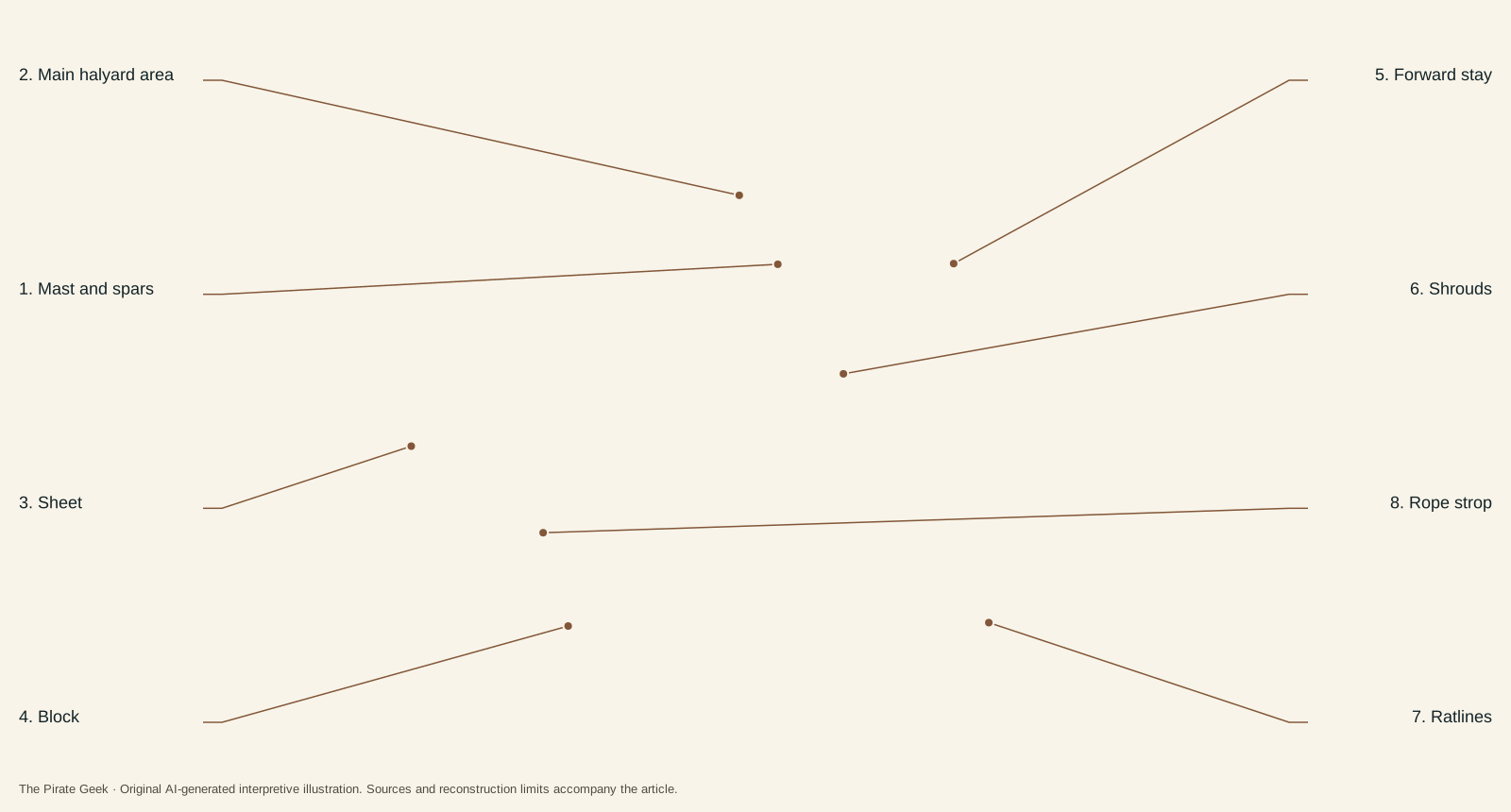
Smith describes stays linking masts or connecting them toward the bowsprit, while shrouds run up either side of masts. Their arrangement helps hold a tall structure in position. He also explains deadeyes and the lanyards used with them. [1]
The important distinction is structural. These are not all lines pulled whenever a sail is adjusted. A mast and its supporting system worked together, so depicting a tall spar without a plausible support arrangement can make an attractive reconstruction misleading.
The horizontal ratlines and thicker shrouds have different functions. Enlarging that distinction is more useful than treating every line as interchangeable.
John Smith · William FalconerA block is not just another knot
The manual describes a block containing a sheave, or wheel, on which a running rope moves. It also distinguishes deadeyes, which have holes but no sheaves. Similar-looking wooden fittings therefore perform different jobs. [1]
| Part | What to notice |
|---|---|
| Stay or shroud | A line contributing to support of the mast |
| Block and sheave | A fitting through which a running line moves |
| Deadeye and lanyard | A different arrangement for tensioning a supporting line |
The sheave sits inside the wooden housing. This is an enlarged type study, not evidence for the dimensions or mechanical advantage of a named vessel’s tackle.
John Smith · William FalconerMaintenance made the network usable
Smith’s account includes protection against chafing, binding material and repairs when a sail parts from its supporting rope. It treats the rig as equipment that wears and needs attention, rather than a permanent geometry. [1]
Falconer’s later description of a boatswain similarly emphasizes inspection and replacement of unfit material. The comparison shows continuing practical concerns, while the date prevents us from mistaking 1769 naval instructions for the exact rules of a 1718 pirate crew. [2]
Read the whole vessel together
A line’s function depends on what it is connected to. A rigging glossary without the mast, sail and working party can become a list of words detached from a ship. Conversely, one striking silhouette cannot establish a universal pirate rig.
Continue with rig and vessel labels, canvas and repair and the work of keeping the system in order. The generated scenes remain interpretive artwork rather than measured rigging plans.
Questions, answered.
Are shrouds and running ropes the same thing?
No. The source distinguishes lines supporting a mast from ropes running through fittings to handle equipment.
Is a deadeye a pulley wheel?
Not in Smith’s description. It has holes but no sheave, and works with a lanyard rather than in the same way as a running block.
Sources & reading notes
Source checks distinguish an artifact, a reported account and a modern interpretation. They do not constitute independent historian review.
- A Sea Grammar (1627)Open the keyboarded source transcriptionJohn Smith; Early English Books Online / Text Creation Partnership · Seventeenth-century seafaring manual; TCP transcription released under CC0
Chapter V, stays, shrouds, deadeyes, blocks, running ropes, ratlines, marling and splicing; Chapter VIII, the boatswain’s responsibility. A prescriptive manual from 1627, not the operating rules of every merchant, naval or pirate vessel. The TCP text preserves gaps and transcription uncertainty. Modernized explanations here do not reproduce its period medical or physical theories as current advice.
- An Universal Dictionary of the Marine (1769)William Falconer; Project Gutenberg transcription · Eighteenth-century technical dictionary; public domain in the USA
Headword “Boatswain,”1769, on support, running ropes and inspection. A later comparison, not a pirate inventory. Published 1769, later than most events in this chapter. Used as a dated terminology comparison, not proof that an earlier pirate carried a particular instrument or followed later naval regulations.