
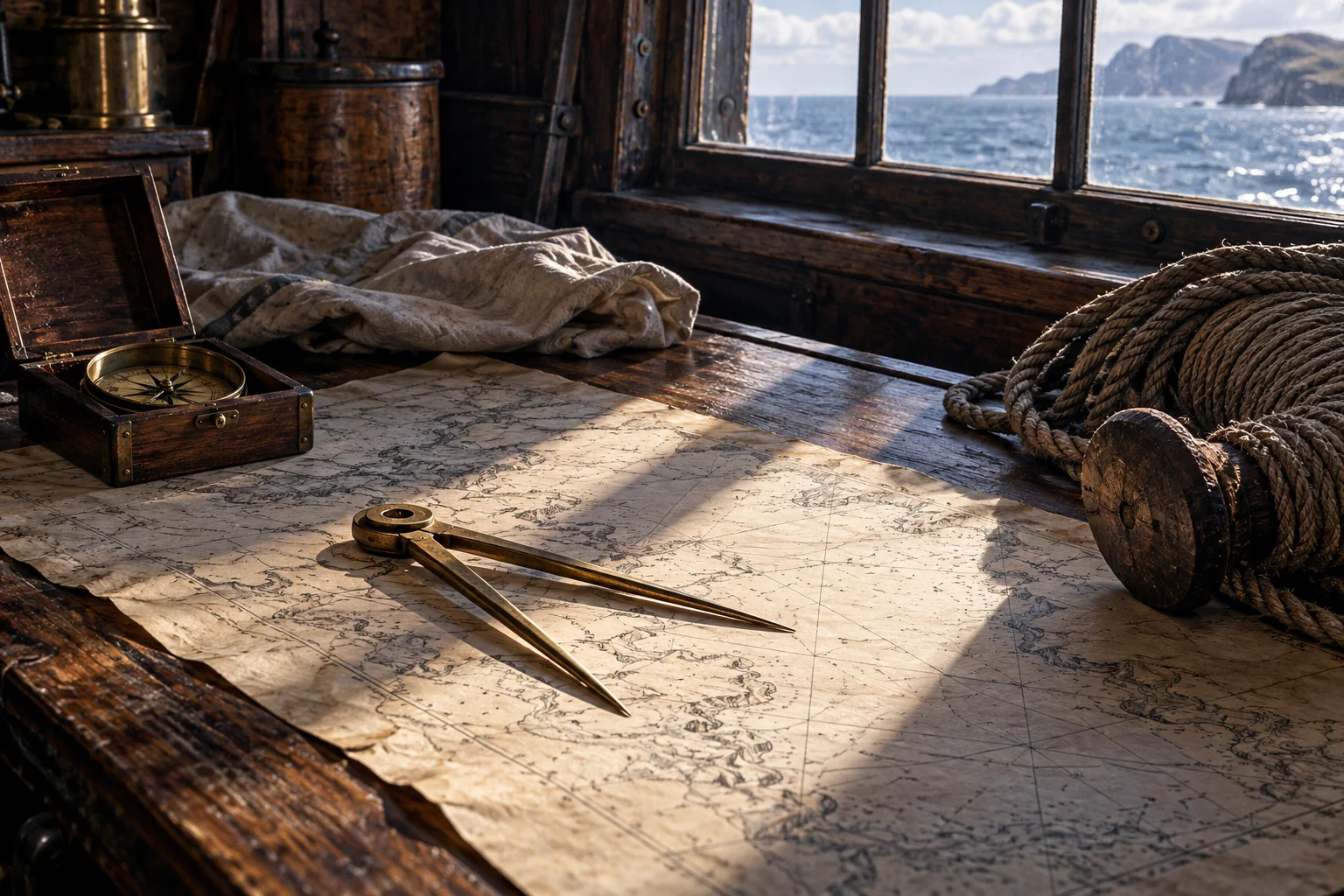
A tool for an observation
Smith lists a backstaff alongside other instruments a seaman might study and obtain. The entry places it within a practical navigation education, rather than declaring one object sufficient for an entire voyage. [1]
The task was astronomical observation, part of finding information useful to position. It was different from measuring depth with a lead or transferring a chart distance with dividers. Confusing those tasks can make a collection of instruments look more powerful than any one actually was.
A surviving example makes the parts visible
The Greenwich catalogue records a backstaff made by Will Garner for Oliver Thompson in 1734. It identifies sight, horizon and shadow vanes and a Flamsteed lens. Those are features of that catalogued object, not a recovered inventory from an earlier pirate flagship. [2]
The distinction gives the object more, rather than less, historical interest. It had a maker, a recipient and a date. Treating it as a timeless generic instrument removes those connections.
Observation depended on an arrangement
The catalogued lens focuses light into a point that can be aligned on the horizon vane. The description explains a relationship between components, not simply a decorative frame with numbers. [2]
A modern illustration should therefore distinguish parts whose shape is supported by an example from details added to make the scene readable. A beautifully rendered instrument can still be an inaccurate reconstruction if its components come from incompatible sources.
A measured angle is not a complete coordinate
Falconer’s definition of a quadrant links the observation of celestial altitude to finding latitude. The measurement still had to be interpreted within a navigational process. The word quadrant also does not make every instrument identical in construction. [3]
That separation is essential when explaining a shipboard scene. An observer, a measured angle, a calculation and a position are connected stages. Collapsing them into one action creates a false impression of automatic navigation.
Keep each example in its period
The 1627 list establishes that the name was available then. The 1734 catalogue establishes details of a particular later object. Neither, alone, establishes the complete equipment aboard a named 1718 vessel. [1][2]
Continue with the position questions, chart measurement and the broader process. The instrument belongs in the history of knowledge and skilled work, not just on a picturesque table.
Questions, answered.
Was every backstaff identical to the 1734 Greenwich example?
No. A dated object’s particular features should not be imposed on every earlier instrument of the type.
Did the backstaff also measure water depth?
That was a different task, associated with sounding equipment rather than the astronomical observation discussed here.
Sources & reading notes
Source checks distinguish an artifact, a reported account and a modern interpretation. They do not constitute independent historian review.
- A Sea Grammar (1627)Open the keyboarded source transcriptionJohn Smith; Early English Books Online / Text Creation Partnership · Seventeenth-century seafaring manual; TCP transcription released under CC0
Chapter XV, the list of instruments fitting for a seaman. A prescriptive manual from 1627, not the operating rules of every merchant, naval or pirate vessel. The TCP text preserves gaps and transcription uncertainty. Modernized explanations here do not reproduce its period medical or physical theories as current advice.
- Backstaff made by Will Garner for Oliver Thompson, 1734Royal Museums Greenwich, National Maritime Museum · Museum object catalogue; NAV0041
NAV0041, dated 1734, including sight, horizon and shadow vanes and the Flamsteed lens. A specific 1734 instrument, not an object recovered from a named pirate vessel. Its lens and other details should not be assigned automatically to every earlier backstaff.
- An Universal Dictionary of the Marine (1769)William Falconer; Project Gutenberg transcription · Eighteenth-century technical dictionary; public domain in the USA
Headword “Quadrant,”1769, on observing celestial altitude for latitude; not a claim that every quadrant is the same instrument. Published 1769, later than most events in this chapter. Used as a dated terminology comparison, not proof that an earlier pirate carried a particular instrument or followed later naval regulations.
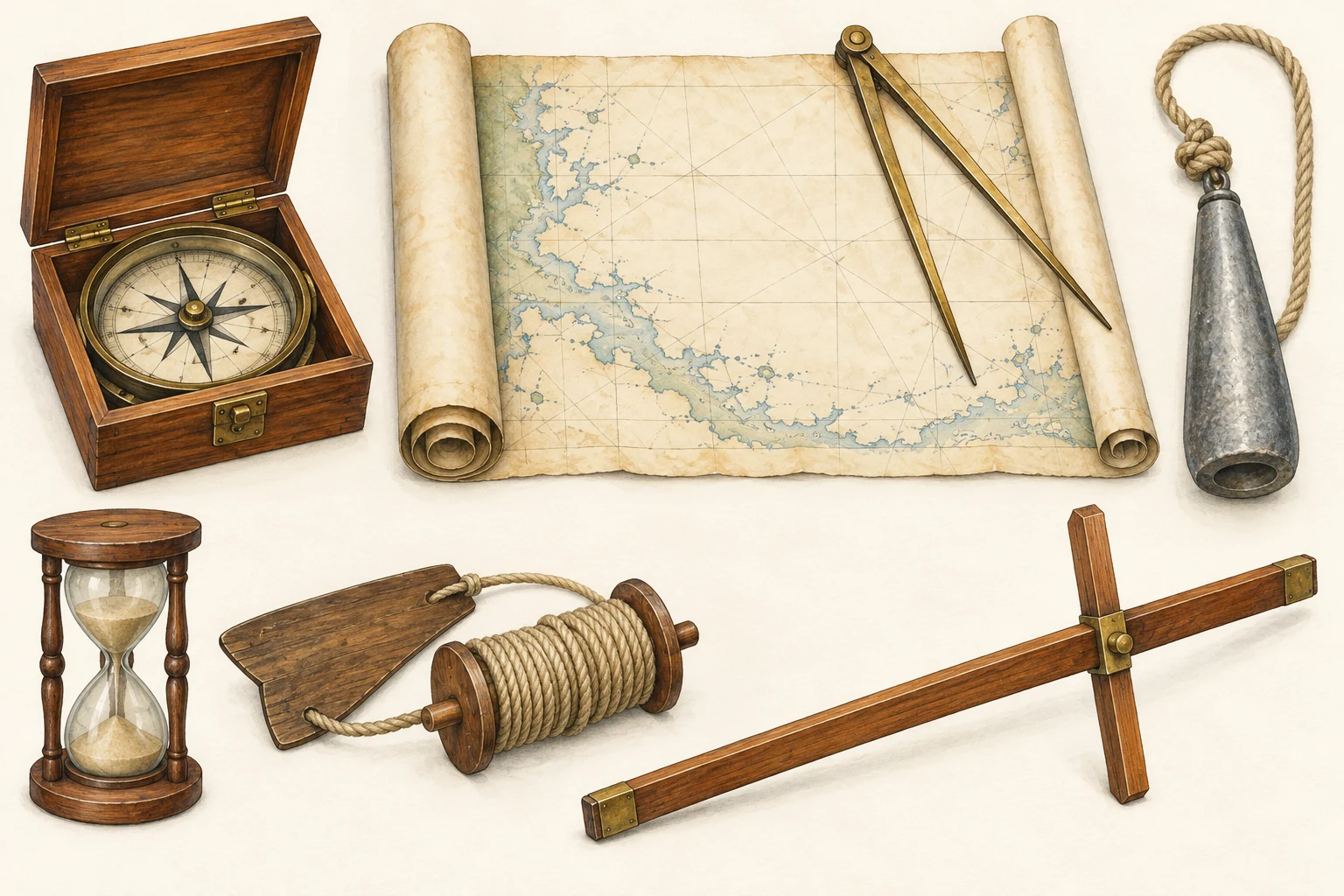 See the details.How sailors found their way.Explore the illustrated guide