
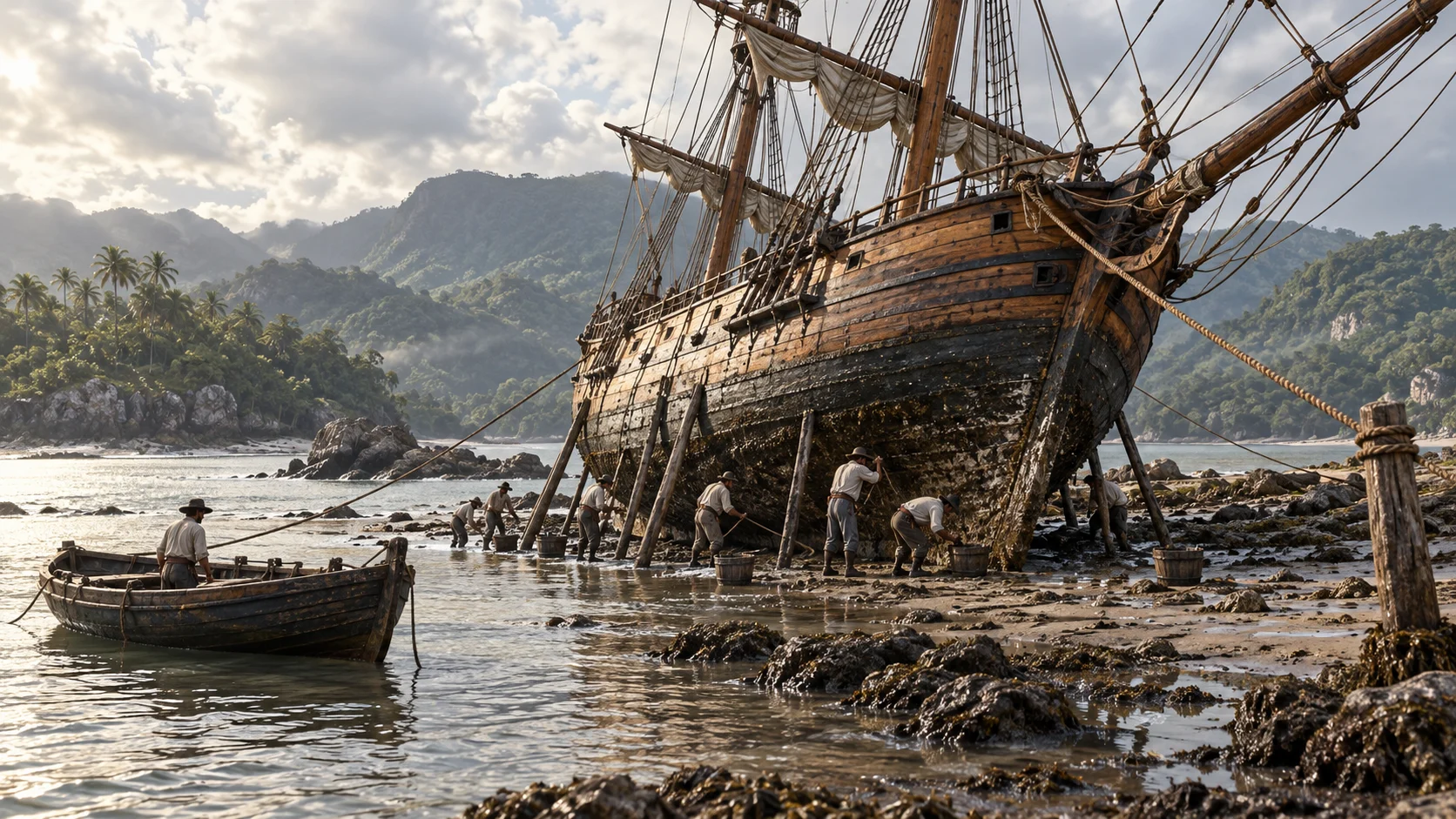
The next cruise began with maintenance
Ringrose records a discussion in which the company chose to go to Golfo Dulce, careen its vessels and then cruise near the equator. Repairs were part of the decision about how to obtain further prizes, not a separate peaceful interval outside the expedition. [1]
The narrative also notes that a smaller bark sailed better than the principal vessel. Owning a larger captured ship did not make every passage easier.
Entering was a sequence of observations
The company approached, anchored, moved farther inside and tested depths. It sent a canoe to seek water and a suitable place to lay the ship. Those actions reveal how a broad destination became a specific working site. [1]
The historical measurements are evidence of the voyage’s observations. They should not be copied into present-day directions for an entrance whose conditions and aids may have changed.
Captivity came before exchange
The canoe party took a man and two boys captive and brought them aboard. Ringrose then describes the man going to find other people while his children remained with the company. Later visits brought honey, plantains and other supplies for purchase or barter. [1]
The author calls the treatment kind. The detention of children still matters to understanding the relationship. A subsequent exchange does not erase the coercive beginning.
Local craft helped with the hull
The company used local bark-logs while tallowing the vessel. The repair therefore depended on more than the tools carried from the previous port: local materials, craft and knowledge entered the operation. [1]
This is one reason to place shore communities inside maritime history. They were involved in the practical work and vulnerability of a visit, not merely background scenery around the anchorage.
A repaired vessel returned to raiding
Once the work was complete, the company left to pursue the next phase of its cruise. The later capture of Rosario belongs to that continuation. The sheltered stop and the violent encounter were parts of the same economy. [1]
Read what careening required, the subsequent prize and how different forms of detention served a company.
Questions, answered.
Did the company arrive at a ready-made shipyard?
The account describes reconnaissance, choosing a site and obtaining local resources. It does not establish a formal pirate shipyard.
Were the local suppliers simply willing crew members?
No. The narrative includes initial captivity and later exchange, which must be distinguished.
Sources & reading notes
Source checks distinguish an artifact, a reported account and a modern interpretation. They do not constitute independent historian review.
- Bucaniers of America, the second volume (1685)Open the keyboarded source transcriptionBasil Ringrose; printed for William Crooke; EEBO–TCP transcription · Participant voyage narrative, published 1685; CC0 keyboarded transcription
Chapter XIX, the decision to careen, approach, soundings, canoe reconnaissance, initial captives, exchange for supplies and use of bark-logs. Quantities and descriptions are period reports, not current sailing directions. The published journal is a mediated participant account. Its nationalist praise, judgments about peoples and claims about motives are not adopted as neutral fact. The XML marks damaged and missing text; page images are not the CC0 transcription.
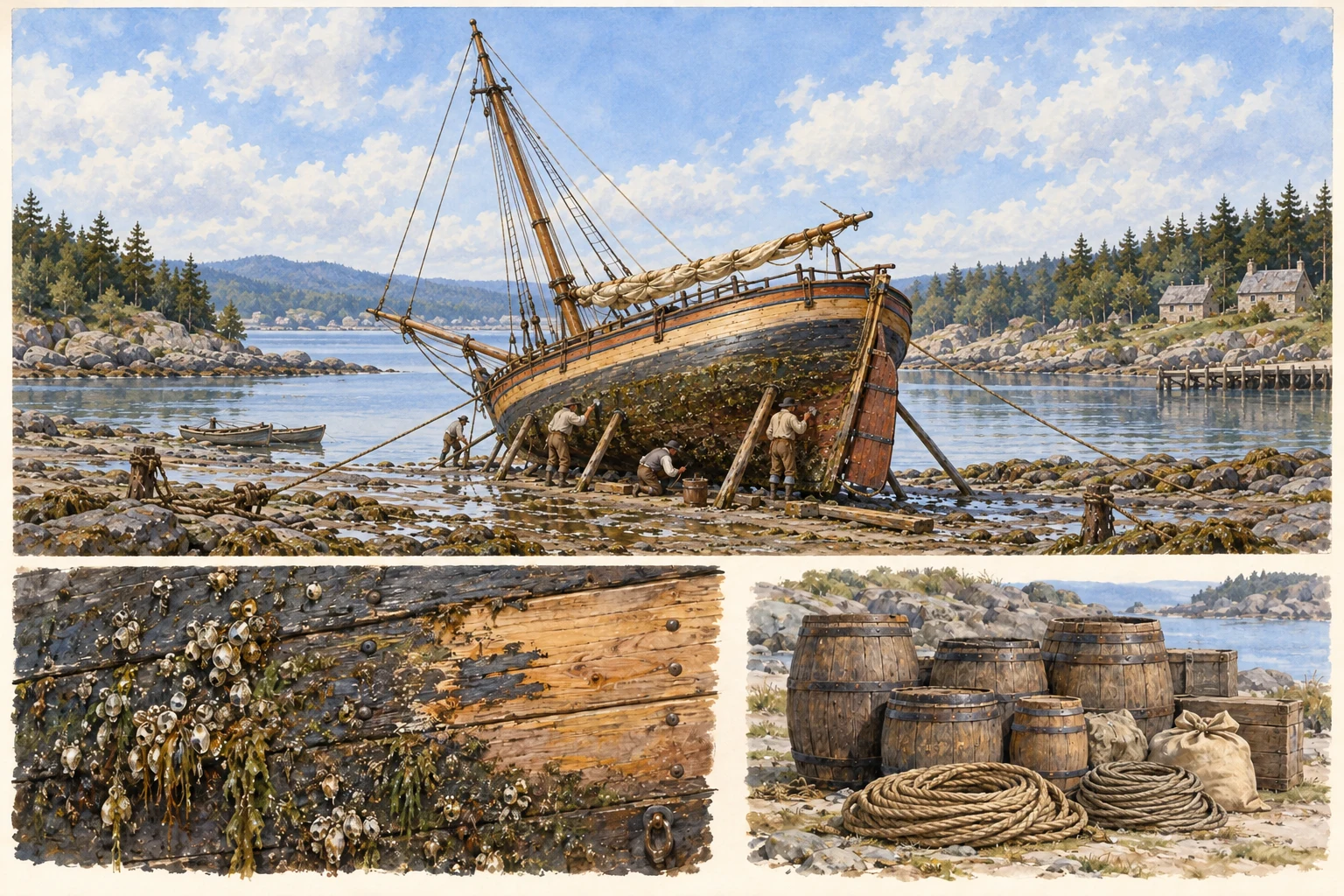 See the details.Careening: the work that made a ship vulnerableExplore the illustrated guide