

Read the number correctly
The QAR project’s November 2015 inventory describes weapons ranging from half- to six-pounders and explains the rating in relation to the cannon ball. Those are reported findings at that time, not a complete modern tally or the original ship’s full armament. [1]
Keep three numbers separate: the gun’s own mass, the weight used to describe its ordinary round shot, and the count of guns reported or recovered. They answer different questions. A six-pounder is not a six-pound metal tube.
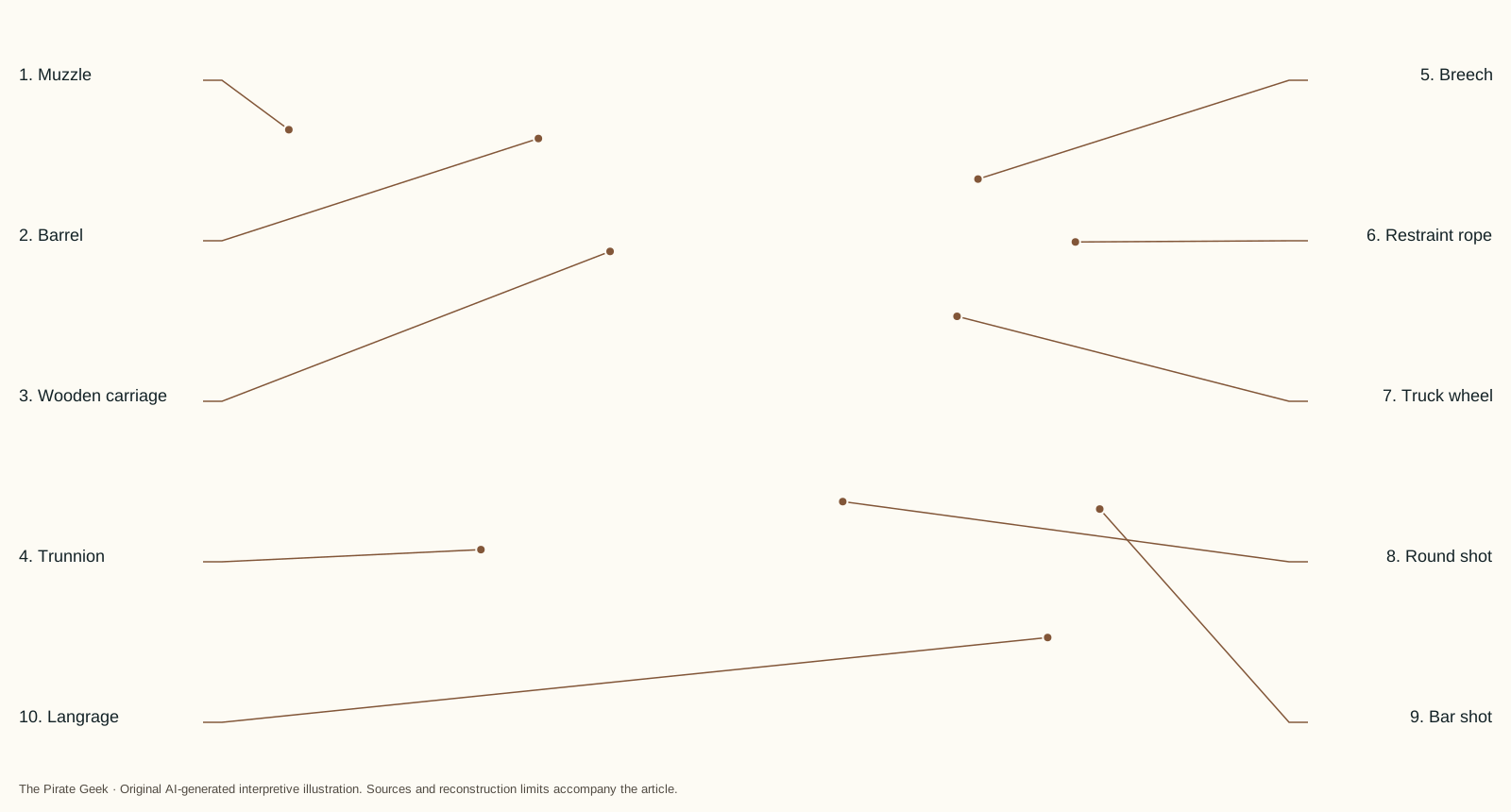
The barrel, bore and carriage perform different jobs; the explanation below separates them rather than treating a cannon as a single undifferentiated object. It has no scale, charge specification or construction dimensions. Its purpose is vocabulary, not operation.
The gun was part of a system
A barrel alone does not explain a working gun position. A historical reconstruction also needs evidence about support, space and the surrounding equipment. The silhouette on a ship drawing can make these relationships disappear.
Johnson’s accounts repeatedly treat powder, guns and stores as things crews acquire, lose or sacrifice. In his Roberts narrative, heavy equipment is thrown overboard during an escape. Such an episode explains why armament is not a fixed decorative feature of a vessel. [2]
It also warns against describing every gun recovered from a wreck as a perfectly working weapon at the ship’s final moment. A physical find, a written count and a performance claim require different support.
The trunnion and carriage cheek are enlarged to explain the mounting relationship. Smith’s period terminology is a teaching source, not a blueprint for this generated assembly.
John SmithAmmunition was not all interchangeable
| Category | What to notice | Source boundary |
|---|---|---|
| Round shot | A roughly spherical projectile; the reference for pounder naming | Do not confuse its weight with the gun’s mass |
| Bar shot | Two end weights joined by a bar; associated with damage to rig and sails | Intended function does not prove every shot’s result |
| Langrage | A collection of smaller damaging material | The QAR example includes bolts from one specific bore |
The bar-shot explanation comes from the project’s artifact entry. Its intended attack on sails and rigging differs from treating every shot as a solid ball meant to pierce a hull. [3]
The langrage entry is particularly useful because it connects an interpretation to context: iron bolts were removed from the bore of cannon C19. That is stronger than finding unrelated metal nearby and assuming its purpose. It is still evidence of one load, not a universal recipe. [4]
Round shot, bar shot and irregular iron bolts are separated visually. They are not interchangeable identities, and the plate does not imply that every gun carried every type.
NC Office of State Archaeology · NC Office of State Archaeology · NC Office of State ArchaeologyWhy recovery totals need dates
Archaeology proceeds through discovery, lifting, conservation and interpretation. An inventory can count objects at one stage while another report counts them at a different stage. A discrepancy is a reason to check definitions and dates before deciding one source is wrong.
The November 2015 cannon page distinguishes identified, recovered and conserved/displayed objects. We preserve that distinction instead of repeating one count as “the number Blackbeard had.” The historical and archaeological questions are not identical. [1]
This same habit applies beyond pirate history: check what a quantity measures before comparing it with another quantity that looks similar.
Look beyond a firepower ranking
To compare two vessels responsibly, define the date, source and purpose of the comparison. Gun count alone cannot establish which vessel would win a hypothetical encounter. Sources about intimidation, crew and condition may tell a more useful story than an invented league table.
Continue with the broader weapons guide for personal arms and fragments, or return to ship types to see why a rig name is not an armament specification. These are connections the evidence can support without pretending we can replay an unrecorded battle.
Questions, answered.
Is a six-pounder a gun weighing six pounds?
No. The rating relates to its ordinary round shot, not the gun’s total mass.
Are recovered and originally carried cannon the same total?
Not necessarily. Recovery dates, missing objects and definitions matter. The dated archaeological inventory is not an original armament list.
Sources & reading notes
Source checks distinguish an artifact, a reported account and a modern interpretation. They do not constitute independent historian review.
- CannonNC Office of State Archaeology · Archaeological collection
Cannon entry, November 2015 inventory, identified/recovered/conserved distinctions and gun sizes. Dated inventory, not all guns ever carried by the ship.
- A General History of the Pyrates (1724)Published under the name Captain Charles Johnson · Early printed account; public-domain text
Chapters on Roberts, Lowther, Phillips, Teach and the reported Cape Coast proceedings. Authorship is disputed. A near-contemporary compilation, not a surviving signed pirate code or a neutral transcript. Cite its claims as reported claims.
- Bar shotNC Office of State Archaeology · Archaeological collection
Bar-shot entry, interpreted damage to rigging and sails. Explains intended use, not the result of every shot.
- LangrageNC Office of State Archaeology · Archaeological collection
Langrage entry, March 2018 update; iron bolts from cannon C19’s bore. One observed load does not establish every gun’s load.