

Why a rank pyramid gets this wrong
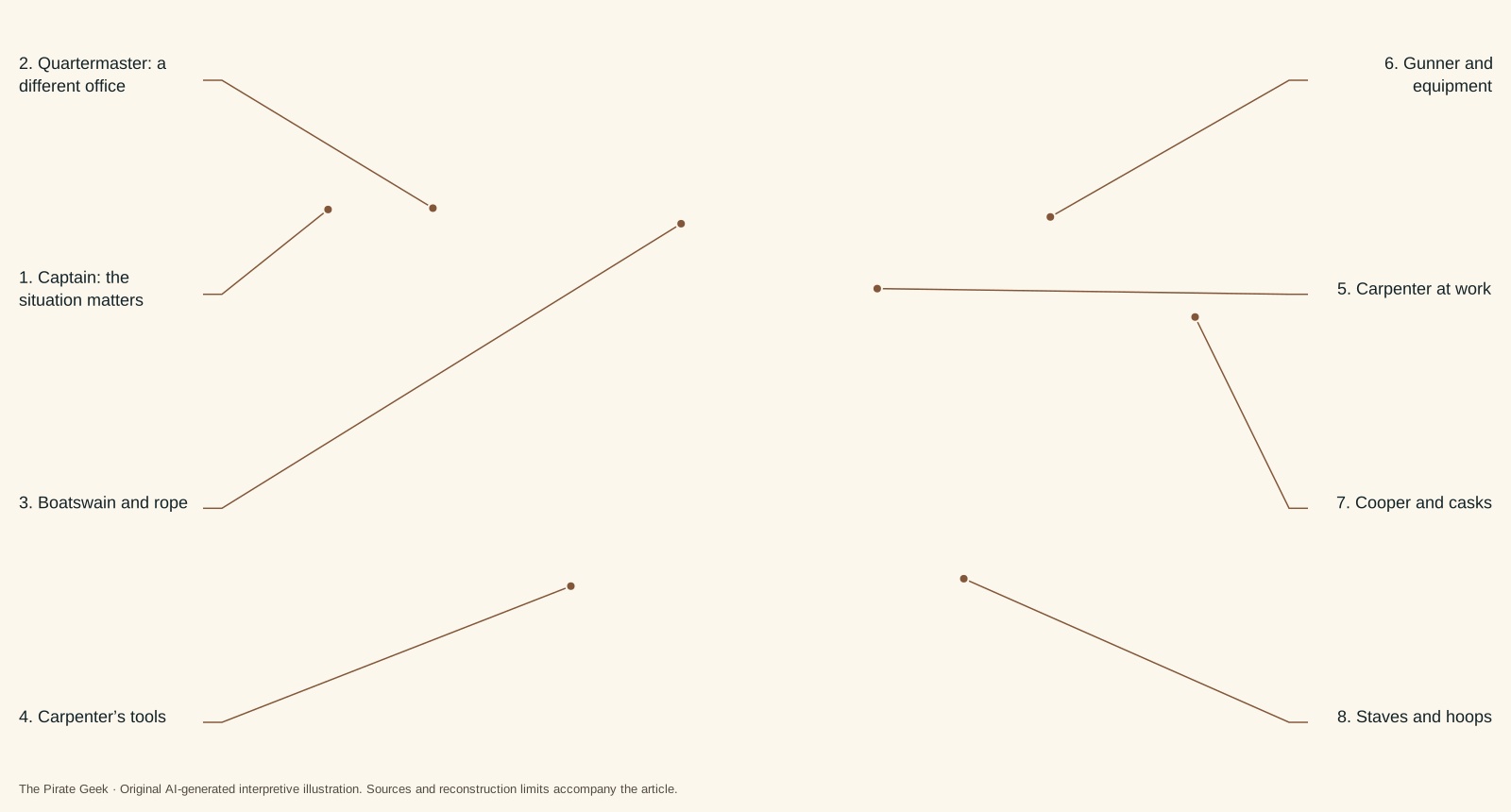
A pyramid suggests a fixed chain of command in which each person is always above the person below. The account associated with Roberts describes something more conditional: elections, rules for sharing, the quartermaster’s disciplinary role and a captain whose battle authority could be stronger than his everyday control. [1]
The responsibilities below are grouped by work rather than represented as a universal organization chart. It also separates a job title from a share entitlement. A skilled officer could receive an increased prize share without occupying the same place in every crew’s decisions.
Keep the setting narrow. Our principal written source is the 1724 General History, published as Captain Charles Johnson. Its author’s identity is disputed, and its descriptions need attribution. It cannot settle the practices of all pirates in all seas.
Captain and quartermaster
In Johnson’s account, a captain could be chosen by a majority. The same discussion describes the captain as commanding decisively during pursuit and combat. Outside those situations, other crew members could limit his privileges. It also explains that Roberts developed considerable personal influence, complicating any neat constitutional diagram. [1]
The quartermaster appears as a representative and disciplinarian who supervises plunder and could administer punishment. The account describes this officer as being chosen by the men. “Representative” does not mean gentle: the same text portrays coercion, beatings and abuse. [1]
Our captain–quartermaster comparison follows the change in authority across situations. Neither role should be translated straight into a modern chief executive or elected ombudsman.
The specialists who kept a vessel working
Johnson’s chapter on Phillips names a master or navigator, a gunner and a carpenter among the first officers selected. His reported King Solomon testimony describes a boatswain taking rope, a sailmaker taking canvas and a cooper taking casks. Those specific examples are more secure than assuming every crew had every specialist at full strength. [1]
| Role | Work to understand | Important qualification |
|---|---|---|
| Master / navigator | Direction and navigation | Title and duties need a vessel-specific source |
| Boatswain | Rope, cables and working equipment | Not simply a ceremonial rank |
| Gunner | Weapons and associated stores | Gun ownership is not the same as gunnery skill |
| Carpenter | Repairs and construction stores | Keeping a vessel usable is ongoing work |
| Cooper / sailmaker | Casks / sails and canvas | These roles appear in particular testimony |
The mallet and plane are modern generic studies. Compare the specialist stores named in the King Solomon testimony with the more prescriptive duties in Smith’s 1627 manual.
Published under the name Captain Charles Johnson · John SmithChoice, force and the people left out
The reported trials distinguish people described as willing participants from prisoners and forced specialists. In one passage, musicians claimed coercion; some defendants were acquitted. Other prisoners said they had followed orders, and the court treated election of their leaders as significant. These are adversarial proceedings as reproduced in a printed narrative, not unfiltered access to private motives. [1]
This is why we avoid describing every person aboard as an enthusiastic equal partner. A list of offices also says little about captives, enslaved people or victims outside the crew’s protected circle. The internal arrangements of a violent group do not tell the whole social story.
The cooper’s trade makes provisions part of the wider labor system. The drawn adze and cask are illustrative, not archaeological identifications.
Published under the name Captain Charles Johnson · NC Office of State ArchaeologyHow to compare two crews
Put the sources side by side. Ask who selected officers, what powers the text assigns them, which rules survive and how shares differ. Mark what is missing. If an account names a role without explaining it, do not fill the gap with a game’s rank system.
Then follow the money: our prize-share model shows how a documented weighting rule differs from an equal split. It is an explanation of the rule, not a claim that every voyage paid out.
Questions, answered.
Was the quartermaster above the captain?
That is too simple. In the Roberts account, the quartermaster has important ordinary disciplinary and prize responsibilities, while the captain’s command is strongest in pursuit and combat.
Did every pirate ship have the same ranks?
No. Use a named crew and source. Do not impose a single modern hierarchy on all pirates.
Sources & reading notes
Source checks distinguish an artifact, a reported account and a modern interpretation. They do not constitute independent historian review.
- A General History of the Pyrates (1724)Published under the name Captain Charles Johnson · Early printed account; public-domain text
Roberts chapter, selection of captain and quartermaster, pursuit authority, articles and Cape Coast proceedings; Phillips chapter, selection of officers. The reproduced King Solomon testimony supplies specialist examples. Authorship is disputed. A near-contemporary compilation, not a surviving signed pirate code or a neutral transcript. Cite its claims as reported claims.