
Begin with a supply problem, not a feast
A ship cannot keep functioning on a legend about rum and treasure. Feeding people is an ongoing task, and the evidence for it is often mundane: containers, provisions taken from another vessel, or scraps that survive long after the meal.
In Johnson’s Roberts narrative, a captured Bristol ship supplies oatmeal, beef, powder, clothes and other stores. Elsewhere the company is short of provisions. Those accounts put food beside the other things needed to continue sailing. They are episodes in one narrative, not a ration standard. [1]
The comparison below separates the kinds of evidence. It does not show an excavated storeroom or a verified meal served on a particular day.
What containers and bones can tell us
The QAR sustenance collection includes barrel hoops, ceramic and glass containers and pewter eating equipment. The project cautions that some objects may have been cargo or may have been used by people aboard. A plate in a wreck is not automatically a plate from a pirate’s dinner. [2]
The faunal entry describes pig and cow remains, including butcher marks on two cow bones. It also identifies a rat bone and notes that some marine-mammal material may be intrusive. Different bones can have different routes into an assemblage. [3]
The useful question is therefore not simply “What animals are listed?” It is “Which remains can reasonably be connected with food, and how confident is that interpretation?” An honest caption preserves that distinction.
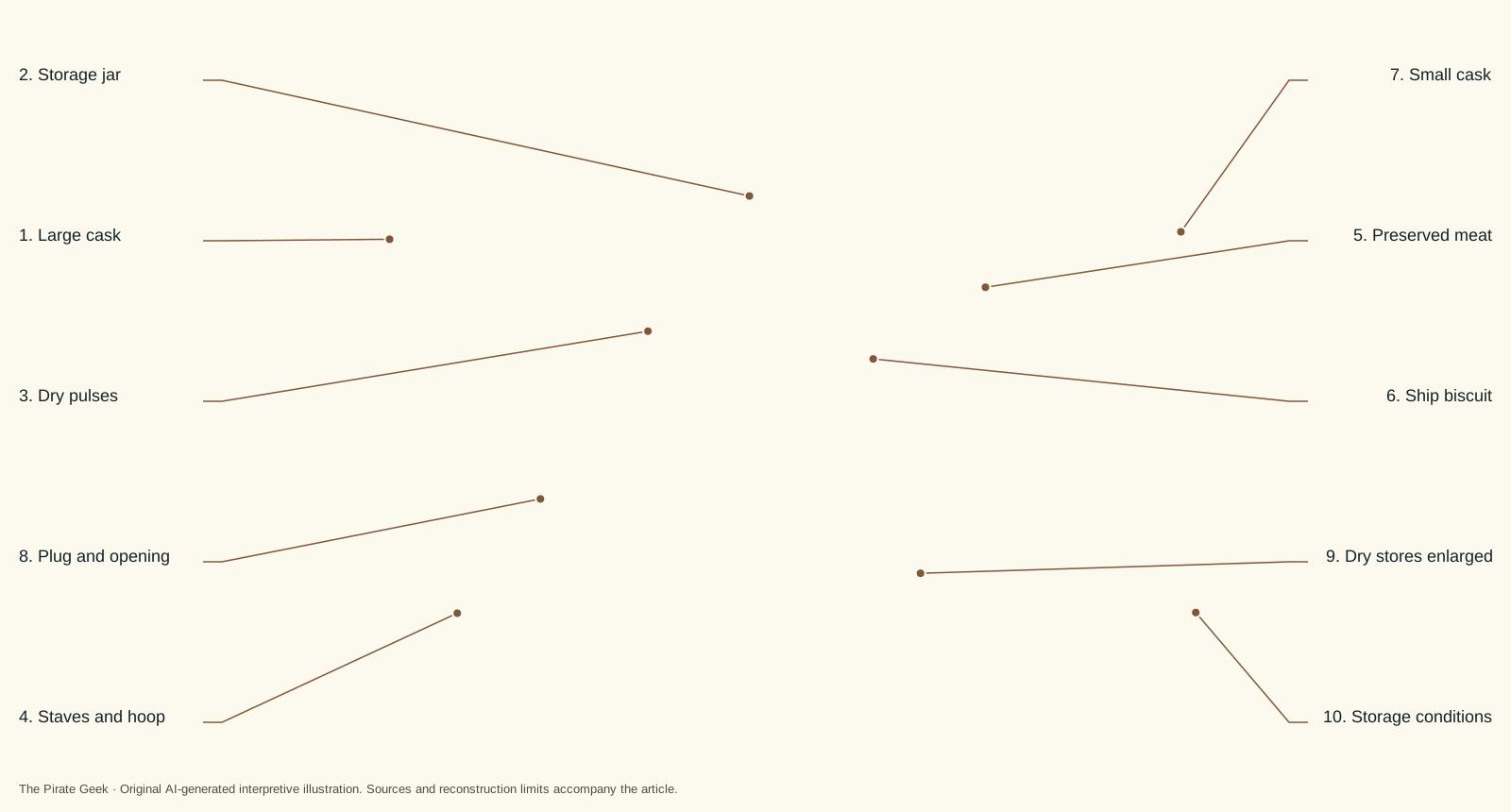
The enlarged cask study shows staves, a hoop and closure. The drawn construction and contents are generic; the archaeological context remains in the source notes.
Published under the name Captain Charles Johnson · NC Office of State ArchaeologyGeneral seafaring context is not a pirate ration book
Royal Museums Greenwich’s broad age-of-sail overview lists preserved meat, fish, cheese, ale and biscuit among sailors’ provisions, and describes storage problems and vermin. Its setting spans centuries and different services. We use it for context, not to assign the same daily allowance to a pirate company in 1718. [4]
This boundary matters because a detailed naval ration table can look authoritative while answering the wrong question. Before borrowing it, check whose ship it describes and when. More detail is not automatically more accurate for the subject at hand.
The supported list describes provisions and storage without inventing a seven-day pirate menu.
Dry stores and biscuit help explain what a voyage needed to manage. They do not turn a broad age-of-sail museum summary into a complete pirate menu.
Royal Museums GreenwichRum does not answer the water question
Johnson’s reported Roberts articles discuss fresh provisions and strong liquor together, including the possibility of restricting access during scarcity. Another rule regulates lights and the place where drinking continues at night. These passages show that supply and conduct were concerns of the account. [1]
They do not tell us that everyone drank a fixed quantity each day, that water was always unsafe, or that a drink cured disease. We do not infer those claims from the presence of a bottle or the later reputation of pirates.
In a historical account, separate the container, its likely contents, the rule about access and the actual amount consumed. Each requires evidence of its own.
A better picture of daily life
Food history becomes more interesting when uncertainty stays visible. The cooper’s work, the space taken by stores and the need to replace supplies link a meal to the rest of the vessel. In Johnson’s reported plundering testimony, casks and tools fall within a cooper’s responsibility. [1]
That connection helps explain why crew roles include more than fighting. It also connects provisions to the vessel’s working systems and to rules about access and discipline.
When a new find or source improves the picture, update the specific claim. There is no need to make the whole menu look certain before sharing the useful parts that are supported.
Questions, answered.
Is there a standard pirate daily menu?
Not established by the sources used here. The evidence concerns particular episodes, a wreck assemblage and broader seafaring context.
Does a bottle prove who drank from it?
No. An object’s likely use and its user are different questions; cargo and intrusive material also require consideration.
Sources & reading notes
Source checks distinguish an artifact, a reported account and a modern interpretation. They do not constitute independent historian review.
- A General History of the Pyrates (1724)Published under the name Captain Charles Johnson · Early printed account; public-domain text
Roberts chapter, captured Bristol ship’s provisions, printed Articles I and IV, and King Solomon specialist testimony. Authorship is disputed. A near-contemporary compilation, not a surviving signed pirate code or a neutral transcript. Cite its claims as reported claims.
- SustenanceNC Office of State Archaeology · Archaeological collection
Sustenance collection, containers and eating equipment with cargo/use ambiguity. Containers and cargo cannot by themselves establish a daily menu.
- Faunal remainsNC Office of State Archaeology · Archaeological collection
Faunal entry, pig/cow remains and butcher marks, rat and possibly intrusive marine material. A mixed assemblage is not a complete diet sample.
- Life at sea in the age of sailRoyal Museums Greenwich · Museum overview
Broad age-of-sail food and living-conditions overview; not a pirate-specific ration table. Covers several centuries and naval/merchant experience. Not a pirate-specific ration schedule.