
Separate the event from the accusation
Panama was extensively burned during the occupation. The question of who caused the fire is a further claim, requiring evidence about action and responsibility. An image of flames establishes neither an order nor the identity of the people who carried it out.
The disagreement is visible in the surviving published accounts. It should not be hidden because a single culprit would make a simpler narrative.
Exquemelin’s telling assigns an intention
The 1684 English narrative says Morgan privately arranged for the city to be set on fire and then sought to place responsibility elsewhere. This is a direct allegation about a commander’s conduct. It appears within a broader account sharply critical of his treatment of captives and of the later division. [1]
The accusation deserves to be recorded, but its vividness is not independent proof. A participant account can preserve important observations while also selecting scenes, repeating information or assigning motives beyond what its reader can verify.
Morgan’s relation offers a different defense
The relation calendared under entry 504 attributes burning to the opposing side and says the attackers tried unsuccessfully to extinguish the fire. It presents the expedition as authorized service and describes its results in that frame. [2]
This account also has a position to defend. Official preservation makes it an important source, not a neutral verdict. Its claims about responsibility should receive the same scrutiny given to its opponent’s accusation.
Copies do not become extra witnesses
The calendar identifies further copies and related versions of Morgan’s relation. Entry 542 includes a version and later testimony about the voyage’s reporting. Repeated preservation can help trace a text without multiplying the number of independent observations behind it. [2]
This is a general source problem with practical consequences. Three later retellings that depend on one account do not carry the same evidential weight as three genuinely separate observations.
The later historian widens the comparison
Haring discusses additional statements when weighing the fire, including reports he takes to support responsibility outside Morgan’s force. His reconstruction is useful for locating the dispute, but the originals and their transmission still matter. [3]
The careful outcome here is a recorded disagreement. The article does not claim a new archival discovery resolving it, nor does it treat all versions as equally accurate simply because more than one exists.
The city’s people remain in the story
Uncertainty about who began the fire does not erase the destruction, captivity and coercion of the wider campaign. The attribution question is one part of the event, not a reason to suspend everything else that the sources establish.
Return to the full expedition, examine Morgan’s changing standing or follow the difference between a calendar entry and a manuscript.
Questions, answered.
Does the website claim to have solved the fire’s origin?
No. It preserves the conflicting claims and identifies the limits of the source comparison.
Are several copies of Morgan’s report several independent eyewitnesses?
No. Copies can trace transmission without providing independent observations.
Sources & reading notes
Source checks distinguish an artifact, a reported account and a modern interpretation. They do not constitute independent historian review.
- Bucaniers of America (1684 English edition)Open the keyboarded source transcriptionAlexandre Olivier Exquemelin; printed for William Crooke; EEBO/TCP transcription · Early English translation through a Spanish version; TCP transcription released under CC0
Part III, Chapter VI, the accusation that Morgan privately caused the fire. This 1684 English edition is not the 1678 Dutch original. Translation, selection, authorial position and transcription gaps remain part of the evidence. Attribution to a participant does not make every anecdote independently verified.
- Calendar of State Papers Colonial, America and West Indies, 1669–1674 (1889)Edited by W. Noel Sainsbury; Her Majesty’s Stationery Office · Nineteenth-century calendar of colonial documents; public-domain printed text
Entry 504, printed pages 201–203, the calendared relation attributed to Morgan; entries 505–506 and 542 identify copies or related versions rather than wholly independent witnesses. The calendar contains abstracts and transcripts, not a substitute for every original manuscript. The downloaded searchable copy is machine OCR; doubtful readings require collation. A commander’s report or deposition remains an interested claim even when preserved in an official record.
- The Buccaneers in the West Indies in the XVII Century (1910)Clarence Henry Haring; Project Gutenberg transcription · Early twentieth-century historical study; public domain in the USA
Discussion of the Panama fire and other reported statements. Later compilation does not replace inspection of the underlying documents. An older secondary study drawing on colonial records and earlier narratives. Its imperial framing, racial generalizations and claims about national character are not adopted as fact. Not a substitute for current scholarship.
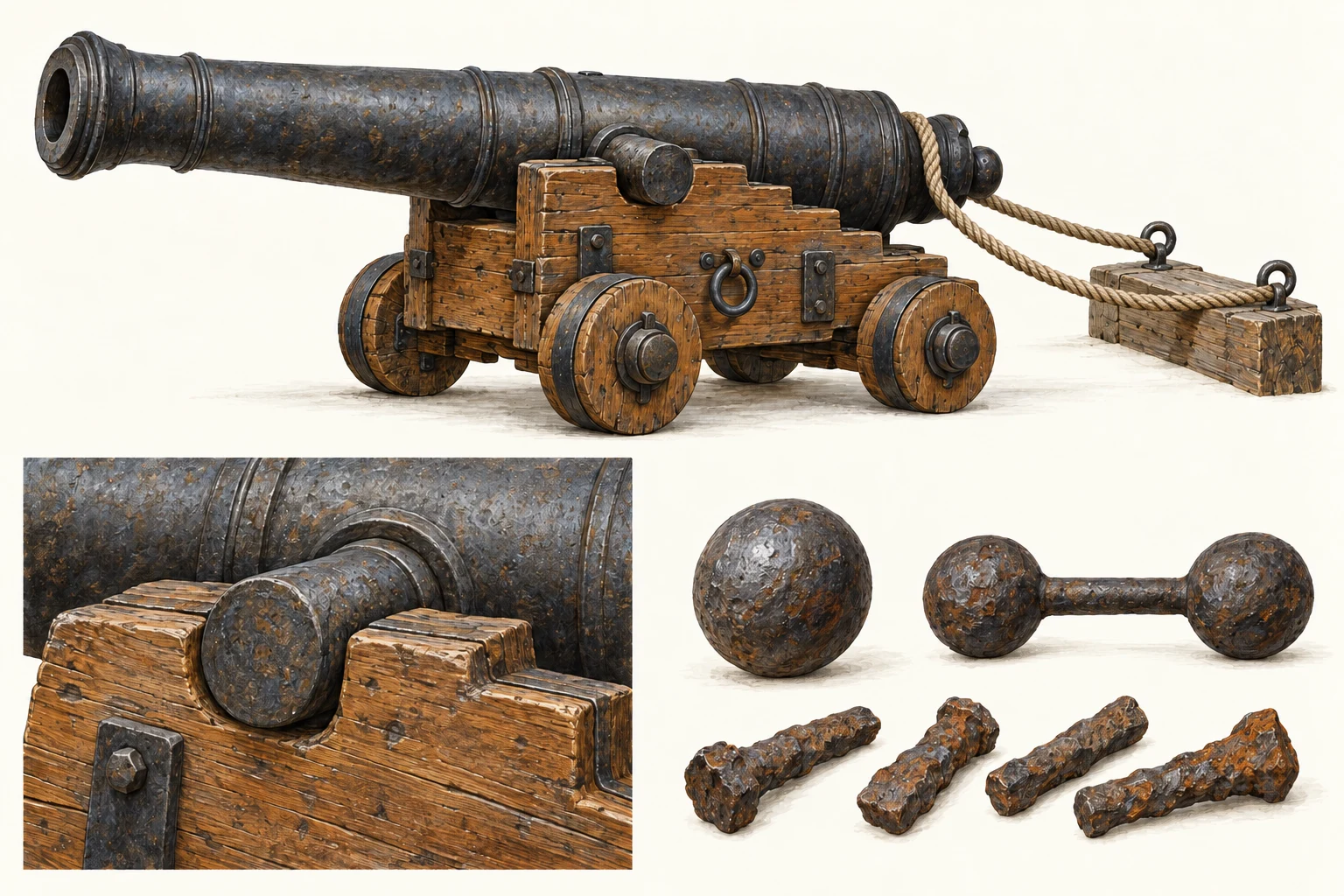 See the details.Cannon, shot and the meaning of a pounder.Explore the illustrated guide