
A campaign presented as defense of Jamaica
Morgan’s report framed the expedition as service performed under a commission from Modyford with the Jamaican council’s advice. It described evidence of Spanish hostility and the captains’ decision that attacking Panama served Jamaica’s safety. That is the commander’s justification, preserved in the calendar, rather than a neutral verdict from outside the expedition. [1]
The framing matters because the attack became part of a political dispute. A commission, an enemy’s alleged actions and the interpretation of peace between crowns all entered the later argument.
The Pacific target required a Caribbean approach
The company did not simply sail its Atlantic vessels into Panama’s harbor. The approach passed through Caribbean positions and the Chagres route, requiring a defended river entrance to be secured before the inland advance. Different parts of the force guarded vessels and the route while others continued. [1][2]
That arrangement divided people and resources. The force that assembled at sea was not identical to the group present at every inland stage, and the connection back to the vessels remained a practical concern.
The river did not carry them the whole way
The sources describe a transition from boats and river movement to marching through a difficult interior. Supplies were scarce, and the accounts make the removal or absence of food an important part of the pressure on the advancing company. [1][2]
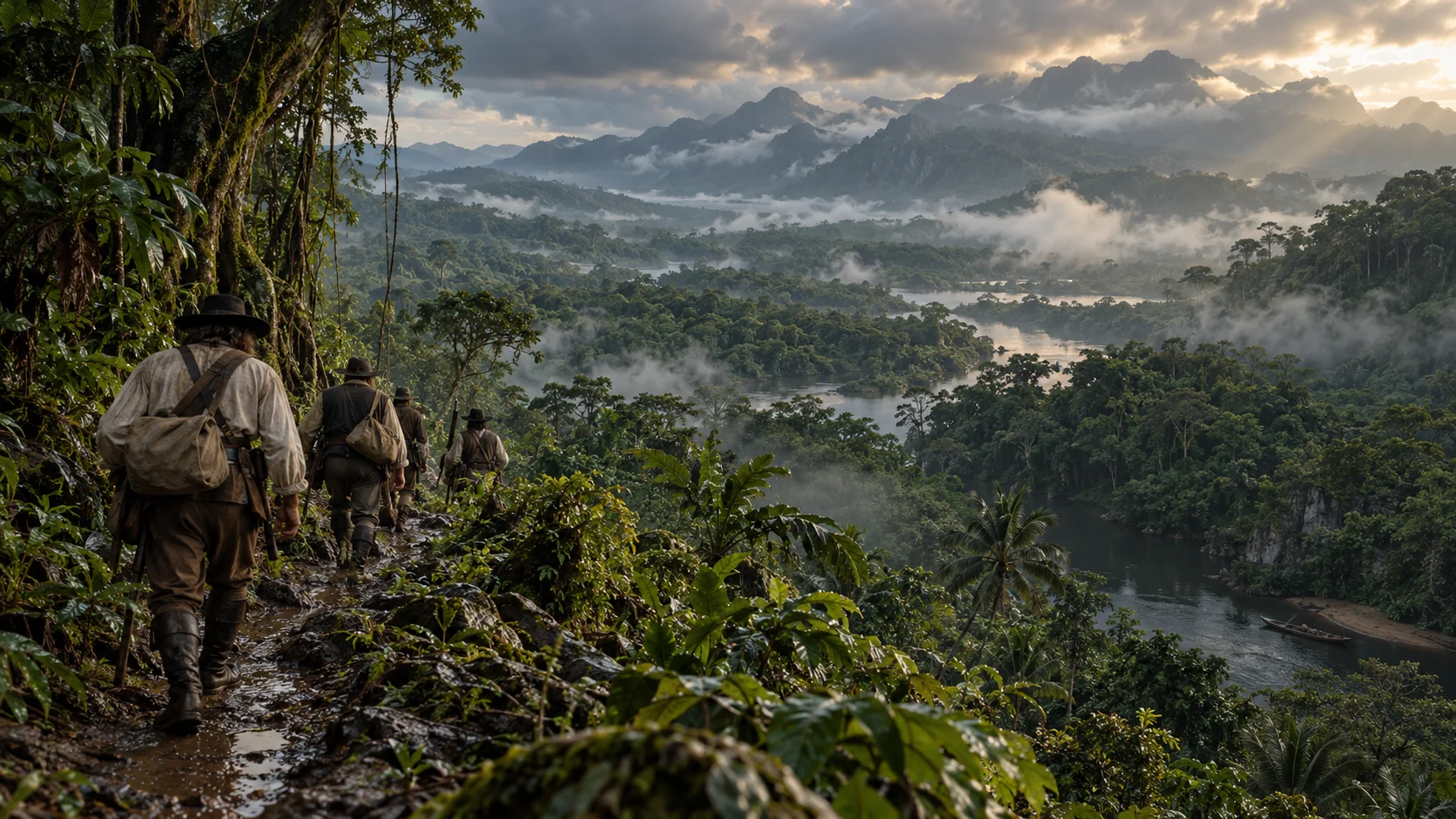
The landscape was inhabited and contested. Villages, paths, guides, defenders and supplies shaped the operation. Describing it as a passage through empty wilderness erases the people whose knowledge and resistance helped determine what the attackers could do.
An army reached the city, with a history of strain behind it
The accounts bring the force out toward the open country and then into battle before the city. Morgan’s relation gives a detailed organization of his men and large claims about the opposing force and casualties. Exquemelin supplies another highly dramatic telling. Their exact-looking figures should remain attributed, rather than silently combined into a single audited tally. [1][2]
The campaign’s success did not begin at the first shot. It depended on maintaining a force through the approach, reaching supplies and preserving enough organization to act together.
Occupation meant capture and coercion
After the city fell, parties searched outward for people and goods. Both the relation and the narrative describe prisoners; Exquemelin gives extensive accounts of cruelty. The commander’s report emphasizes the results of the expedition, while the narrative makes the pursuit of hidden property and ransom part of the occupation. [1][2]
The absence of all the wealth the attackers expected did not make the occupation harmless. People could suffer captivity and dispossession even when a company complained that its return was disappointing.
The fire has more than one account
Exquemelin’s published narrative accuses Morgan of causing the fire. Morgan’s relation attributes burning to the defenders and claims an attempt to extinguish it. Haring discusses still other statements when weighing the dispute. The destruction is clear; a confident attribution needs more than choosing the most vivid story. [2][1][3]
The issue deserves its own comparison of the source claims. An illustration of burning buildings cannot settle who ordered or began the fire.
The return included people as well as plunder
The relation follows the retreat through Venta Cruz to the Caribbean side, the collection of provisions, the division of returns and the departure for Jamaica. Captives remained inside that process. The expedition was not over merely because the force had entered the Pacific city. [1]
Back in Jamaica, the voyage was initially thanked and recorded by the council. Later questions about authorization and responsibility continued. Read Morgan’s career beside the claim of permission and the separate crossing of 1680.
Questions, answered.
Did Morgan sail directly from the Caribbean into Panama’s Pacific harbor?
No. The campaign secured a Caribbean approach and advanced through the isthmus.
Did the sources agree about the fire?
No. Exquemelin’s narrative and Morgan’s reported relation assign responsibility differently. The disagreement is retained rather than resolved by assertion.
Sources & reading notes
Source checks distinguish an artifact, a reported account and a modern interpretation. They do not constitute independent historian review.
- Calendar of State Papers Colonial, America and West Indies, 1669–1674 (1889)Edited by W. Noel Sainsbury; Her Majesty’s Stationery Office · Nineteenth-century calendar of colonial documents; public-domain printed text
Entries 504–506, printed pages 201–203, Morgan’s relation and copies; entry 542 and annexes, pages 220–221, including Peek’s later deposition. These are calendared texts, not original manuscripts inspected here. The calendar contains abstracts and transcripts, not a substitute for every original manuscript. The downloaded searchable copy is machine OCR; doubtful readings require collation. A commander’s report or deposition remains an interested claim even when preserved in an official record.
- Bucaniers of America (1684 English edition)Open the keyboarded source transcriptionAlexandre Olivier Exquemelin; printed for William Crooke; EEBO/TCP transcription · Early English translation through a Spanish version; TCP transcription released under CC0
Part III, Chapters III–VI, the approach, Chagres, inland march, attack and occupation. The printed Chapter V opening date conflicts with its surrounding sequence; it is not adopted. This 1684 English edition is not the 1678 Dutch original. Translation, selection, authorial position and transcription gaps remain part of the evidence. Attribution to a participant does not make every anecdote independently verified.
- The Buccaneers in the West Indies in the XVII Century (1910)Clarence Henry Haring; Project Gutenberg transcription · Early twentieth-century historical study; public domain in the USA
Morgan chapter, Chagres and Panama campaign, including discussion of the disputed fire. Exact days depend on calendars and conflicting accounts; this article uses month/year where appropriate. An older secondary study drawing on colonial records and earlier narratives. Its imperial framing, racial generalizations and claims about national character are not adopted as fact. Not a substitute for current scholarship.
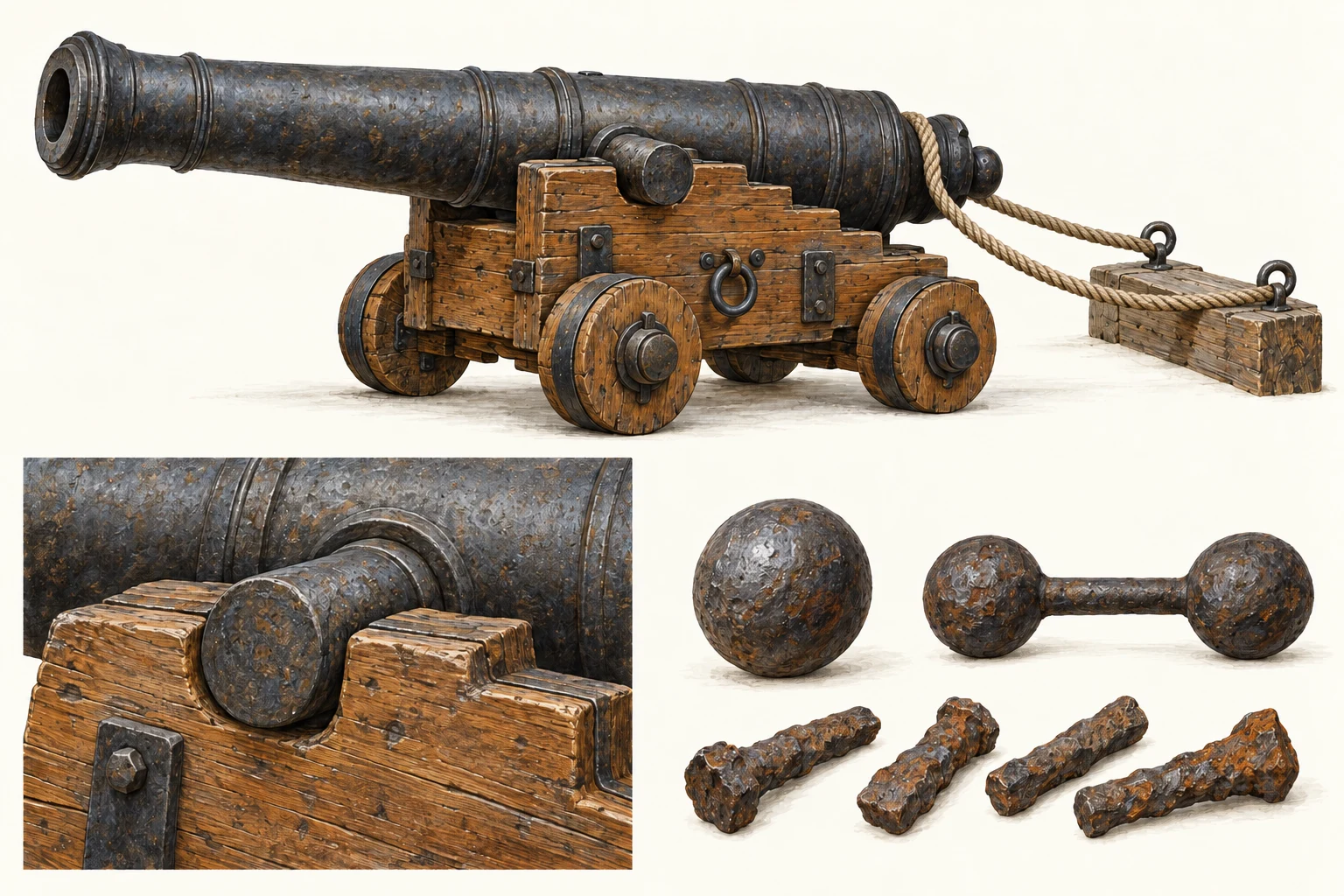 See the details.Cannon, shot and the meaning of a pounder.Explore the illustrated guide