

The warning was available
Before the attack, Ringrose records information that Arica had been strengthened. He also condemns the killing of an older captive whose warning the company had disbelieved. The narrative thus places a failure of judgment before the fighting itself. [1]
The company hoped to find concentrated wealth at a valuable port. That expectation encouraged another attempt after an earlier failure, even while information about defenses challenged the plan.
The landing preserved a route back
The attackers came ashore south of the town and left men with the boats. Ringrose describes agreed smoke signals intended to call different levels of assistance. The shore party therefore began with a plan for communication and possible withdrawal. [1]
Lookouts saw the approach. Surprise was already compromised before the attackers reached the streets, and the boat guard could not simply know everything happening inland.
Two objectives divided a small force
Watling sent part of the company against the fort while others moved toward the town. The fort party abandoned its first attempt to assist companions under pressure. Although the attackers gained positions in the streets, defenders reoccupied places they could not hold. [1]
The distinction between passing through a position and controlling it explains the failure better than a single claim that the town was “taken.” There were too few attackers to secure every gain while pursuing another objective.
The fort survived another assault
The account describes renewed pressure on the fort, including firing from a nearby building. While that continued, opposing forces recovered positions and threatened to surround the attackers. Their attention and strength were divided between the fort, the streets, wounded companions and prisoners. [1]
Watling and other officers were killed. A plan aimed at plunder had become a problem of keeping a damaged company together long enough to escape.
Retreat was still contested
Sharp resumed command, and the survivors fought their way out. Ringrose describes thirst, dust, wounded men and pursuit as they moved back toward the shore. He also reports that captured men revealed the signals previously arranged with the boats. The retreat therefore had an information problem as well as a physical one. [1]
The author’s praise of Sharp and blame of other men are retained as his judgments. They do not need to be accepted uncritically to understand the operation’s result: the company failed to secure its objective and lost people it could not bring home.
A failure changed the future voyage
The disagreement continued after the survivors reached their vessel. Some later left the company for a return across the isthmus. Arica links the brief command of Watling, Sharp’s restoration and the divided routes home. [2][1]
It is a useful counterweight to histories made entirely from successful captures. Prepared defenses, limited manpower and the need to protect a retreat could defeat an experienced company.
Questions, answered.
Did entering the town mean the attack succeeded?
No. The attackers could not secure the fort and all the positions they reached, and eventually withdrew.
Why does the journal print a different January year?
The printed account’s January entries sit in an old year sequence. This guide identifies the event in its modern chronological placement, January 1681, without changing the source quotation silently.
Sources & reading notes
Source checks distinguish an artifact, a reported account and a modern interpretation. They do not constitute independent historian review.
- Bucaniers of America, the second volume (1685)Open the keyboarded source transcriptionBasil Ringrose; printed for William Crooke; EEBO–TCP transcription · Participant voyage narrative, published 1685; CC0 keyboarded transcription
Chapter XVI, the approach, warnings, land party, successive fort attacks and retreat. The journal prints January 1680 in the old year sequence; this guide identifies the episode as January 1681. Force and casualty totals are the narrator’s reports. The published journal is a mediated participant account. Its nationalist praise, judgments about peoples and claims about motives are not adopted as neutral fact. The XML marks damaged and missing text; page images are not the CC0 transcription.
- History of the Buccaneers of America (1816)James Burney; Project Gutenberg transcription · Nineteenth-century historical compilation; public domain in the USA
The second Arica attempt and restoration of Sharp. Burney’s summary is later and partly dependent on the voyage narratives. Later than the events. Burney selects and compares earlier voyage narratives; his reconstruction is not an eyewitness record of every episode. Period ethnographic and colonial judgments require critical reading.
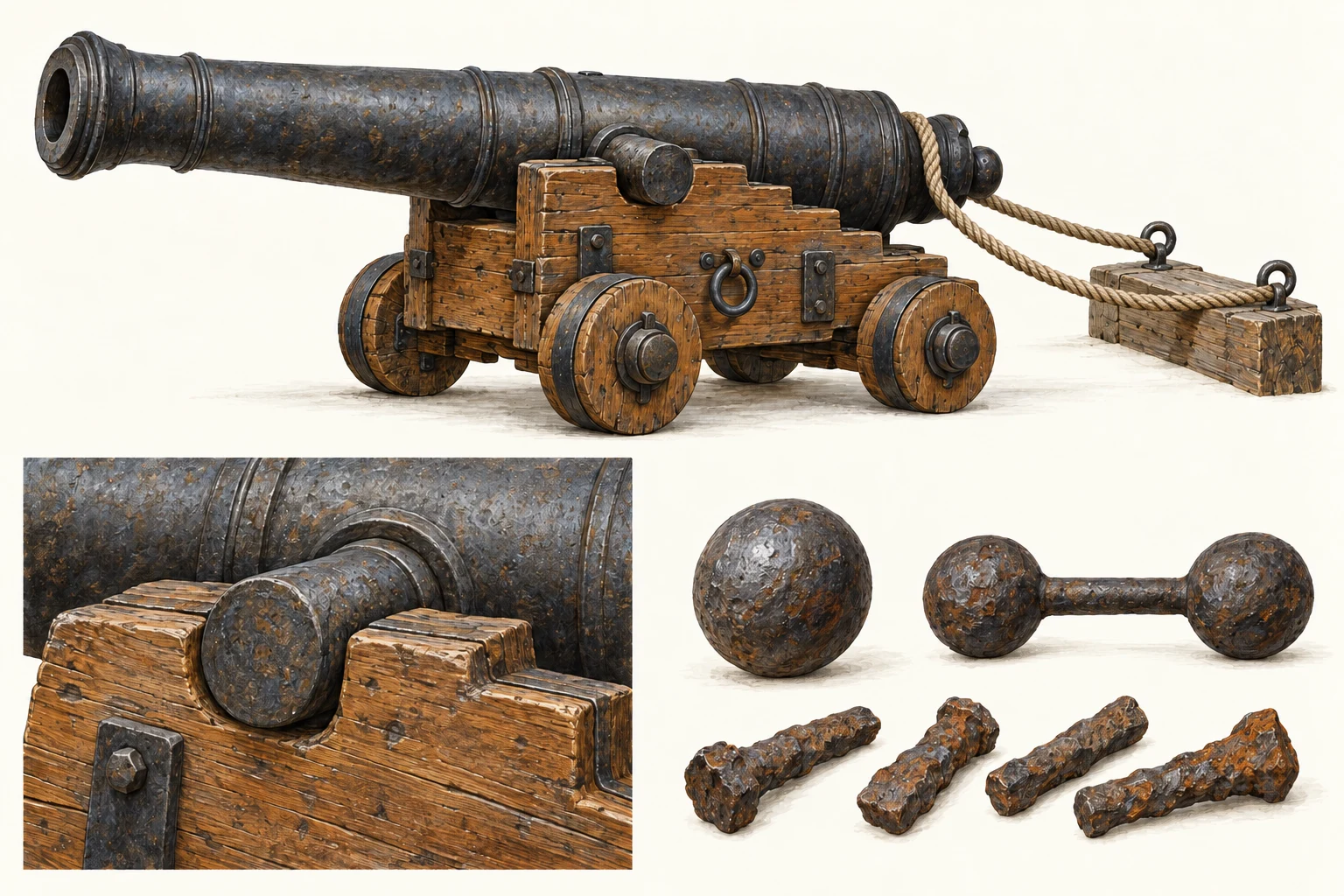 See the details.Cannon, shot and the meaning of a pounder.Explore the illustrated guide