

An approach shaped by expectation
Haring describes a force assembled from several national backgrounds rather than a single national navy. Information that the town expected particular shipping helped the raiders approach under a misleading appearance. The inhabitants’ expectation became part of the opportunity. [1]
This was an information problem as well as a military one. A coast might have defenses while still being vulnerable to a plausible explanation for an arriving vessel.
Taking the town began a period of coercion
The account follows a landing and rapid occupation, then the search for valuables in houses, churches and other buildings. Captives and threats against them entered the demands for payment. Haring describes several days of occupation rather than a momentary theft from an empty harbor. [1]
The violence reached people who were not combatants. Treating the raid only as an ingenious surprise removes those people from the mechanism by which the company tried to obtain wealth.
The fleet outside did not solve the immediate crisis
A Spanish fleet was nearby while the raiders held the city, according to the reconstruction. Its presence did not translate into an immediate attack that freed the captives. It nevertheless increased pressure on the buccaneers, alongside news of an approaching response from inland. [1]
That distinction matters. A force can influence decisions without engaging in the expected battle. The fleet’s proximity is part of explaining departure even when its action disappointed the city’s defenders.
Division could produce another fight
After withdrawal, the account describes the distribution of plunder and a quarrel between Vanhorn and Laurens. Vanhorn was wounded and later died; Grammont took his ship back toward Petit-Goâve. The company that cooperated during the raid did not thereby become a permanently harmonious organization. [1]
A common enterprise still contained competing claims to reward and authority. The moments after success can therefore reveal as much about a company as the attack itself.
Enslaved people were carried into the aftermath
Haring’s reconstruction and its notes describe large numbers of enslaved people taken away. Different reports offer different totals; the violence is not dependent on choosing the most spectacular estimate. Their movement belongs in the account beside the division of money and goods. [1]
The raid’s economic consequences also continued beyond the captors’ departure. Haring follows the effect on trade, the treatment of the governor and diplomatic demands addressed to English authority in the region.
Compare the mechanisms, not a ranking of raids
At Portobelo, Maracaibo and Veracruz, different combinations of geography, surprise, captives, negotiation and opposing forces shaped events. Their shared association with buccaneers does not make them repetitions of one adventure.
Read Portobelo, Maracaibo and the limits of freedom within the company together.
Questions, answered.
Was this a single national navy attacking another country?
Haring describes a buccaneer force with captains from several backgrounds. That differs from a uniform national naval organization.
Did the nearby Spanish fleet immediately retake the city?
Not in the account used here. Its presence still helped shape the raiders’ calculations and withdrawal.
Sources & reading notes
Source checks distinguish an artifact, a reported account and a modern interpretation. They do not constitute independent historian review.
- The Buccaneers in the West Indies in the XVII Century (1910)Clarence Henry Haring; Project Gutenberg transcription · Early twentieth-century historical study; public domain in the USA
Late buccaneer campaigns, printed pages 241–244, including the rendezvous, approach, occupation, fleet, division and aftermath; notes on Spanish reports preserve different estimates. Haring’s totals and causal judgments remain those of an older reconstruction. An older secondary study drawing on colonial records and earlier narratives. Its imperial framing, racial generalizations and claims about national character are not adopted as fact. Not a substitute for current scholarship.
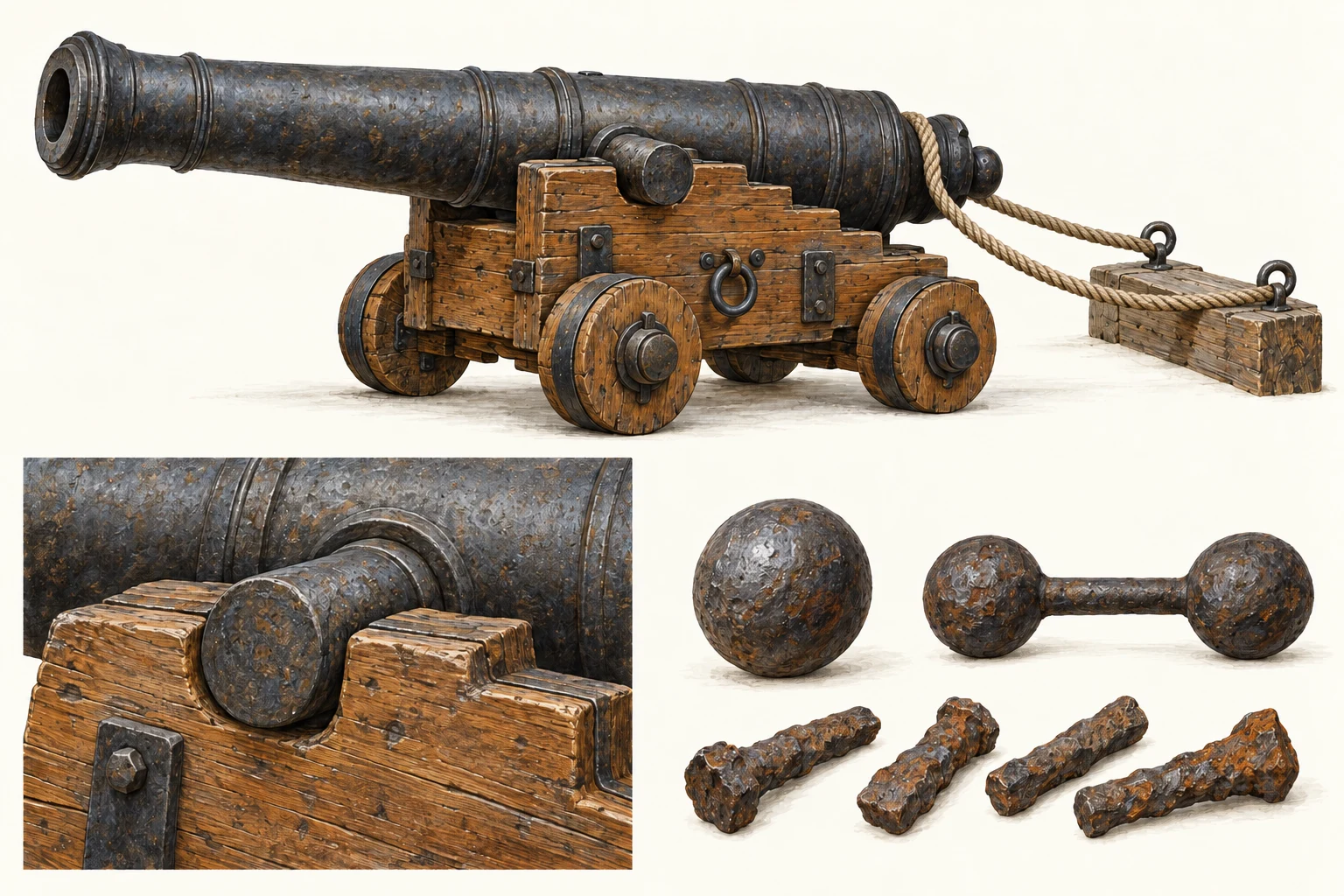 See the details.Cannon, shot and the meaning of a pounder.Explore the illustrated guide