
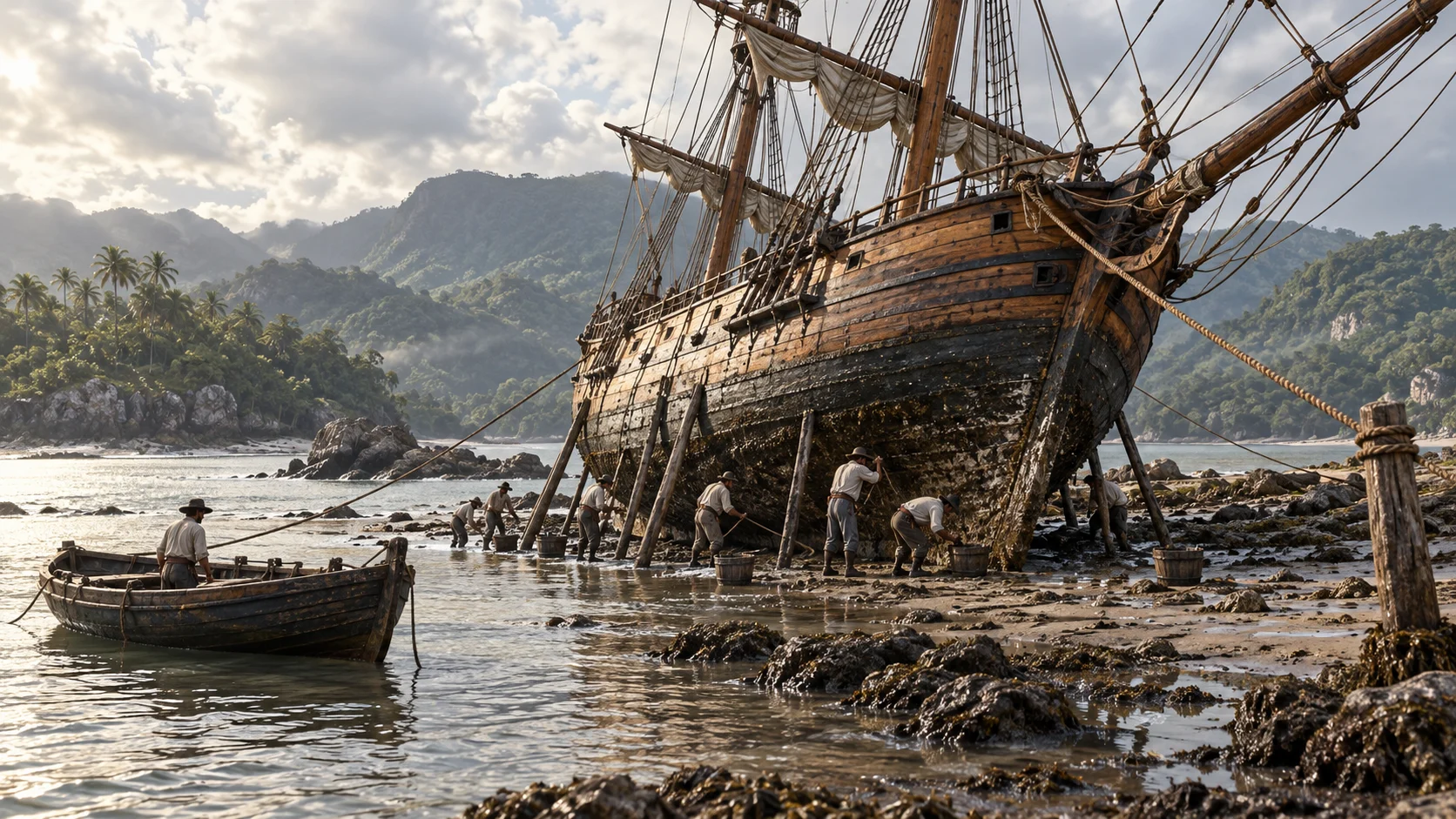
An anchoring place could assemble a temporary fleet
Morgan used a rendezvous at the island before his Panama campaign. Later, Grammont and de Graff combined their forces there before sailing for Campeche. [1]
These were separate ventures at different times. The common place illustrates a recurring need: vessels that normally operated apart needed somewhere to exchange information, agree a purpose and begin moving as a larger company.
Repair work changed how long a ship remained
Haring’s account of the hunt for La Trompeuse includes intelligence that the pirate vessel was careening near Île-à-Vache. A pursuer sent after it found that the ship had already left. [1]
A careening place was not a permanent address. The duration of a repair and the age of a report could determine whether an expedition arrived in time to find its target.
A wreck could disrupt government as well as a raid
The vessel carrying Morgan back to Jamaica in his later official role was wrecked at the island, with military stores lost. Haring places the incident within the quarrel between Morgan and Governor Vaughan. [1]
This was not the earlier explosion of Oxford. Keeping the two events separate avoids giving one ship a sequence of losses it never experienced.
A shared location did not make every visit lawful
A royal official’s transport, a suspected pirate’s repair stop and a raiding coalition could all use the same maritime landscape. Their purposes and legal standing differed. The name of a sheltered place cannot establish a vessel’s commission or the ownership of its cargo.
That distinction also explains the value of local intelligence: authorities needed to know which vessel was present and what it was doing, rather than merely where ships sometimes gathered.
Follow the island’s connections
The useful historical map runs outward to Jamaica, Petit-Goâve and the coasts targeted by particular expeditions. It records gathering, supply and departure rather than imagining an isolated republic with permanent control over every visitor.
Read Morgan’s Panama expedition, the separate Oxford explosion and the 1685 campaign. No present-day sailing or anchorage advice is implied by these historical episodes.
Questions, answered.
Was the wreck of Morgan’s later transport the Oxford explosion?
No. They are different events involving different vessels.
Did every ship remain at the island permanently?
No. The cited episodes concern temporary gathering, repair, departure and wreck.
Sources & reading notes
Source checks distinguish an artifact, a reported account and a modern interpretation. They do not constitute independent historian review.
- The Buccaneers in the West Indies in the XVII Century (1910)Clarence Henry Haring; Project Gutenberg transcription · Early twentieth-century historical study; public domain in the USA
Chapter V, Morgan’s rendezvous;Chapter VI, pp.212–213, Morgan’s transport wreck;Chapter VII, pp.234–235 and 245, La Trompeuse search and Campeche gathering. Distinguish separate losses and visits rather than treating the place-name as one event. An older secondary study drawing on colonial records and earlier narratives. Its imperial framing, racial generalizations and claims about national character are not adopted as fact. Not a substitute for current scholarship.
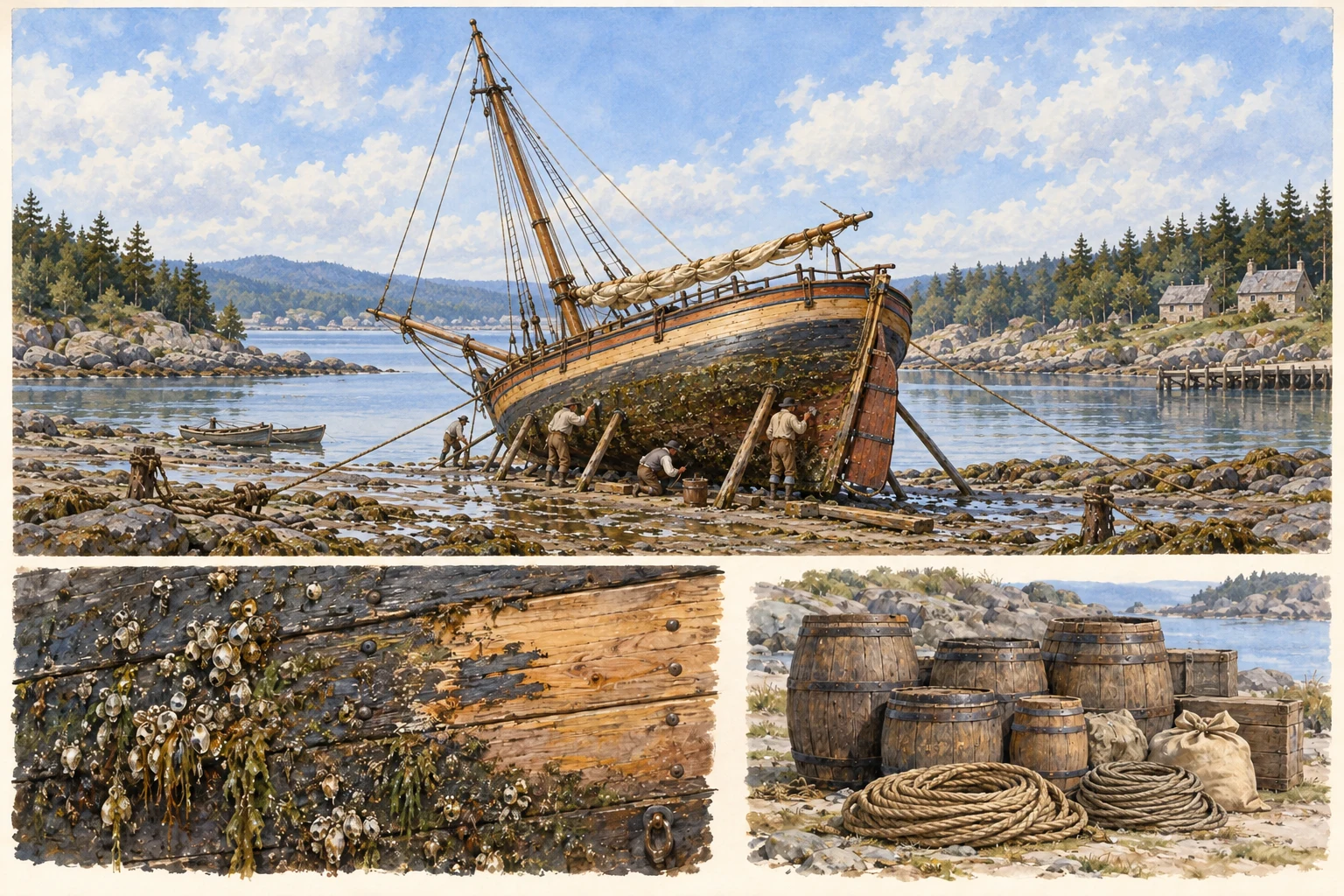 See the details.Careening: the work that made a ship vulnerableExplore the illustrated guide