
The inaccessible part of a working vessel
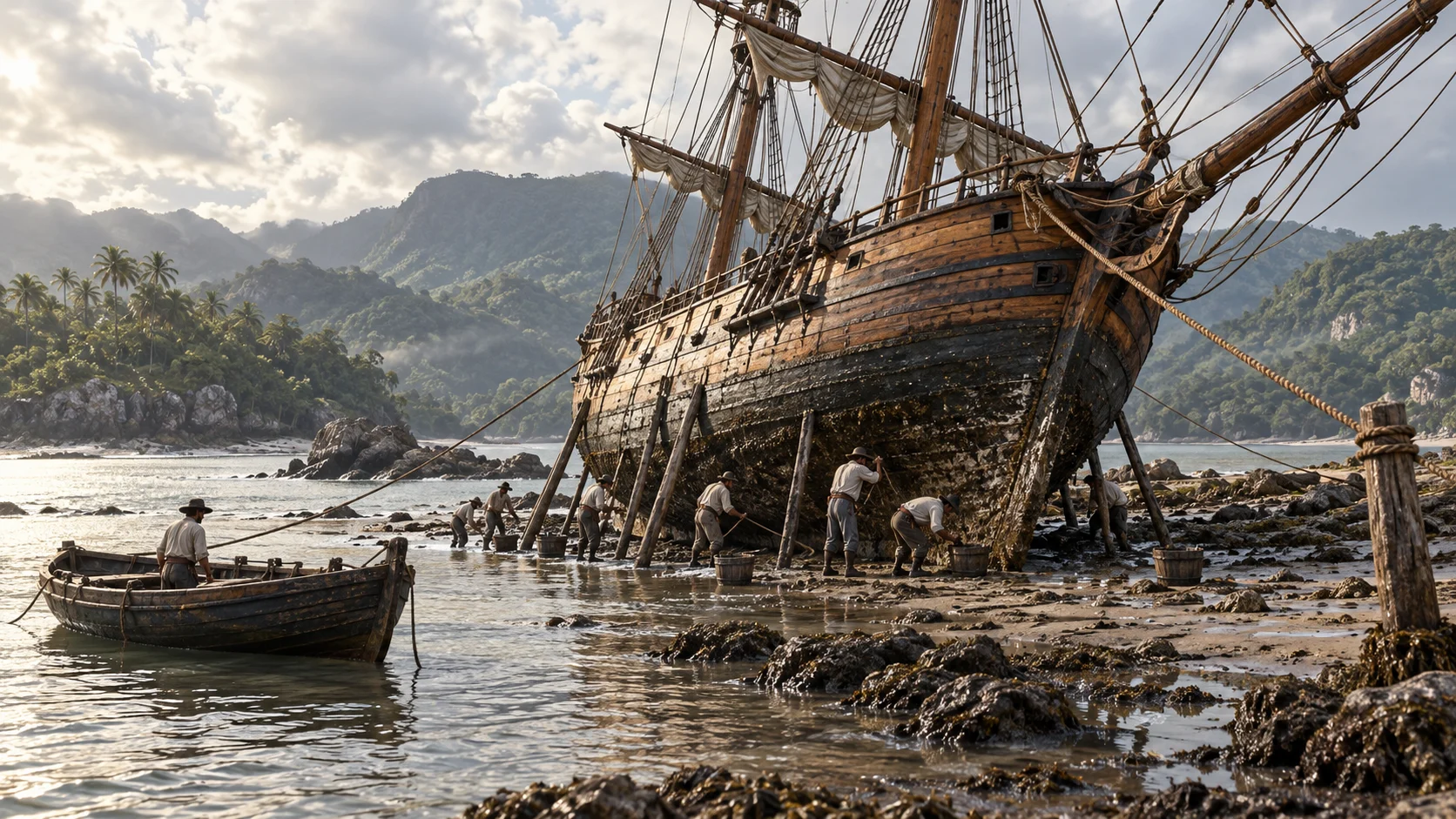
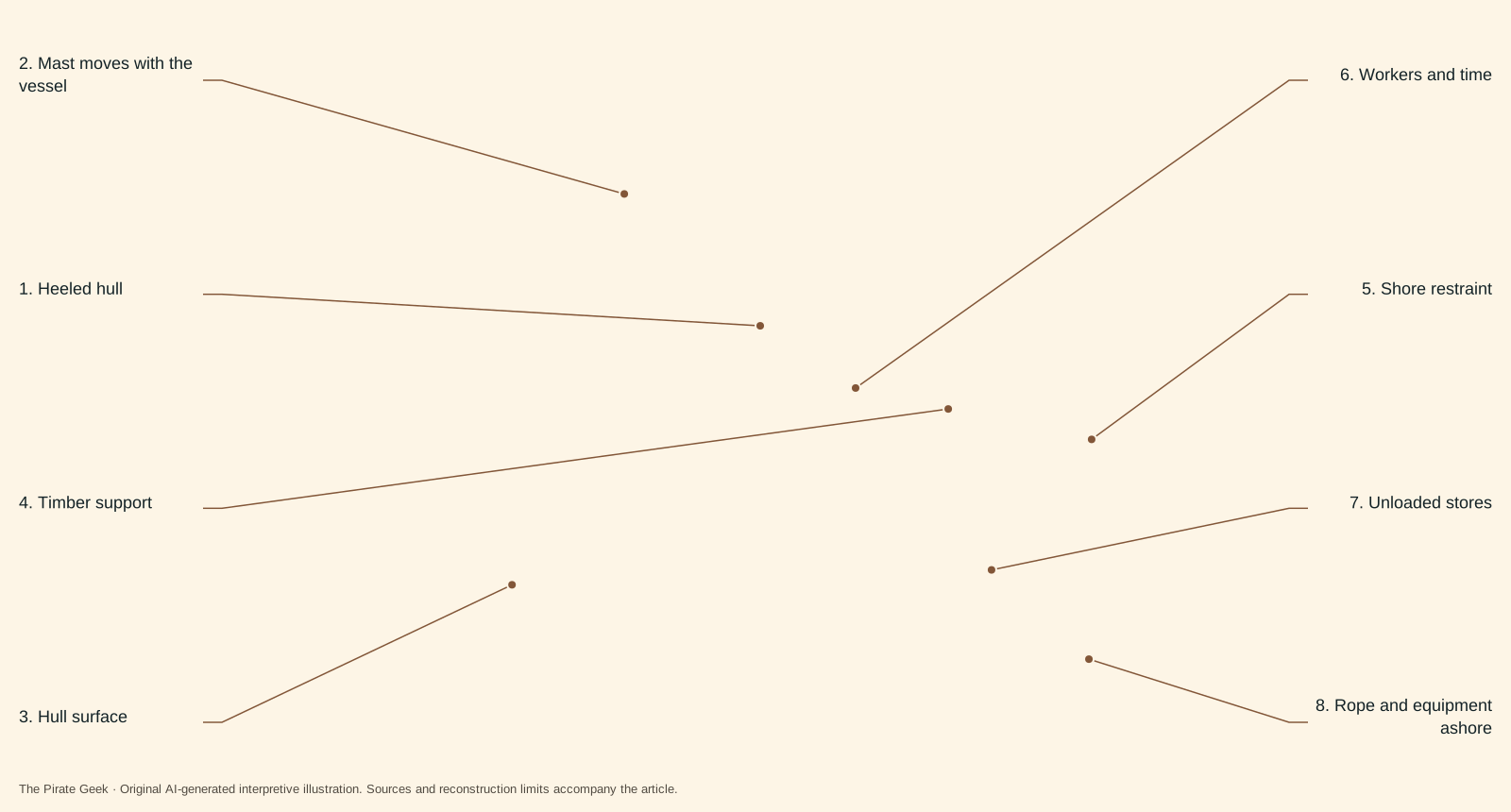
The bottom of a floating hull is difficult to reach for inspection and maintenance. Careening changed the vessel’s position to make part of that surface accessible. Falconer’s 1769 definition describes heaving a ship onto one side so the opposite bottom could be cleaned. [1]
The definition explains the purpose. It does not prove that every earlier company used identical equipment or the same shore arrangement. A detailed reconstruction needs evidence for the vessel, site and date, rather than a generic diagram labeled as an actual event.
The fouling-and-planking study explains why underwater maintenance mattered. It is an interpretation of a task, not a claim about the exact organisms on one historical hull.
William Falconer · John SmithThe job extended beyond the hull
A vessel being prepared for work could have guns, stores and other material removed or shifted. The operation therefore created a working area and a material problem ashore as well as a maintenance problem afloat. In the Anstis narrative, those preparations are explicit at Tobago. [2]
People had to keep track of what had been removed and how the vessel would be restored to service. Cleaning the bottom was not the last task if essential equipment still lay ashore.
Stores, tackle and people had to be managed together. The later dictionary gives terminology; the article keeps that separate from the earlier reported Lowther episode.
William Falconer · Published under the name Captain Charles JohnsonA suitable place had several requirements
The company needed access to the part of the hull being worked on, the labor and material to carry out the work, and a prospect of remaining long enough to finish. A sheltered-looking coast did not automatically satisfy every requirement.
Smith’s discussion of the carpenter and of vessel condition helps explain why a repair could not be reduced to a captain ordering everyone to leave sooner. Damage and access imposed practical limits. The delay at Cape Fear in Bonnet’s story makes those limits concrete. [3][2]
Surprise was especially disruptive
At Tobago, the arrival of Winchelsea interrupted the work on a captured ship. The account describes burning, escape and men hiding ashore. Lowther’s company also suffered an attack while its vessel was on the careen at Blanco. These are two reported episodes, not a rule that maintenance always ended disastrously. [2]
The recurring connection is loss of readiness. A ship in service, a ship temporarily heeled and a boat carrying stores did not offer the same choices when an opponent appeared.
Read the aftermath as well as the interruption
Not everyone in a scattered company had the same fate. Some escaped aboard another vessel, some were captured and others remained ashore. A headline about the captain’s escape can conceal the loss of equipment and the people left behind. [2]
Follow the Tobago case in sequence, Lowther’s career and the carpenter’s work. Careening becomes an explanation of mobility, labor and risk rather than a picturesque beach scene.
Questions, answered.
Is careening the same as building a new ship?
No. It is a way of gaining access to parts of an existing hull for cleaning or work.
Did every pirate company use a permanent secret careening island?
The cited cases do not establish that. Identify the actual company, place and maintenance episode rather than inventing a universal hidden base.
Sources & reading notes
Source checks distinguish an artifact, a reported account and a modern interpretation. They do not constitute independent historian review.
- An Universal Dictionary of the Marine (1769)William Falconer; Project Gutenberg transcription · Eighteenth-century technical dictionary; public domain in the USA
Headwords “Careening” and “Breaming,”1769 terminology comparison; do not apply every later technical detail to an earlier wreck. Published 1769, later than most events in this chapter. Used as a dated terminology comparison, not proof that an earlier pirate carried a particular instrument or followed later naval regulations.
- A General History of the Pyrates (1724)Published under the name Captain Charles Johnson · Early printed account; public-domain text
Chapter X, Tobago and Anstis’s company; Chapter XII, Lowther at Blanco; Chapter IV, Bonnet’s extended Cape Fear repairs. Authorship is disputed. A near-contemporary compilation, not a surviving signed pirate code or a neutral transcript. Cite its claims as reported claims.
- A Sea Grammar (1627)Open the keyboarded source transcriptionJohn Smith; Early English Books Online / Text Creation Partnership · Seventeenth-century seafaring manual; TCP transcription released under CC0
Chapters VIII and XI, repair responsibilities and vessel condition. A prescriptive manual from 1627, not the operating rules of every merchant, naval or pirate vessel. The TCP text preserves gaps and transcription uncertainty. Modernized explanations here do not reproduce its period medical or physical theories as current advice.