
The expedition began with a dispute ashore
French authorities in Hispaniola faced conflicting pressures: discourage unauthorized attacks while retaining men they might want in a future war. Haring places the Campeche expedition amid these negotiations and records the governor trying to dissuade its leaders. [1]
The fact that a company departed from a French base does not by itself settle whether every part of its operation complied with royal instructions.
Île-à-Vache was a place to combine forces
Grammont and de Graff assembled their companies at the island off Hispaniola before sailing toward Yucatán. The rendezvous linked separate vessels to a common project. Haring’s reported manpower is a contemporary-history estimate rather than a surviving complete muster. [1]
A gathering point supplied time to coordinate intentions as well as a place to anchor. A large raid had to be made from smaller working companies.
Mérida and Campeche had different outcomes
The attempted move against Mérida was frustrated. Campeche, on the coast, was occupied, and Haring reports the invaders remaining for six weeks. [1]
That difference prevents the episode being flattened into a single arrow labeled “conquest of Yucatán.” Entering one town did not establish permanent control of a region or erase resistance elsewhere.
Destruction was part of the departure
The account describes the destruction of the town and fortifications before the raiders left. Haring also repeats Charlevoix’s story of a huge celebratory fire fueled with valuable logwood, while identifying the narrative source. [1]
The destruction and the striking anecdote require different treatment. The latter is not an audited statement of exactly how much wood was burned or what it would fetch in a modern market.
The consequences reached back to Hispaniola
Haring connects the attacks at Campeche and Veracruz, alongside Pacific raiding, to renewed hostility between Spanish and French communities. The return of a successful company could create new dangers for its base. [1]
Continue with the logwood dispute, Île-à-Vache and the separate Veracruz campaign. The wider story concerns trade, neighboring settlements and state policy as well as the captains’ proceeds.
Questions, answered.
Was this the same raid as Veracruz in 1683?
No. Campeche was a separate campaign in 1685.
Does an occupation prove the raiders established a permanent colony there?
No. The account describes a raid, occupation and destructive withdrawal.
Sources & reading notes
Source checks distinguish an artifact, a reported account and a modern interpretation. They do not constitute independent historian review.
- The Buccaneers in the West Indies in the XVII Century (1910)Clarence Henry Haring; Project Gutenberg transcription · Early twentieth-century historical study; public domain in the USA
Chapter VII, pp.244–247, note 452 and following. Haring reports a six-week occupation. The spectacular logwood-bonfire story is explicitly attributed to Charlevoix and is not treated as an audited inventory. An older secondary study drawing on colonial records and earlier narratives. Its imperial framing, racial generalizations and claims about national character are not adopted as fact. Not a substitute for current scholarship.
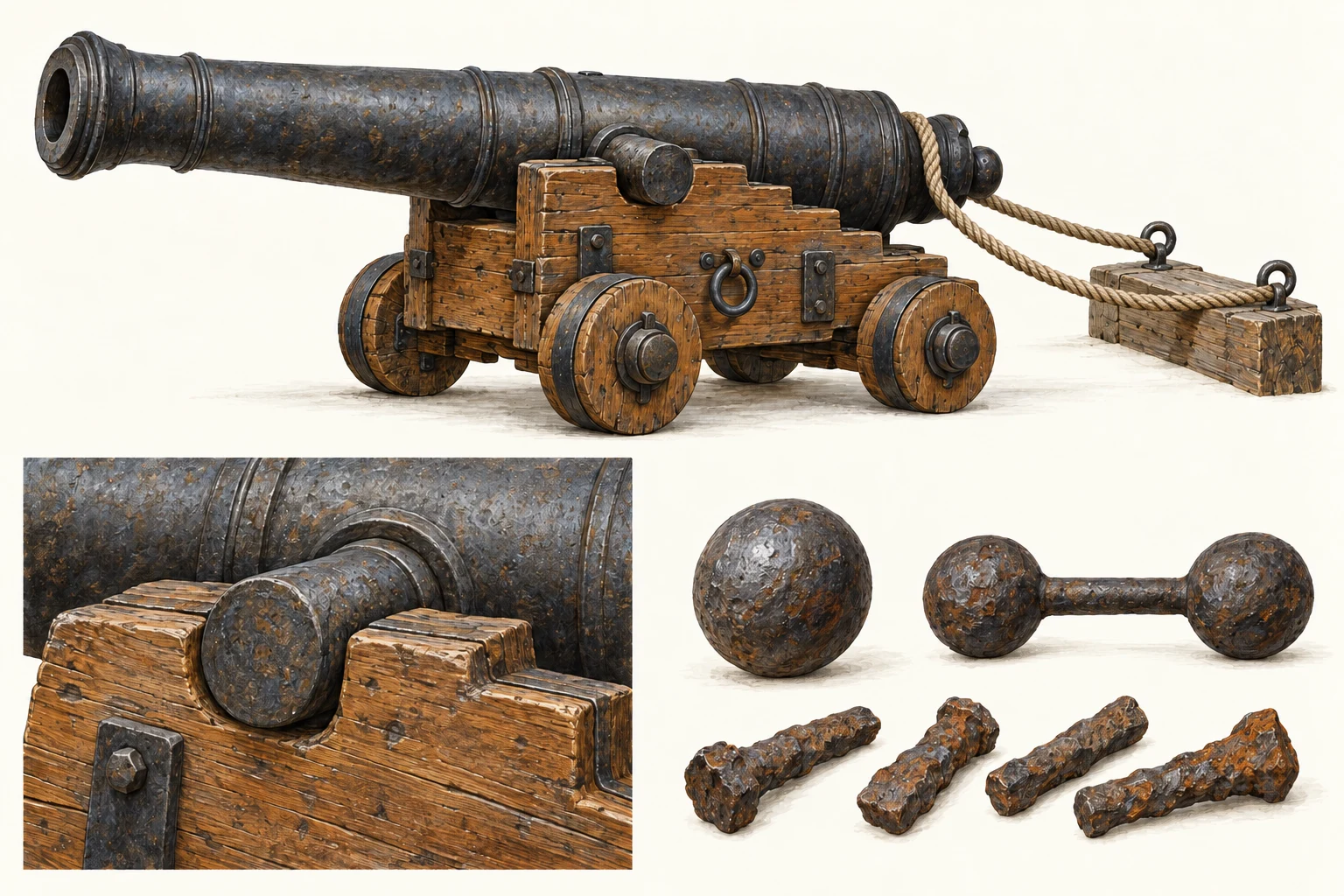 See the details.Cannon, shot and the meaning of a pounder.Explore the illustrated guide