
A split produced two different routes home
After disagreements over the Pacific cruise, some men chose to leave Sharp’s ship. Dampier places the separation on 17 April 1681 near the Isle of Plata. Ringrose describes the same division from the side of the people who stayed. [1][2]
“The return” therefore has to be specified. This party went toward the isthmus; the remaining company later made a long ocean passage around southern South America.
Their first craft were precarious
Dampier describes a launch and canoes, including one previously sawn apart and rejoined. A sea breeze made their low craft vulnerable, and the company improvised protection against water coming aboard. They subsequently captured a timber-carrying bark because their boats were too small for the passage. [1]
The party that wanted to avoid notice still took another vessel. Escape from the main company did not mean escape from coercive acts.
A familiar stop could be watched
At Gorgona the party found signs of a Spanish presence and heard that a canoe regularly checked the island for them. They cleaned the captured bark, filled water and left. The same place that had offered repairs could now expose their route. [1]
The episode shows why returning by a known path was not necessarily safer. Other people could anticipate the stops a ship needed.
The land crossing redistributed the burden
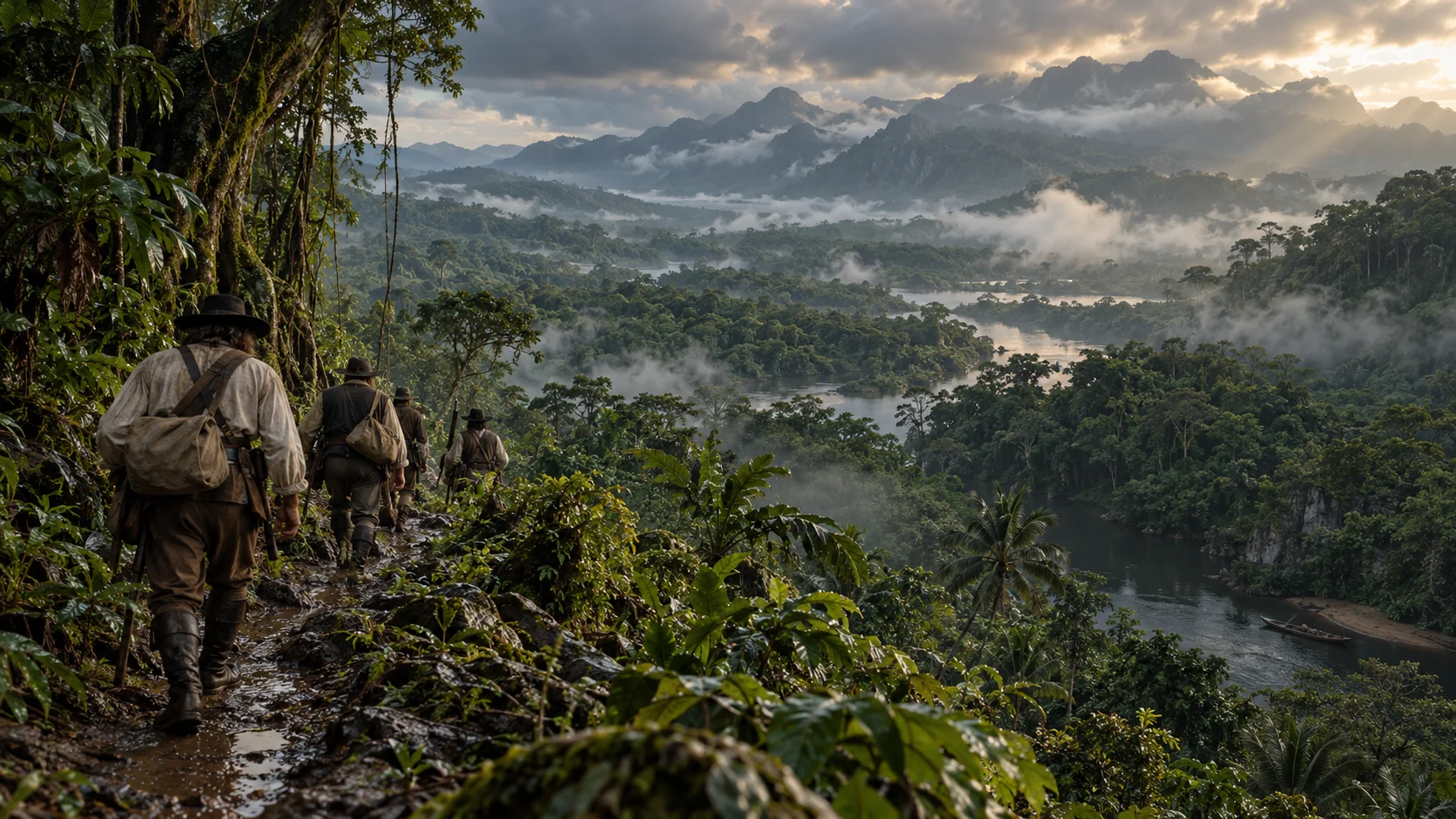
The party landed and used pocket compasses, guides and local supplies. Dampier’s account includes heavy rain, difficult fires and repeated movement through deep or rising rivers. Enslaved people carried provisions and equipment. [1]
The geographical crossing was also a social arrangement. The armed travelers’ ability to continue depended on people whose labor and choices were not equivalent to their own.
An injury threatened the whole party
A powder accident burned Wafer’s knee. Others lagged behind, and a rising river separated companions after an initial crossing. Dampier also describes protecting his journal and writings inside a sealed bamboo container. [1]
People, equipment and records did not face the same problem: paper could be enclosed, while an injured person needed assistance and a passable route. The detail makes the journey tangible without turning it into a modern survival manual.
Read both sides of the separation
Dampier explains why and how his party went back. Ringrose calls the departing men mutineers and follows the remaining ship. The difference in labels is evidence of the broken company, not a reason to choose one side’s language as a neutral description. [1][2]
Continue with Dampier, Wafer and the company that remained at sea. The outward crossing of 1680 was a separate operation.
Questions, answered.
Was this Morgan’s march to Panama?
No. Morgan’s expedition reached Panama in 1671. This was a return journey by another party in 1681.
Did all of Sharp’s company cross the isthmus together?
No. The company split. The people remaining aboard later returned by a different ocean route.
Sources & reading notes
Source checks distinguish an artifact, a reported account and a modern interpretation. They do not constitute independent historian review.
- A New Voyage Round the World (1697), with collected voyage textsOpen the keyboarded source transcriptionWilliam Dampier; James Knapton; EEBO–TCP transcription · Voyage writing and later collected parts; CC0 keyboarded transcription
Chapters I–II, separation near Plata, the captured timber bark, Gorgona, approach to the gulf, land march, guides, Wafer’s injury and bamboo container. Dampier writes as an involved traveler, not an impartial observer. His racial, colonial and medical judgments are not present-day facts. The catalogue describes a multi-volume set; individual parts and dates must be distinguished. Volume 3 is absent from this transcription.
- Bucaniers of America, the second volume (1685)Open the keyboarded source transcriptionBasil Ringrose; printed for William Crooke; EEBO–TCP transcription · Participant voyage narrative, published 1685; CC0 keyboarded transcription
Chapter XVIII, the separation on 17 April and Ringrose’s description of those who remained. The accounts’ participant counts and labels differ. The published journal is a mediated participant account. Its nationalist praise, judgments about peoples and claims about motives are not adopted as neutral fact. The XML marks damaged and missing text; page images are not the CC0 transcription.
 See the details.Cannon, shot and the meaning of a pounder.Explore the illustrated guide