
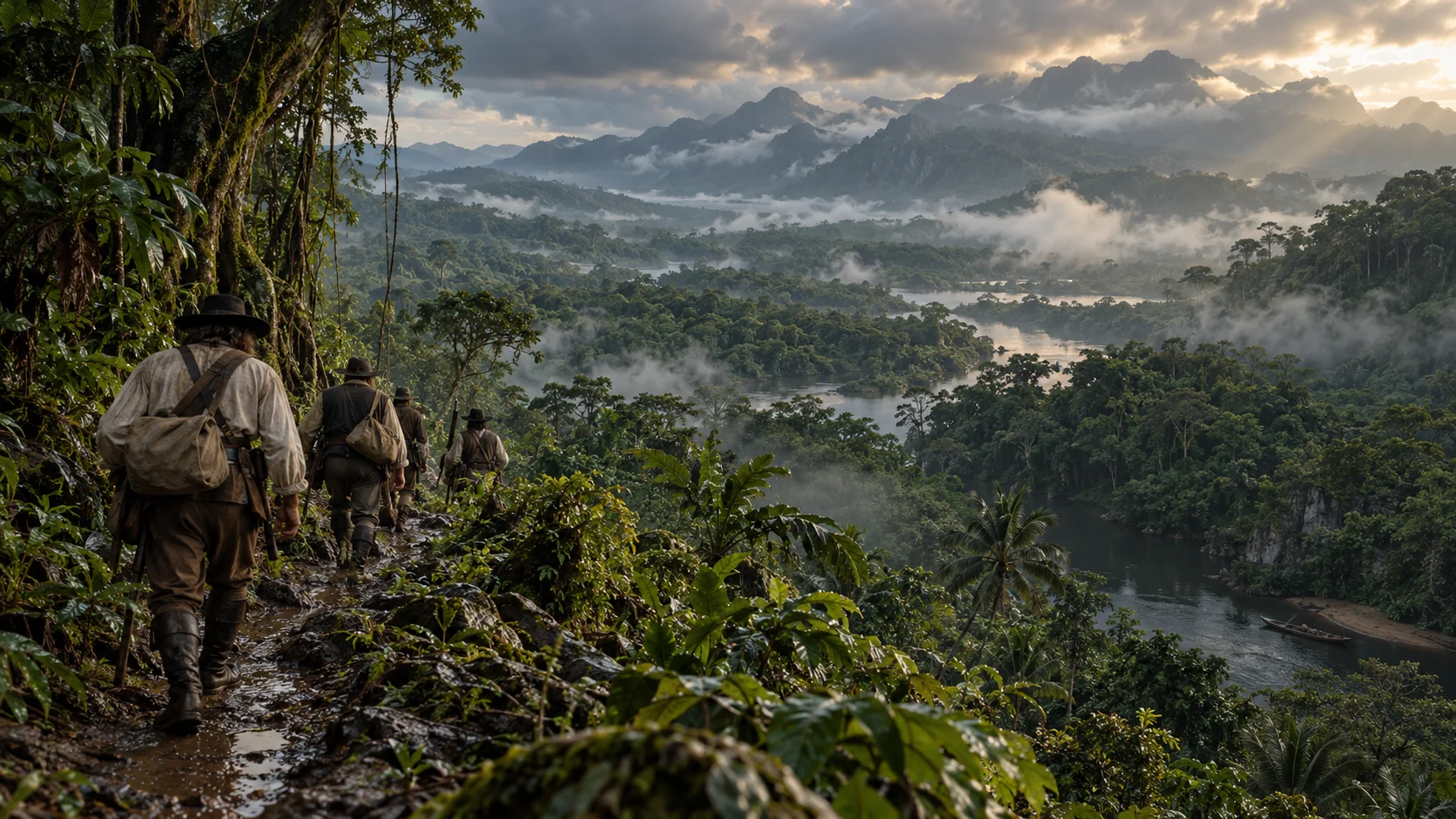
An agreement before the march
Burney describes arrangements at Golden Island, including men left to guard the vessels while the expedition went inland. The participants expected the absence to be limited. They also arranged for assistance and supplies from people in Darién. [1]
The sea and land parties belonged to one operation but faced different risks. Guarding the vessels was not an empty detail: those vessels represented equipment, a potential return route and the material left behind.
The country was not empty
The account names Indigenous allies and describes exchanges for provisions. Local knowledge helped make the journey possible. Those people had purposes of their own within the region’s conflicts; they were not simply anonymous guides waiting for Europeans to arrive. [1]
Burney’s text uses categories and political judgments of its period. Its references to people from Darién and to Miskito participants should not be flattened into one undifferentiated group. The expedition brought together people with different origins and relationships.
Water travel could be hard work too
The march alternated with movement in canoes. Burney describes obstacles that required boats to be worked across rocks, fallen timber or intervening ground. Taking to the river was not an automatic escape from fatigue. [1]
That detail changes how a route line should be imagined. On a small map, river travel can look smooth and continuous. The narrative instead shows repeated interruptions demanding labor and local skill.
The company’s direction remained contested
A quarrel between Coxon and Harris interrupted the journey, according to the account. After Santa María, the question of continuing toward the Pacific divided the participants again. Coxon and his followers considered returning; offering him the chief command helped persuade them to continue. [1]
The appointment thus served a coalition’s immediate need. It should not be read simply as a unanimous judgment that one man was the best possible commander. The title and the negotiation around it are both part of the evidence.
A crossing became a new maritime campaign
Once the expedition reached the Bay of Panama, captured vessels changed the company’s possibilities. Men moved from cramped canoes into prizes, and the operation developed beyond the journey originally imagined. [1]
The transition connects the land crossing to the later encounter in the bay. It also shows why a voyage’s geography cannot be understood only through the ship with which a participant eventually became famous.
Keep the two Panama stories distinct
Morgan’s 1671 campaign and this 1680 crossing involved different forces, routes and decisions. By 1680, the city itself also had a changed setting. Reusing a single map or battle summary for both would conceal those differences. [1]
Continue with the encounter in the bay, Coxon’s changing command and the earlier expedition.
Questions, answered.
Was this Morgan’s famous Panama attack?
No. The crossing described here belongs to 1680 and a different company. Morgan’s campaign reached Panama in 1671.
Did rivers remove the need for difficult overland work?
No. Burney describes interruptions and obstacles that required repeated effort with the canoes.
Sources & reading notes
Source checks distinguish an artifact, a reported account and a modern interpretation. They do not constitute independent historian review.
- History of the Buccaneers of America (1816)James Burney; Project Gutenberg transcription · Nineteenth-century historical compilation; public domain in the USA
Chapters on the journey across the isthmus and first South Sea expedition, printed pages 91–99, including the agreement at Golden Island, the march, Santa María and Coxon’s selection. Burney is an 1816 compiler of earlier narratives; his generalizations about Indigenous people are not adopted. Later than the events. Burney selects and compares earlier voyage narratives; his reconstruction is not an eyewitness record of every episode. Period ethnographic and colonial judgments require critical reading.
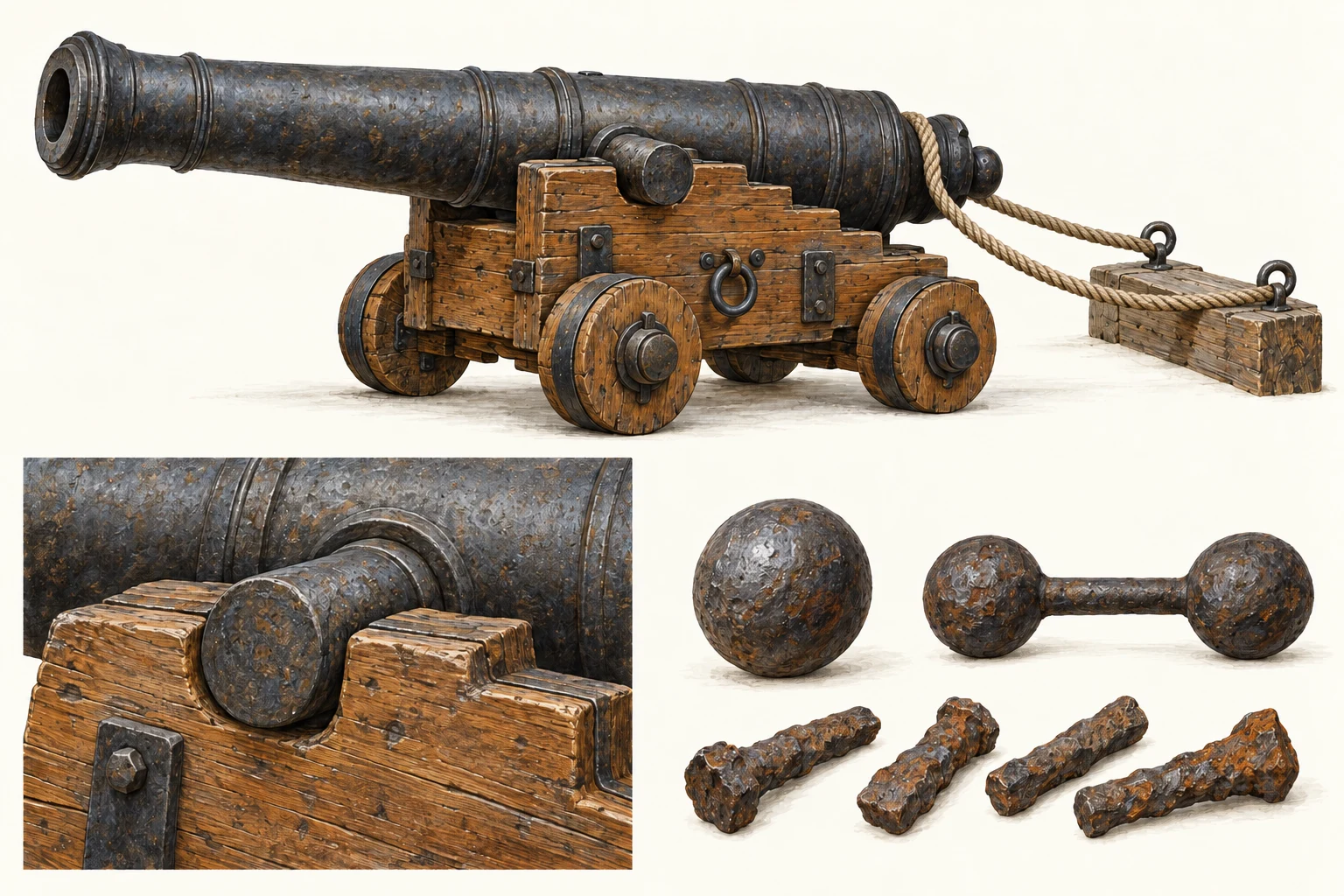 See the details.Cannon, shot and the meaning of a pounder.Explore the illustrated guide