

A large venture needed a reluctant coalition
French orders required Ducasse to gather buccaneers for an expedition organized by de Pointis with royal support and private capital. Keeping the men waiting at Hispaniola created friction before they sailed. [1]
The leaders did not share one understanding of command. The buccaneers expected to act as partners in a venture; de Pointis required subordination within his military expedition. That disagreement would later become a dispute about money.
A defended port required more than surprise
Cartagena’s harbor and fortifications made it a difficult target. Haring describes fighting and bombardment before the outworks fell, followed by the garrison’s departure in May. Some inhabitants and property had been moved inland before the surrender. [1]
The city was not simply an undefended chest waiting to be opened. Its defenses, warnings and evacuation efforts shaped both the attack and what the invaders found.
The arguments concerned the rules of distribution
Buccaneers expected a much larger part of the proceeds than de Pointis allotted under his published arrangement for the expedition. They were also excluded while his officers collected plunder. Ducasse protested on their behalf. [1]
The conflict was not settled by a universal pirate share table. Different participants believed different commitments governed the same venture, while the people whose property was being taken had no equal place in that negotiation.
The city suffered another attack
After the main fleet prepared to leave, buccaneers returned to Cartagena and extracted further property from inhabitants and religious establishments. Their grievance against a commander became additional violence against the city. [1]
The distinction between the initial siege and the subsequent sack is essential. A single date or total for “the capture” can hide separate decisions and another set of victims.
Returning with plunder was still hazardous
An allied fleet intercepted the departing buccaneers. Haring describes captures, ships driven ashore and others escaping to Hispaniola. Ducasse subsequently pursued compensation and recognition in France; promised distributions remained vulnerable to delay and diversion. [1]
Read how a share system worked and a different venture’s committees. Winning an engagement, possessing property and receiving a final dividend were distinct outcomes.
Questions, answered.
Did all the French participants agree on how the proceeds would be divided?
No. The dispute between the royal expedition’s terms and the buccaneers’ expectations was central to the aftermath.
Did every buccaneer vessel carry its gains safely home?
No. The account records interceptions, captures and losses on the return.
Sources & reading notes
Source checks distinguish an artifact, a reported account and a modern interpretation. They do not constitute independent historian review.
- The Buccaneers in the West Indies in the XVII Century (1910)Clarence Henry Haring; Project Gutenberg transcription · Early twentieth-century historical study; public domain in the USA
Chapter VII, pp.262–266, notes 516–527. Date sequence and disputed distributions follow Haring’s synthesis. Widely varying treasure estimates are deliberately not combined or converted into modern currency. An older secondary study drawing on colonial records and earlier narratives. Its imperial framing, racial generalizations and claims about national character are not adopted as fact. Not a substitute for current scholarship.
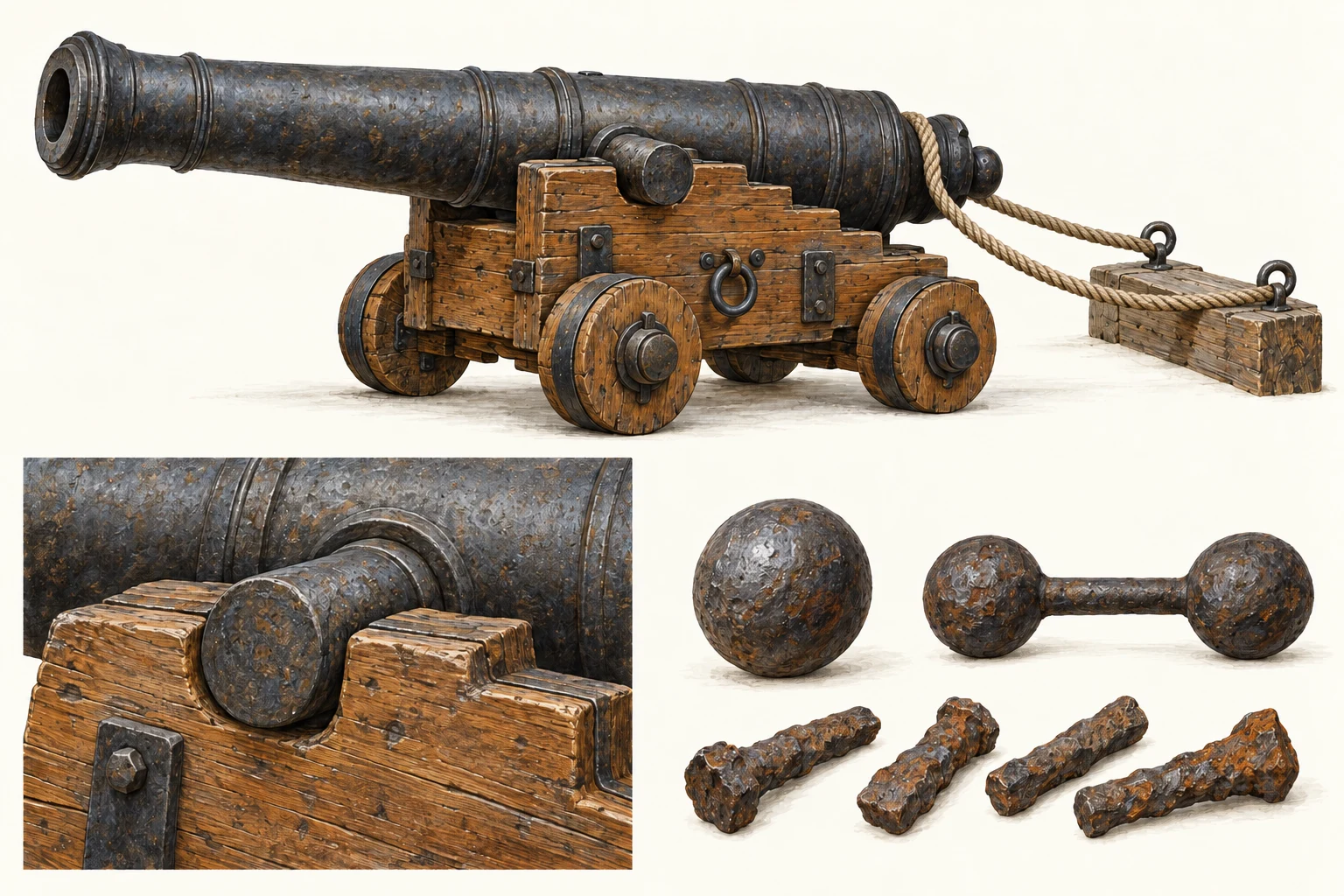 See the details.Cannon, shot and the meaning of a pounder.Explore the illustrated guide