
A campaign begins with a changed company
The loss of Oxford disrupted the gathering for Morgan’s next expedition. Haring describes a reduced force turning toward Maracaibo rather than proceeding with its earlier plan against Cartagena. The target was part of a changing situation, not a destination chosen by an all-powerful commander without constraints. [1]
Ships, people and supplies available at the moment helped determine what the company could attempt. A fleet list belongs to a date; it cannot simply be carried unchanged from one campaign into the next.
Shallow water shaped the entrance
Exquemelin describes the bar and the use of canoes and smaller boats when the larger vessels could not pass as readily. The attackers then encountered defenses and entered a town from which many inhabitants had fled. [2]
The movement between large and small craft is essential to the geography. A lake on a map can look like open access while its actual entrance controls which vessels can reach which places.
The campaign reached beyond one town
The company moved on toward Gibraltar and searched for people and property. The sources describe coercion against prisoners and inhabitants, followed by return toward Maracaibo with plunder and hostages. The raid was not a single brief visit to an empty port. [2][1]
Those movements also extended the company’s exposure. The farther it operated inside the system, the more important a secure way back to the Caribbean became.
An opponent explained his own intention
The English narrative reproduces a letter attributed to Don Alonso del Campo y Espinosa. It presents him as determined to dispute the passage and pursue the company, while offering terms involving surrender of captured property and people. His force was acting to contain the raiders, not merely waiting to become another prize. [2]
The letter is mediated by the publication in which it survives. Even so, including the opposing commander’s stated purpose makes the confrontation more intelligible than a story told only through Morgan’s ingenuity.
The naval encounter did not remove every barrier
The company used a fireship in the confrontation with the Spanish vessels. Haring’s reconstruction describes one ship burning, another destroyed by its own side and a third captured. The fort still mattered after that encounter; control of the vessels and control of the exit were not the same achievement. [2][1]
Negotiation and deception continued before the company got out. The sequence explains why a naval success did not automatically mean freedom of movement.
An escape returned the dispute to the wider Atlantic
Haring places the return to Port Royal in May 1669 and follows the diplomatic complaints and renewed uncertainty over commissions. The expedition’s consequences were carried home in goods, reputations and official correspondence. [1]
Compare Portobelo’s ransom, Panama’s overland approach and the vessel lost before the campaign. Different material constraints produced different histories, even under the same leader.
Questions, answered.
Did the Spanish ships and the fort create the same obstacle?
They were connected defenses, but defeating vessels did not by itself neutralize the fortified exit.
Was the expedition only a raid on Maracaibo itself?
No. The accounts include operations around the lake, notably toward Gibraltar, before the confrontation on the way out.
Sources & reading notes
Source checks distinguish an artifact, a reported account and a modern interpretation. They do not constitute independent historian review.
- The Buccaneers in the West Indies in the XVII Century (1910)Clarence Henry Haring; Project Gutenberg transcription · Early twentieth-century historical study; public domain in the USA
Morgan chapter, printed pages 155–159, for the 1669 sequence and the return to Jamaica. Precise plunder and casualty totals remain reported estimates. An older secondary study drawing on colonial records and earlier narratives. Its imperial framing, racial generalizations and claims about national character are not adopted as fact. Not a substitute for current scholarship.
- Bucaniers of America (1684 English edition)Open the keyboarded source transcriptionAlexandre Olivier Exquemelin; printed for William Crooke; EEBO/TCP transcription · Early English translation through a Spanish version; TCP transcription released under CC0
Part II, Chapter VII, from preparations after the loss of Oxford through Maracaibo, Gibraltar, Don Alonso’s letter, the naval confrontation and withdrawal. This 1684 English edition is not the 1678 Dutch original. Translation, selection, authorial position and transcription gaps remain part of the evidence. Attribution to a participant does not make every anecdote independently verified.
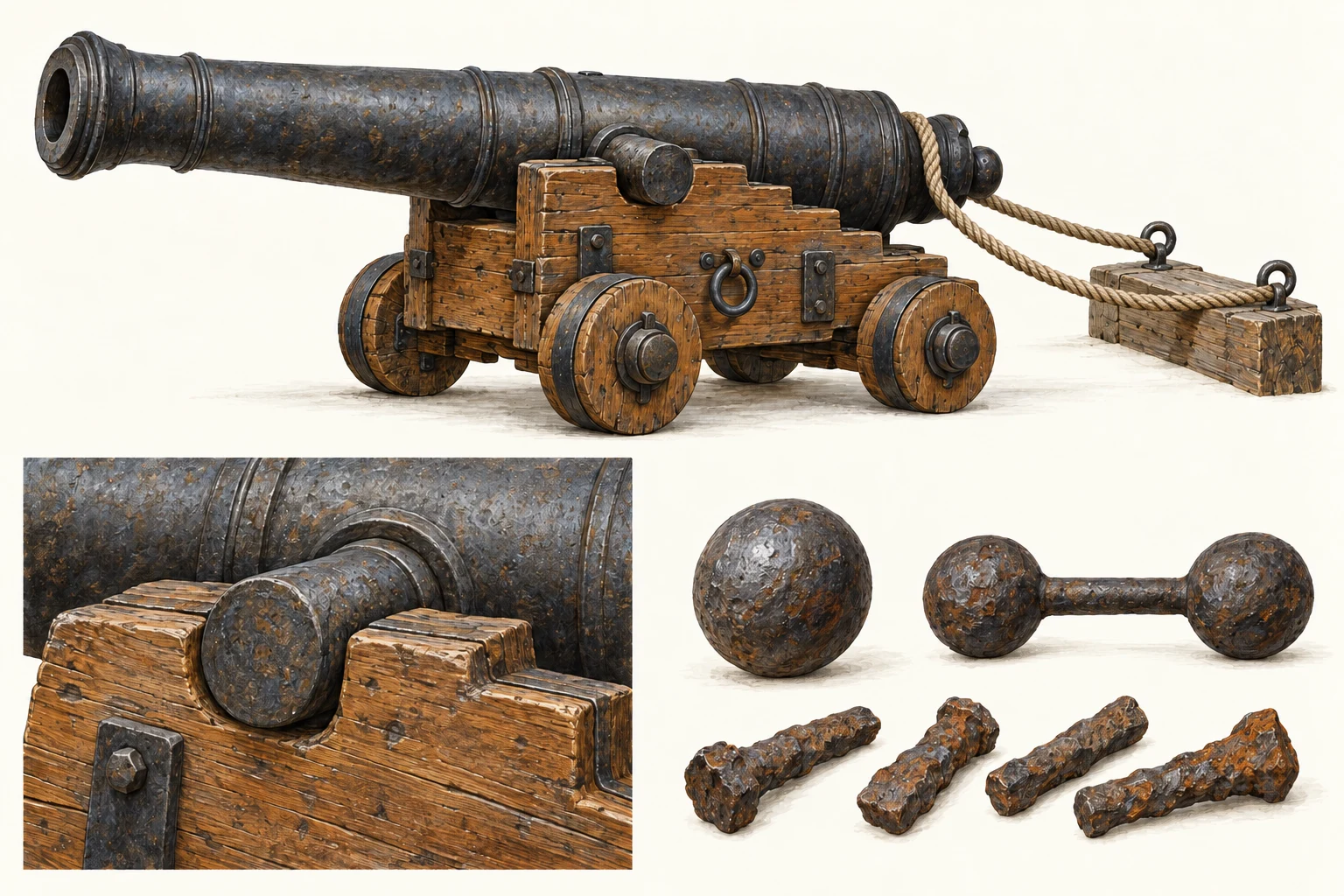 See the details.Cannon, shot and the meaning of a pounder.Explore the illustrated guide