
Arrival did not mean the whole company stayed together
In Burney’s reconstruction, the buccaneers captured small vessels after reaching the bay. Some men moved into them, while others sought water and provisions. The company was already distributed when it approached the area around Panama. [1]
That is important when reading a head count. The number who crossed the isthmus, the number remaining in a party and the number taking part in a particular fight are not automatically the same.
The defenders assembled what they could
The account describes Spanish vessels being equipped with men drawn from shipping and ashore. They went out to meet the buccaneers, rather than leaving the arrivals to take prizes without opposition. [1]
Burney’s language about different groups among the defenders reflects the prejudices of his period. The modern explanatory point is the mobilization of a mixed maritime and local force, not a hierarchy of racial courage or competence.
The action was costly
Burney describes a severe encounter ending with two Spanish vessels taken and another escaping. Peter Harris was wounded and subsequently died. Richard Sawkins receives particular attention for his part in boarding. These outcomes give several people a place in the story beyond the commander’s title. [1]
The sequence should not become a claim that small craft always defeated larger vessels. Conditions, distribution of people and the particular encounter mattered. An outcome is not a universal tactical law.
The source itself exposes a numerical problem
One account quoted by Burney gives 68 buccaneers engaged. Another describes no more than 200 in the canoes, explaining that men had been sent away in a prize. Rather than hiding the difference, Burney places the reports beside one another. [1]
The responsible result is a range of reported claims with their explanations. Taking the smaller number for a dramatic headline and the larger one for a convenient reconstruction would create a certainty the evidence does not possess.
The prizes changed the expedition
Near the city, the company took shipping including the vessel called Trinidad in Burney’s account. The captured hulls and cargoes offered transport and resources after the strain of the crossing. The campaign could continue in a different material form. [1]
Panama was also a changed city compared with the place attacked by Morgan. Burney distinguishes the new settlement from the old ruins. A later voyage map should not simply reuse the earlier city’s location and plan.
Command changed again
Coxon and a group of followers returned toward the Caribbean after disagreement. Sawkins was then selected as chief commander. The political community that had crossed Darién was not fixed for the rest of the voyage. [1]
Continue with Coxon’s choices, Sharp and the continuing Pacific voyage and the crossing that made the encounter possible.
Questions, answered.
Is one exact number of buccaneers established for the fight?
No. Burney preserves accounts with different figures and explanations. The total should remain attributed and qualified.
Did the same commander lead every later stage?
No. The account describes departures and new choices of command as the expedition continued.
Sources & reading notes
Source checks distinguish an artifact, a reported account and a modern interpretation. They do not constitute independent historian review.
- History of the Buccaneers of America (1816)James Burney; Project Gutenberg transcription · Nineteenth-century historical compilation; public domain in the USA
First South Sea expedition, printed pages 98–102: approach, Spanish armament, different buccaneer counts, Peter Harris, Richard Sawkins, captured Trinidad and Coxon’s departure. The figures are reported claims, not an independently reconstructed casualty or strength return. Later than the events. Burney selects and compares earlier voyage narratives; his reconstruction is not an eyewitness record of every episode. Period ethnographic and colonial judgments require critical reading.
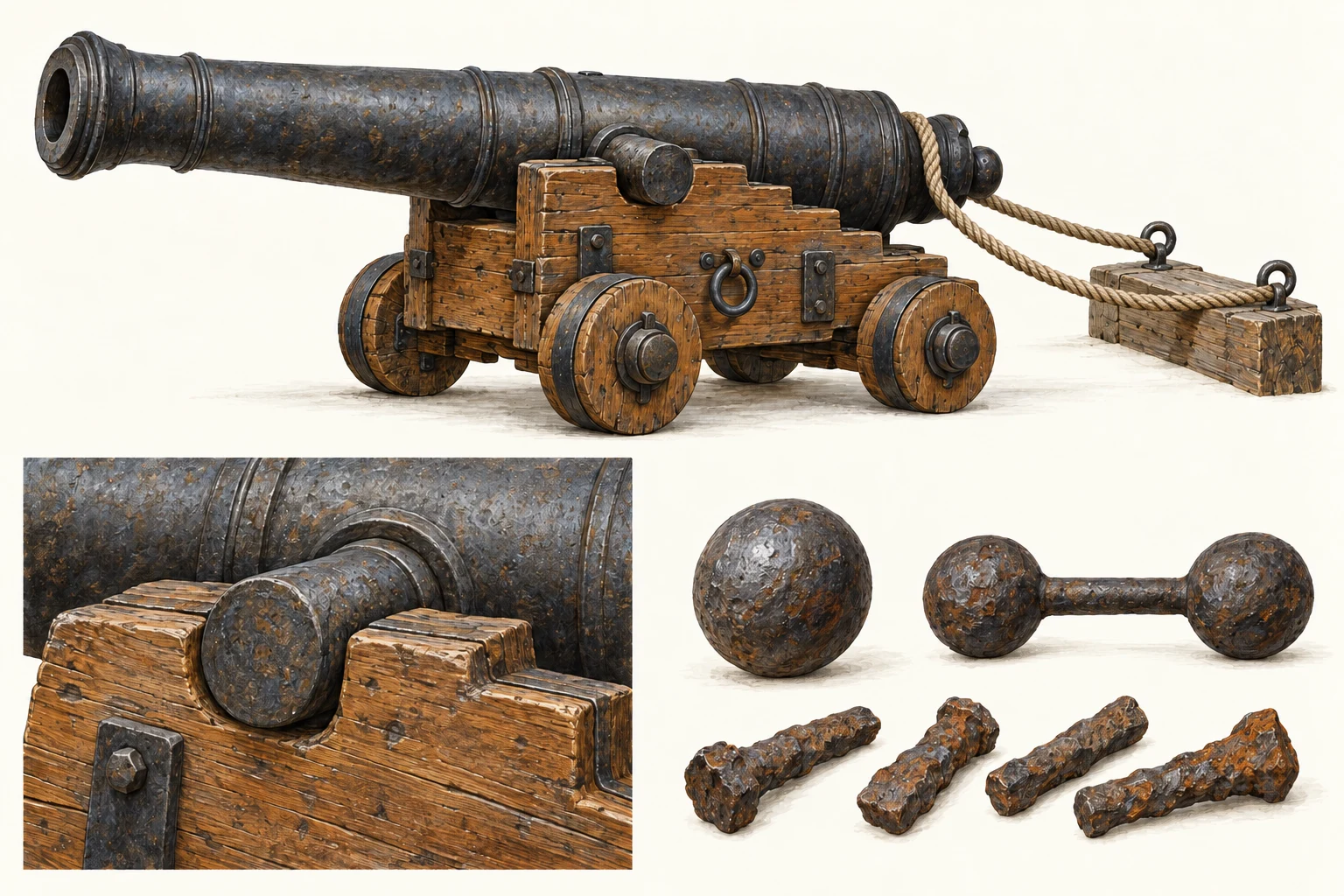 See the details.Cannon, shot and the meaning of a pounder.Explore the illustrated guide