
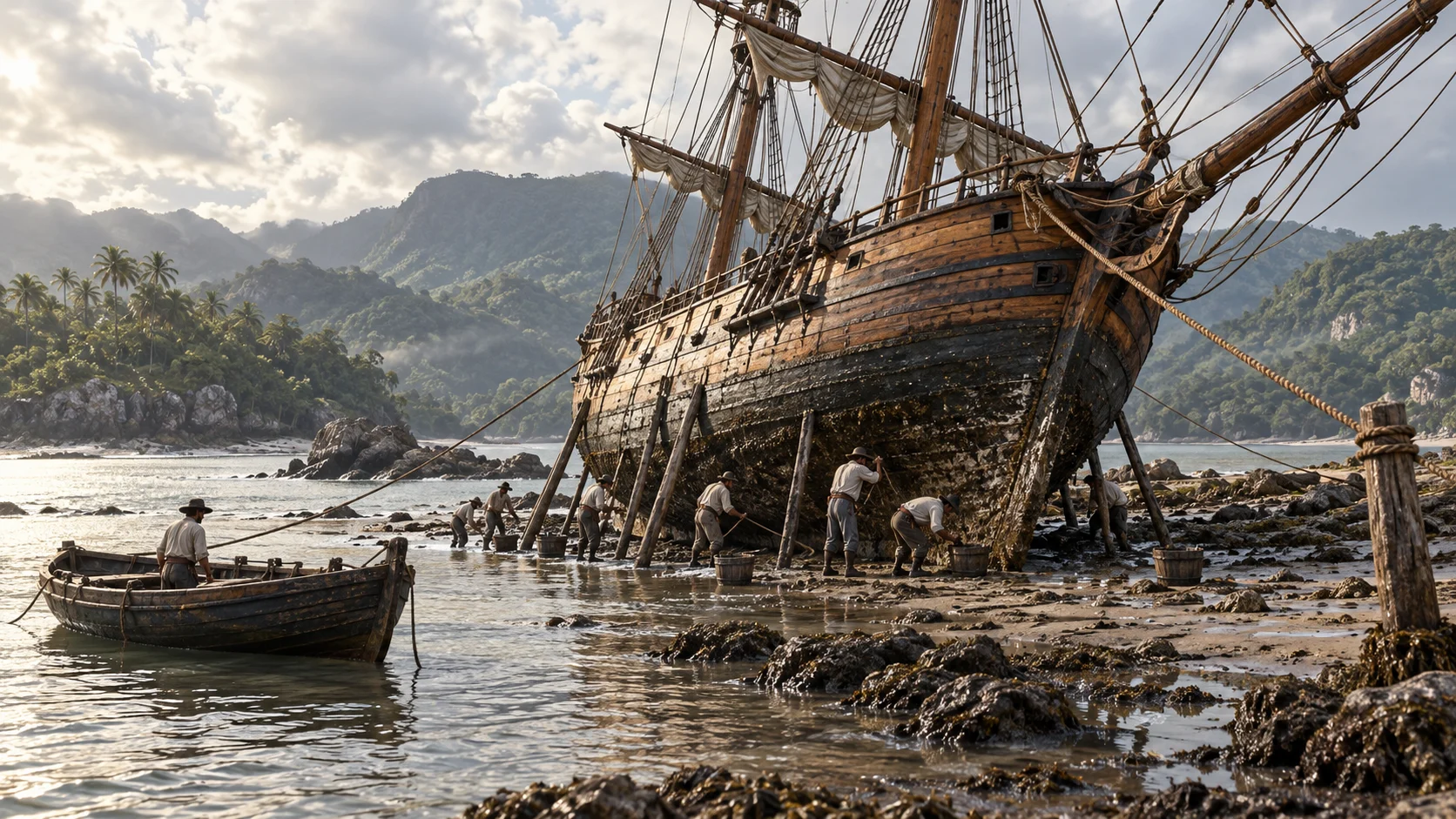
A stock of food began with someone’s work
Dampier describes fish, turtle and manatee coming aboard through the work of skilled people using small craft. Food did not simply appear whenever a captain decided to refresh the crew. Someone had to know where to look and how to work in those waters. [1]
The labor belongs alongside a cooper maintaining casks or a sailmaker repairing canvas: it made the next passage possible.
The best repair stop also needed provisions
In his account of Miskito specialists, Dampier says companies chose careening places partly because turtle or manatee could be obtained there. [1]
A shore that offered convenient access to the hull might still be unsuitable if it could not sustain the men during the work. Repair, fresh water and food were connected decisions rather than separate items on an ideal checklist.
A small canoe could carry specialized authority
Dampier describes specialists keeping their own canoes and managing their own work. He also records English sailors accommodating their preferences because their skill mattered. [1]
The passage is written from a European sailor’s perspective, but it still shows expertise producing some bargaining power. Rank aboard the main ship did not mean every officer knew how to perform the essential task.
Provisioning could also be coercive
Exquemelin’s narrative describes raiders taking turtle fishermen and making them work. That is a different relationship from Dampier’s account of valued associates choosing how to operate. [2]
Both must remain in view. A general statement that pirates “lived on turtle” can hide whether the people obtaining it were participants, captives or inhabitants being threatened.
Read the historical ecology without turning it into advice
These accounts concern particular voyages and the exploitation of marine animals in an earlier world. They are not a statement about present conservation status, legal harvesting rights or safe preparation.
Continue with Miskito seamen, shipboard food and water and careening. The useful explanation connects a meal to a place, a worker and a relationship of power.
Questions, answered.
Was every person supplying turtle a willing member of the crew?
No. The narratives describe different relationships, including forced labor.
Did provisioning affect the choice of a repair stop?
Dampier explicitly links the choice of careening places to available marine food and the specialists obtaining it.
Sources & reading notes
Source checks distinguish an artifact, a reported account and a modern interpretation. They do not constitute independent historian review.
- A New Voyage Round the World (1697), with collected voyage textsOpen the keyboarded source transcriptionWilliam Dampier; James Knapton; EEBO–TCP transcription · Voyage writing and later collected parts; CC0 keyboarded transcription
Volume I,Chapter I, the Miskito account;Chapter III, small canoes, provisioning places and strikers. Dampier’s claims about how many men one specialist could feed are praise in a travel narrative, not measured production statistics. Dampier writes as an involved traveler, not an impartial observer. His racial, colonial and medical judgments are not present-day facts. The catalogue describes a multi-volume set; individual parts and dates must be distinguished. Volume 3 is absent from this transcription.
- Bucaniers of America (1684 English edition)Open the keyboarded source transcriptionAlexandre Olivier Exquemelin; printed for William Crooke; EEBO/TCP transcription · Early English translation through a Spanish version; TCP transcription released under CC0
Part I,Chapter VII, provisioning and the coercion of turtle fishermen. Historical practices are described, not recommended as modern hunting or dietary advice. This 1684 English edition is not the 1678 Dutch original. Translation, selection, authorial position and transcription gaps remain part of the evidence. Attribution to a participant does not make every anecdote independently verified.
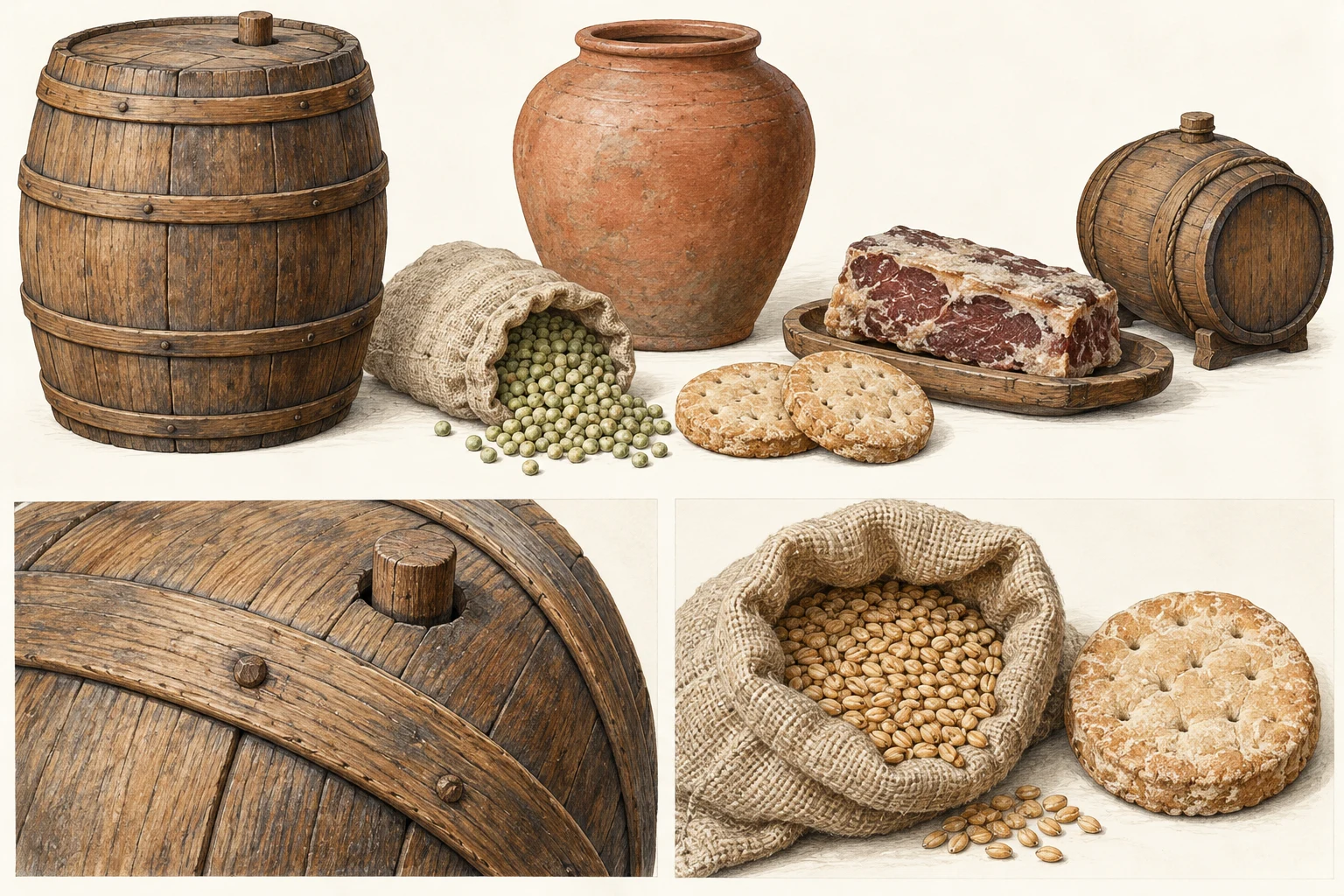 See the details.What did pirates eat and drink?Explore the illustrated guide