
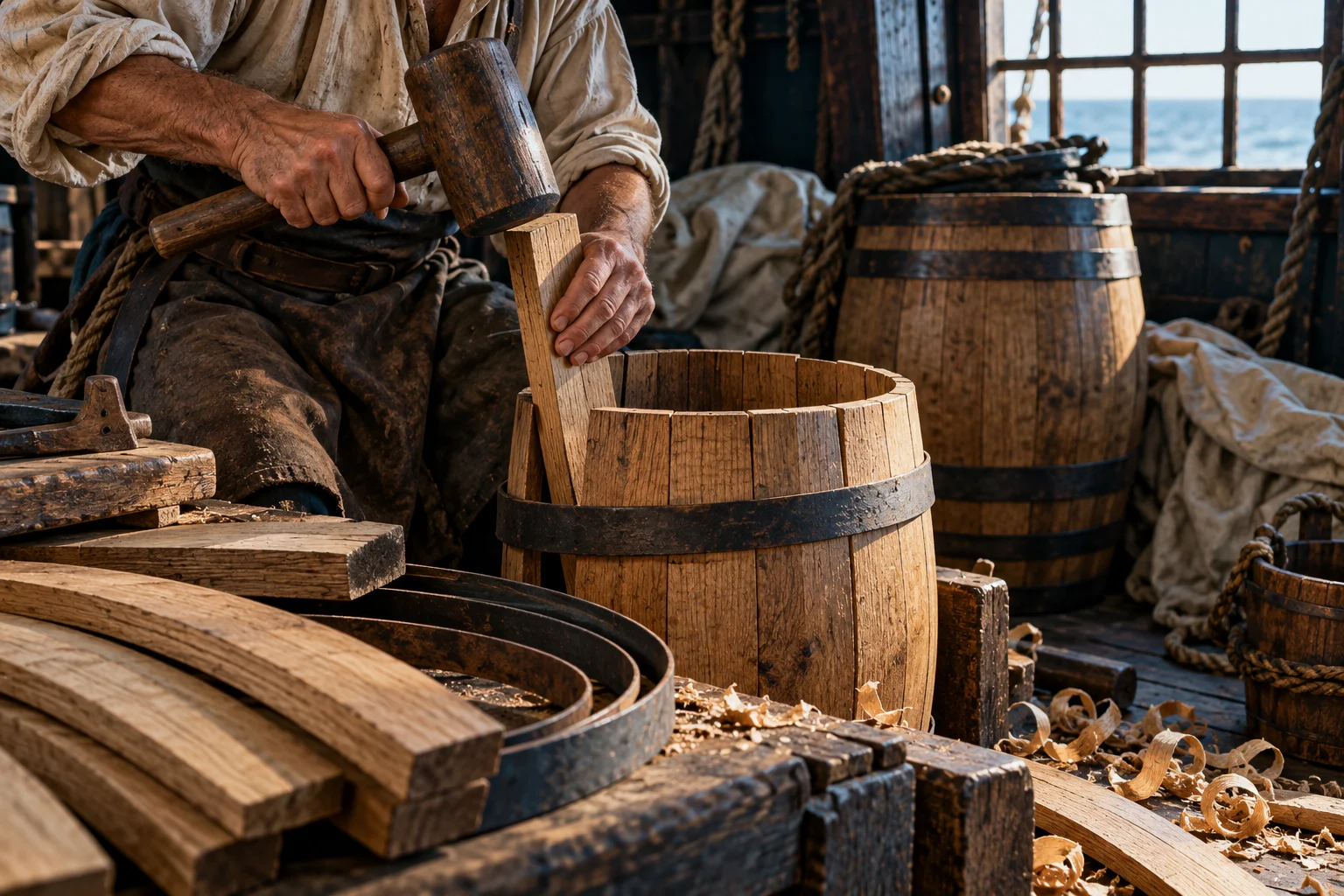
Think container, not barrel decoration
In a familiar pirate image, a barrel often acts as background furniture. In Smith’s manual, the cooper’s responsibility is much more specific: casks, hoops and an assortment of containers used for water and other liquids. A container’s condition determined whether its contents remained available to the company. [1]
Holding a quantity, carrying it, stowing it and issuing it are related tasks, but they are not identical. The cooper’s work connects the first two especially closely. A supply that leaks away cannot be recovered merely by writing a larger amount in an inventory.
Many names, several kinds of work
Smith lists buckets, baricos, cans, steep tubs, runlets, hogsheads, pipes and butts. The point is not to memorize every name as a universal standardized size. His list shows a range of vessels serving different purposes around the ship. [1]
| Question | What it can reveal |
|---|---|
| What was it intended to hold? | The demands placed on its construction and condition |
| How was it handled? | The labor and equipment needed to move or empty it |
| Which source defines its name? | Whether a claimed capacity is appropriate to that place and period |
| Was it full at the relevant moment? | Whether the container represents an actual usable supply |
Repair belonged to the job
The manual tells the cooper to look to containers and repair them. He was not simply the person who received a finished stock at the beginning of the voyage. Casks experienced handling and needed continued attention. [1]
The need for repair helps explain why a specialist was valuable aboard a working vessel. A long passage separated the company from workshops ashore. Keeping existing containers useful could matter as much as having brought enough in the first place.
Cooper, steward and cook were connected
Smith distinguishes the cooper from the steward who issued victuals and the cook who prepared and delivered them. These jobs form a chain: a supply must remain in its container, be accounted for and distributed, then be made available in a form people can use. [1]
A shortage could arise at more than one stage. That is why a simple list of foods aboard does not fully explain provisioning. The company also needed a working organization around the material.
A specialist within a coerced company
The reported proceedings after Roberts’s defeat name skilled workers, including a cooper. Such references help recover people who are easily lost in captain-centered stories. They do not by themselves establish that each specialist joined willingly or had the same share arrangement. [2]
Continue with the evidence for food and drink, issuing and preparing provisions and the question of consent aboard.
Questions, answered.
Was a cooper a cook?
No. The source distinguishes maintaining containers from issuing and preparing their contents.
Did “hogshead” always mean one exact capacity?
A historical label needs a place, period and commodity before a precise capacity is assigned. This guide does not impose a single modern conversion on Smith’s whole list.
Sources & reading notes
Source checks distinguish an artifact, a reported account and a modern interpretation. They do not constitute independent historian review.
- A Sea Grammar (1627)Open the keyboarded source transcriptionJohn Smith; Early English Books Online / Text Creation Partnership · Seventeenth-century seafaring manual; TCP transcription released under CC0
Chapter VIII, “The Cooper and his Mate,” alongside the steward and cook; Chapter XV on provisioning and the practical limits of resupply. A prescriptive manual from 1627, not the operating rules of every merchant, naval or pirate vessel. The TCP text preserves gaps and transcription uncertainty. Modernized explanations here do not reproduce its period medical or physical theories as current advice.
- A General History of the Pyrates (1724)Published under the name Captain Charles Johnson · Early printed account; public-domain text
Chapter IX, Cape Coast proceedings naming a cooper among specialist workers. Authorship is disputed. A near-contemporary compilation, not a surviving signed pirate code or a neutral transcript. Cite its claims as reported claims.
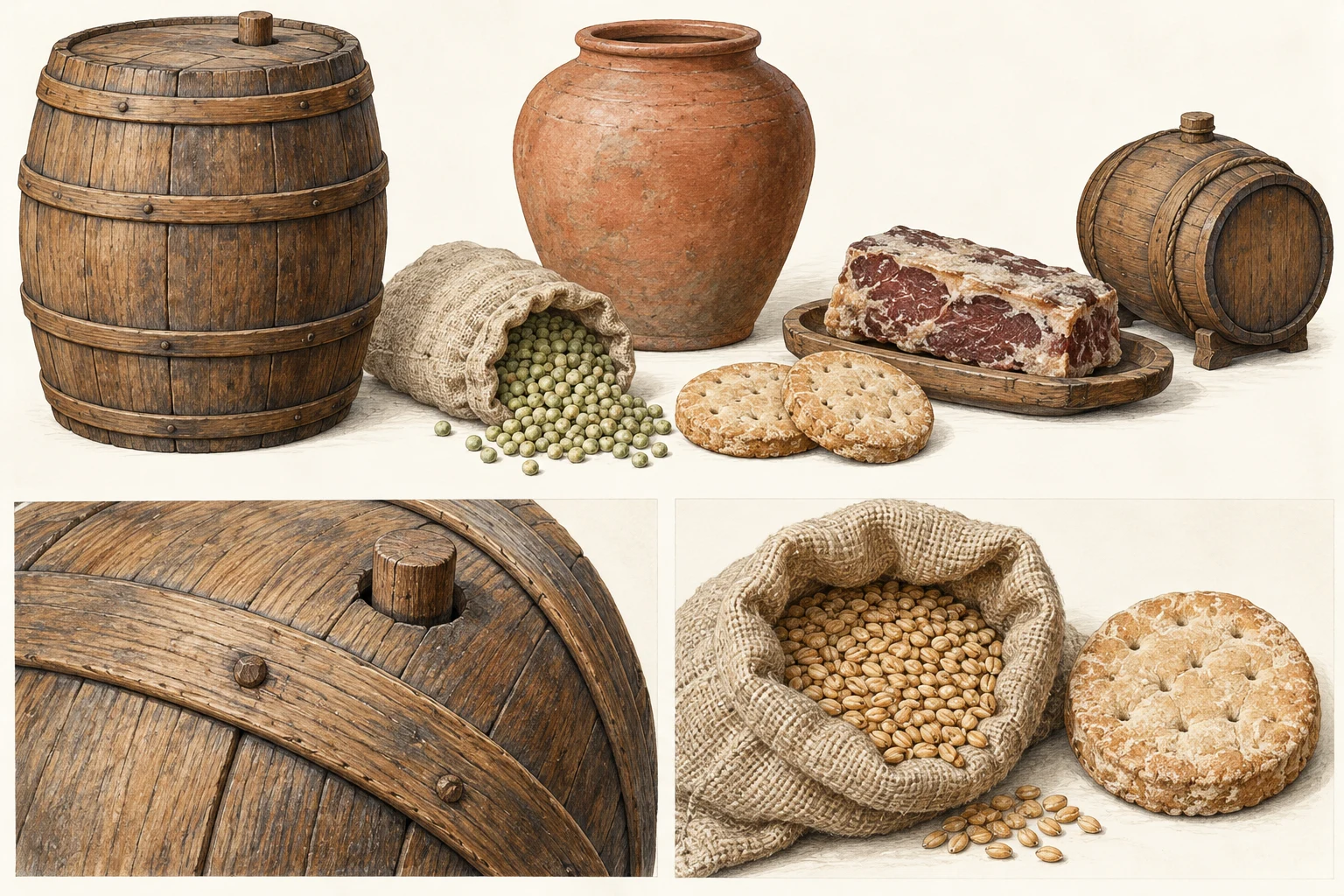 See the details.What did pirates eat and drink?Explore the illustrated guide