
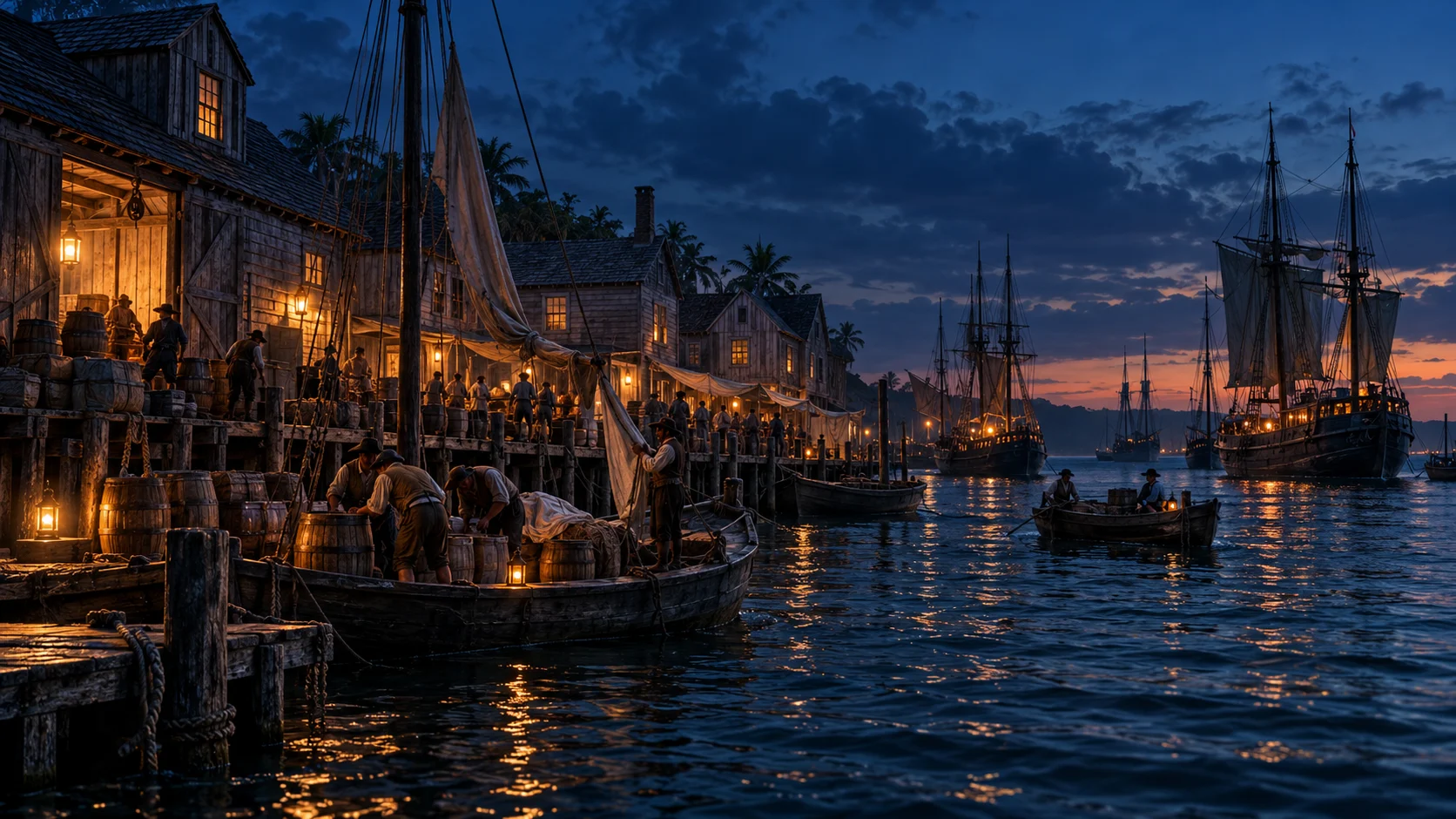
A small island beside a larger economy
Tortuga lies off Hispaniola. Haring’s account places its development beside the hunters operating on the larger island, rather than treating it as an isolated settlement that somehow produced everything raiders needed. The movement of meat, hides, people and supplies connected the two. [1]
The word buccaneer is linked to the preparation of meat on a boucan. Later usage expanded toward sea raiders. A useful history keeps that relationship in view without assuming every hunter was a pirate or every pirate lived the same working life.
Control was repeatedly contested
The island was not a stable refuge under one flag throughout its history. Haring reconstructs English, French and Spanish interventions, expulsions and returns. Settlement could be disrupted by an armed expedition, then resume when a garrison left. [1]
It is therefore misleading to give Tortuga one timeless political identity. Ask who controlled it at the date of a particular voyage and what authority a visitor claimed to recognize. A useful haven in one decade might be a dangerous destination in another.
Defense, water and an anchorage
Haring describes the governor Levasseur taking advantage of high ground overlooking the anchorage and a source of fresh water. His account explains a defensive position through the relationship between terrain, artillery and access. [1]
Those practical features make the place more interesting than a decorative fort on an imagined map. A ship’s company needed a safe approach, water and space to work; a governor needed a position from which to control arrivals. Geography offered possibilities, while fortification and organization made use of them.
A market as well as a refuge
Hunters used Tortuga for supplies and retreat. Raiders returned to refit and find markets for what they had taken. Planters and visiting traders participated in the same developing economy. Haring names exchanges involving hides, tobacco and sugar on one side and guns, powder, cloth and drink on the other. [1]
That mixture is central. Treating every resident as a pirate obscures the labor that made a settlement function and the commercial relationships that connected legitimate and predatory enterprise.
Keep the different Levasseurs apart
The seventeenth-century Tortuga governor called Levasseur is not automatically the later Indian Ocean pirate Olivier Levasseur. A repeated surname can create a convincing but false connection. The same caution applies to ships, islands and colonial officeholders. [1]
Read Tortuga beside Port Royal and Nassau. All can be called pirate centers, but their dates, institutions and connections differ. The comparison explains more than ranking them by how lawless they sound.
Questions, answered.
Was Tortuga only a pirate base?
No. Hunters, planters and traders also appear in its history, and its role changed with control and commerce.
Does buccaneer simply mean pirate?
The word’s history is connected to meat preparation and hunters. Its later association with sea raiding does not make those occupations identical in every context.
Sources & reading notes
Source checks distinguish an artifact, a reported account and a modern interpretation. They do not constitute independent historian review.
- The Buccaneers in the West Indies in the XVII Century (1910)Clarence Henry Haring; Project Gutenberg transcription · Early twentieth-century historical study; public domain in the USA
Chapter II, “The Beginnings of the Buccaneers,” especially printed pages 58–67: Tortuga’s repeated occupations, Levasseur, provisioning and the terminology of hunters and corsairs. Distinguish this Levasseur from the later Indian Ocean pirate Olivier Levasseur. An older secondary study drawing on colonial records and earlier narratives. Its imperial framing, racial generalizations and claims about national character are not adopted as fact. Not a substitute for current scholarship.
 See the details.Careening: the work that made a ship vulnerableExplore the illustrated guide