
Landing did not mean everyone rested
Rogers describes moving sick men ashore while other people cleared the ship, repaired sails and fetched wood and water. Dutchess had more sickness and received the loan of a sailmaker. The two companies’ needs were handled together. [1]
The stop was a redistribution of labor. Some men could not perform their ordinary duties, while the ships still required work before another long passage.
A temporary settlement appeared
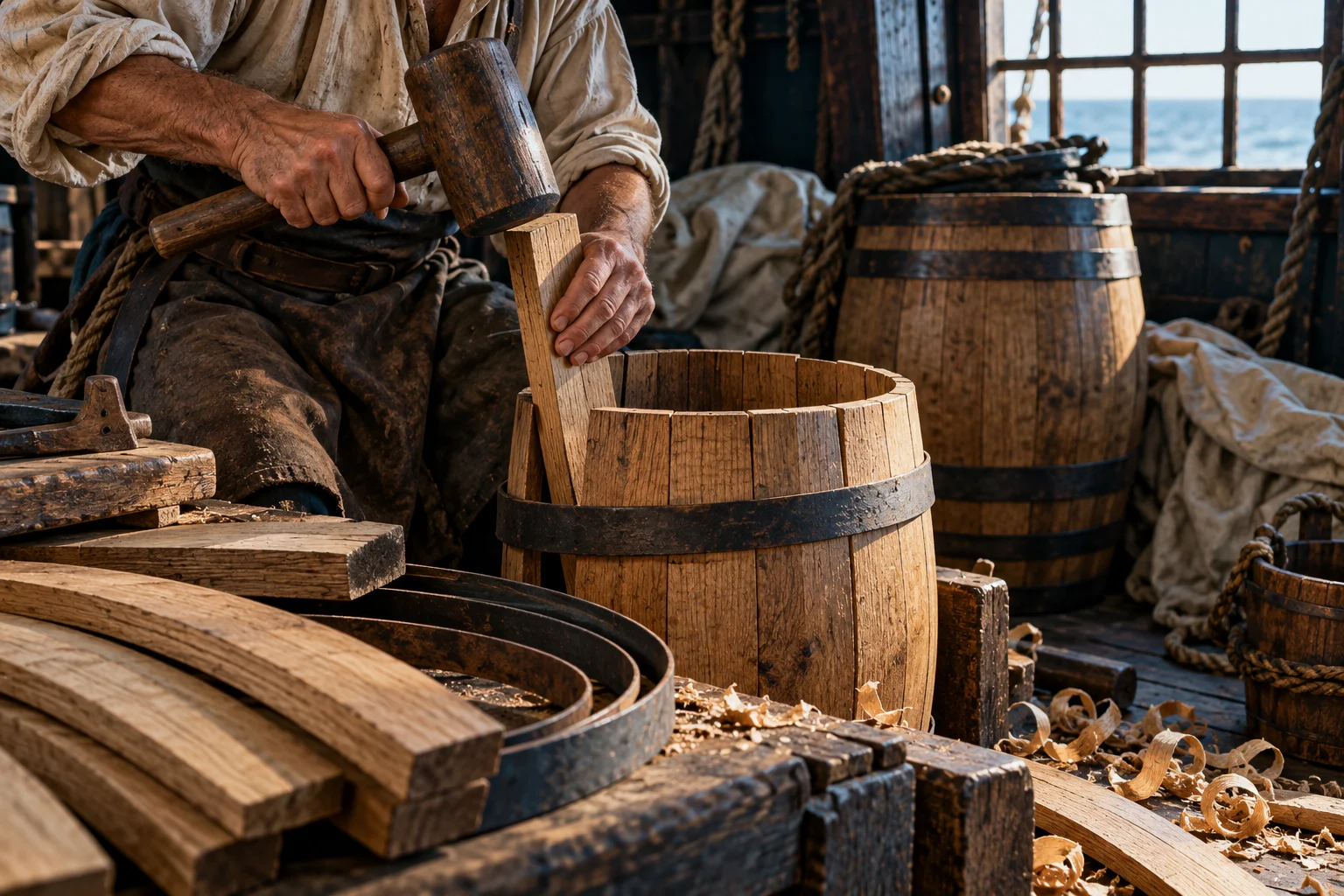
The journal describes a forge set up ashore, coopers working in another place and tents made with sails. Rogers likened the arrangement to a little town in which everyone was employed. [1]
The description reveals how much a vessel carried the means of adapting its workplace. Tools and canvas could be rearranged into a shore-based operation.
Food and water depended on local knowledge
Selkirk supplied goats and helped the arriving company find resources. Fishing and gathering supplemented provisions while water was brought aboard. The account connects these supplies with the men’s recovery. [1]
Its explanations include the period’s assumptions about air, diet and disease. This article reports what the commander observed and believed; it does not prescribe a treatment or diagnose every illness retrospectively.
A bad cask could spoil an earlier investment
Rogers says water brought from previous stops had spoiled through the condition of its casks. Filling new water was therefore inseparable from the work of making containers reliable. [1]
The quantity carried at departure was not the whole supply problem. Storage had to preserve a usable resource throughout the passage.
The camp ended when the voyage could resume
The dated entries follow the return of sails, wood, water, equipment and people aboard. The company also wanted to leave before opponents could interfere. Restoring health and seaworthiness occurred under a strategic deadline. [1]
Read Selkirk, the cooper and the surgeon. The work between encounters was not an empty pause in maritime history.
Questions, answered.
Was the camp only a place for sick sailors to sleep?
The journal describes repairs, a forge, coopering, sail work and provisioning alongside care of sick men.
Are Rogers’s disease explanations modern medical advice?
No. They are identified as historical observations and beliefs.
Sources & reading notes
Source checks distinguish an artifact, a reported account and a modern interpretation. They do not constitute independent historian review.
- A Cruising Voyage Round the World (1712; 1928 reprint)Woodes Rogers; 1928 edition with introduction and notes by G. E. Manwaring; Project Gutenberg · Participant voyage narrative in a later public-domain edition
1–12 February 1709, sick men ashore, tents, smiths, coopers, sailmakers, provisions and spoiled casks. Rogers’s diagnosis and explanations are attributed to his journal; no modern clinical recommendation is inferred. Distinguish Rogers’s journal from Manwaring’s 1928 introduction and notes. Rogers writes as a commander accounting for his decisions and profits. Reported medical explanations and national or racial judgments are not adopted as modern science or neutral fact.
 See the details.What did pirates eat and drink?Explore the illustrated guide