
The sail and the system around it
A canvas sail belonged to a larger arrangement of spars, lines and supporting structures. Reading only the outline misses the work required to set, adjust, reduce or stow it. Smith’s chapters on rigging and sails name parts according to their functions within that arrangement. [1]
Damage to one part could therefore change what the company could do with the rest. Having a mast did not guarantee a usable sail, and having spare cloth did not guarantee that a repair could be completed immediately.
Small tools made repairs possible
Needles and twine appear in Smith’s boatswain’s stores beside sailcloth. Their presence is a good correction to the idea that shipboard maintenance was only heavy work with timber and iron. Repair also depended on smaller skilled actions and on materials that might be consumed as the voyage continued. [1]
The list is evidence for what the manual expected to be provided. It is not an inventory recovered from every pirate wreck. A named vessel needs its own equipment record before a detailed tool kit can be reconstructed.
A job need not equal a universal rank
Someone had to perform sail work, but a task and an office are not the same thing. Smith’s allocation to the boatswain demonstrates one way of organizing responsibility. A later naval complement could identify more specialized positions; that later structure should not be silently imposed on a smaller earlier company. [1][2]
This distinction is useful throughout pirate history. A company might depend on a person’s skills without using a familiar modern title, and the same title could cover a changing range of work.
Weather did not wait for a convenient shift
Smith warns young commanders that inexperienced people could increase the load on capable sailors. Bad weather demanded the greatest effort at the very moment men were wet, cold and exhausted. He presents skilled labor as a limit on the vessel’s effective strength. [1]
Sail repair belongs in that account of capacity. It was not a separate decorative craft performed after the real action. A company’s ability to continue depended on whether enough people and usable material remained to restore the system.
Read a painting with the work in mind
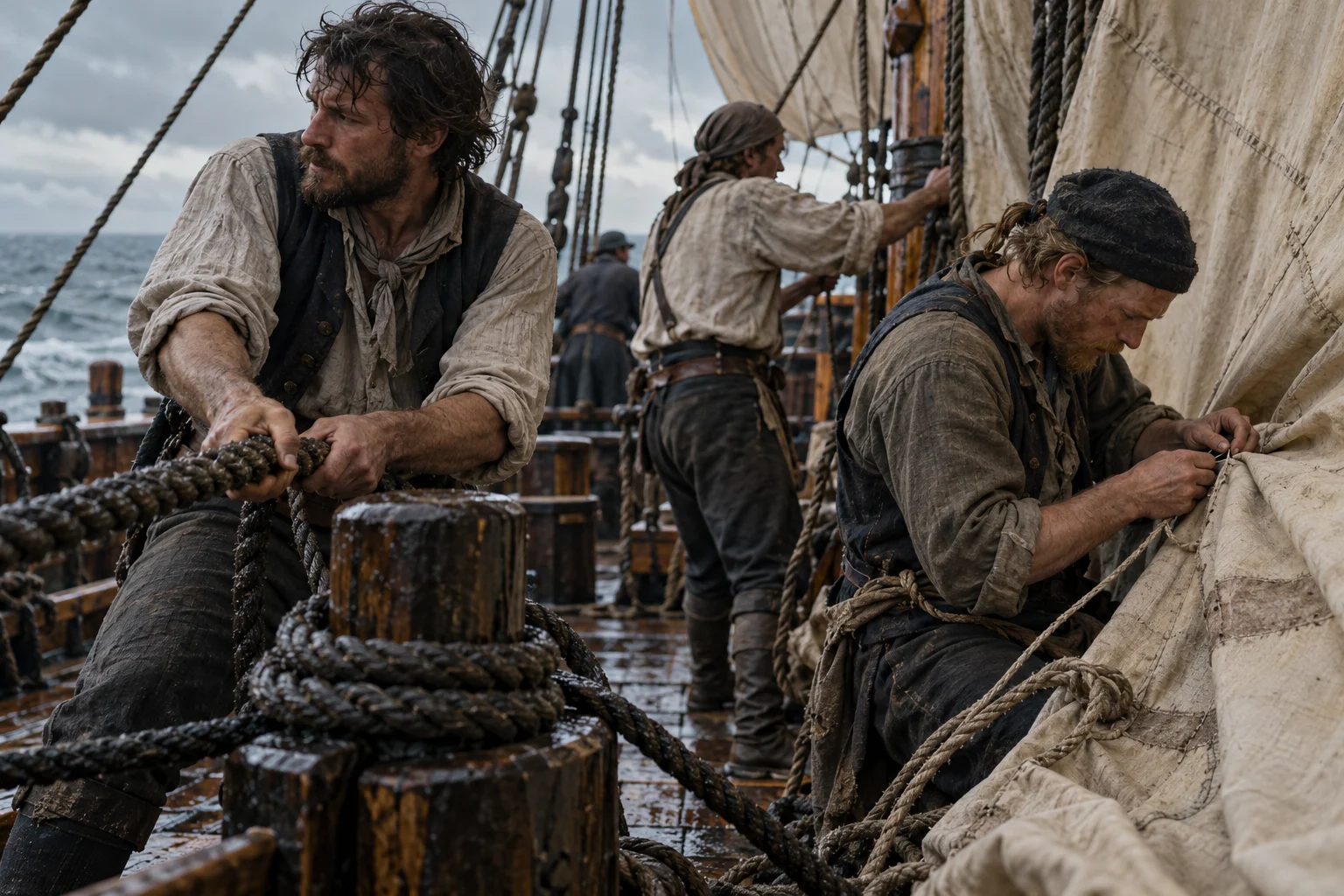
A dramatic painting can show an impressive spread of canvas without showing how it was handled. Ask which sails are set, whether the image is tied to a documented vessel and which details are artistic reconstruction. The generated artwork here illustrates the topic; it does not certify an exact historical rig.
Follow the officer responsible for these stores, compare rig and vessel terminology and explore the distinction between supporting and working lines.
Questions, answered.
Did every pirate ship carry a person called the sailmaker?
That is not established by the sources used here. The need for sail work does not prove one uniform office or complement.
Can a modern image establish the exact sails of a named pirate vessel?
No. A reconstruction needs vessel-specific evidence; generic artwork remains interpretation.
Sources & reading notes
Source checks distinguish an artifact, a reported account and a modern interpretation. They do not constitute independent historian review.
- A Sea Grammar (1627)Open the keyboarded source transcriptionJohn Smith; Early English Books Online / Text Creation Partnership · Seventeenth-century seafaring manual; TCP transcription released under CC0
Chapters V, VII and VIII: rigging, the different sails and the boatswain’s store of needles, twine and sailcloth; Chapter XV on experienced sailors and excessive workloads. A prescriptive manual from 1627, not the operating rules of every merchant, naval or pirate vessel. The TCP text preserves gaps and transcription uncertainty. Modernized explanations here do not reproduce its period medical or physical theories as current advice.
- An Universal Dictionary of the Marine (1769)William Falconer; Project Gutenberg transcription · Eighteenth-century technical dictionary; public domain in the USA
The 1769 dictionary’s discussions of rigging and naval complements are a later comparison only. Published 1769, later than most events in this chapter. Used as a dated terminology comparison, not proof that an earlier pirate carried a particular instrument or followed later naval regulations.
 See the details.What did pirates eat and drink?Explore the illustrated guide