
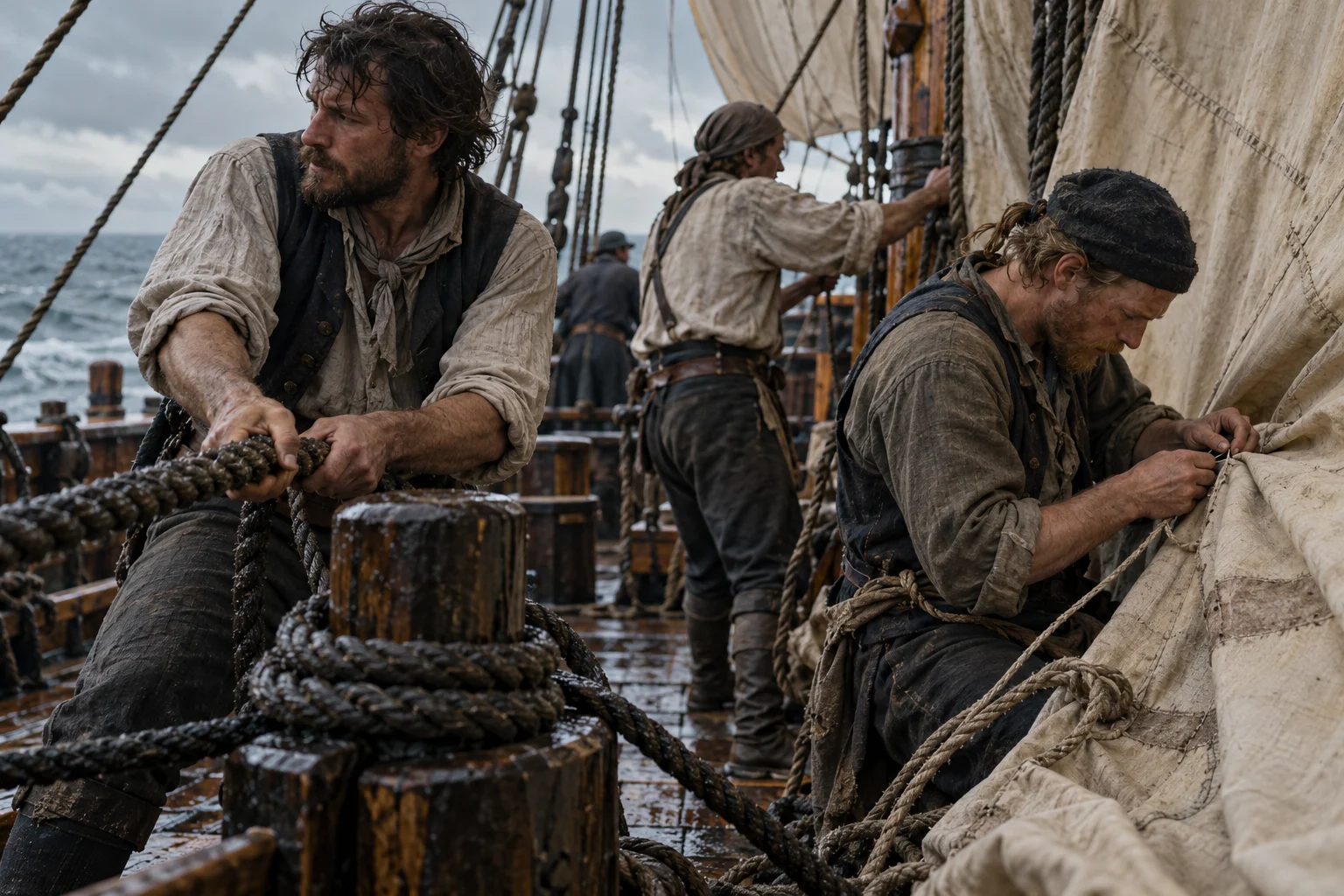
Movement required people after dark
A sailing vessel still needed attention when some of its company slept. Smith names steering, trimming sails, pumping and other duties when describing the watch. The division into working periods was therefore part of operating the vessel, not simply a way to make the day orderly. [1]
The arrangement also makes a familiar head count less informative than it appears. A vessel with sixty people did not necessarily have sixty available for every routine task at every hour. Rest, sickness, specialist work and other demands changed the effective workforce.
Two sides, then smaller groups
Smith’s master led a starboard watch and his mate a larboard watch, choosing men until the company was divided. The groups could be subdivided into squadrons according to the ship’s number and burden. Companions were placed in different watches so they would have more room in their sleeping places. [1]
That last detail connects the timetable to space below. A watch was not only an abstract schedule: it influenced who was awake, who was using accommodation and which experienced people were available together.
What four hours meant in this description
The manual calls eight glasses, or four hours, a watch. The glasses are part of the means of measuring time, rather than proof that a modern clock stood on every deck. This stated duration is useful evidence for Smith’s scheme; a particular vessel’s routine still needs its own record. [1]
| Period | On ordinary duty | Off ordinary duty |
|---|---|---|
| First four-hour block | Group A | Group B |
| Next four-hour block | Group B | Group A |
| Following block | Group A | Group B |
The model explains alternation. It does not specify a historical start time, everyone’s actual sleep or later naval variations.
All hands could interrupt the pattern
Smith expressly allows a storm, gust or accident to require everyone’s help. Being off the ordinary watch was not an unconditional guarantee of undisturbed rest. The schedule yielded to the vessel’s immediate needs. [1]
That is an important part of understanding fatigue. A neat table can give an appearance of sufficient rest even when repeated emergencies remove it. The organization and the conditions of the voyage must be considered together.
Experience was unevenly distributed
Smith warns that too many learners could overload the capable sailors, especially in bad weather. Counting bodies and counting effective experience are different calculations. The watch had to keep necessary knowledge available, not merely put an equal number on each side. [1]
Continue with the boatswain’s coordination, the information needed to navigate and pumping as continuing labor. These tasks explain why a ship was a workplace through the whole night.
Questions, answered.
Was everyone asleep when the ship sailed at night?
No. The watch organized continuing duties while others were off ordinary duty.
Did all pirates follow Smith’s four-hour scheme?
That is not established. The manual supplies one dated model; actual arrangements require vessel-specific evidence.
Sources & reading notes
Source checks distinguish an artifact, a reported account and a modern interpretation. They do not constitute independent historian review.
- A Sea Grammar (1627)Open the keyboarded source transcriptionJohn Smith; Early English Books Online / Text Creation Partnership · Seventeenth-century seafaring manual; TCP transcription released under CC0
Chapter IX, the division of the company, companions in opposite watches, steering, sail trimming and pumping; Chapter XV, experienced labor and the cost of overloading a smaller skilled workforce. A prescriptive manual from 1627, not the operating rules of every merchant, naval or pirate vessel. The TCP text preserves gaps and transcription uncertainty. Modernized explanations here do not reproduce its period medical or physical theories as current advice.
 See the details.What did pirates eat and drink?Explore the illustrated guide