
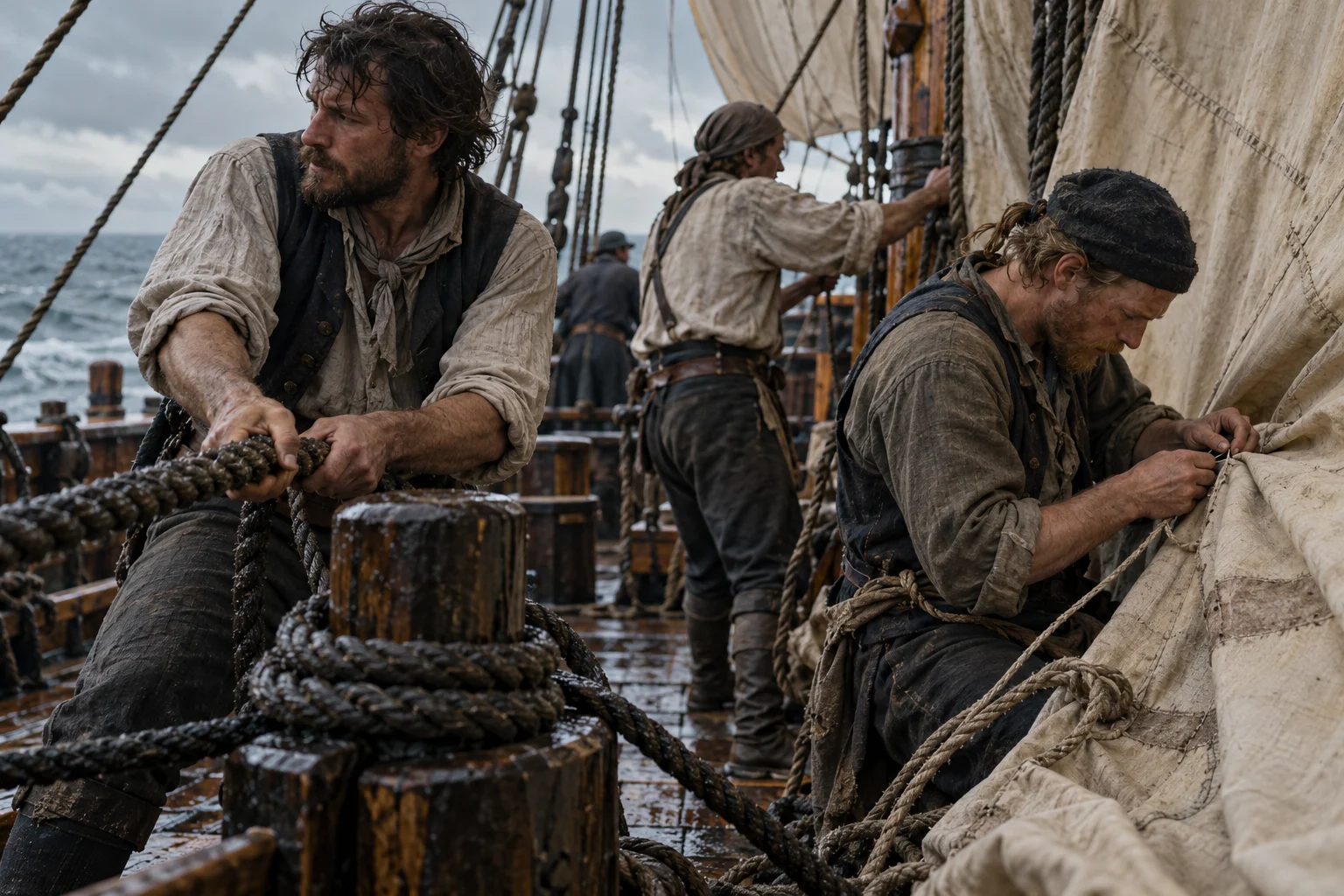
A change of clothes was a practical resource
Smith asks a prospective commander to think about bedding, linen and apparel as part of the cost of going to sea. His account of sailors soaked by bad weather also describes men without adequate clothes to change into. Clothing belongs in his explanation of the voyage’s working conditions. [1]
That perspective is more useful than starting with a dramatic coat. What could a person wear while working? What remained dry? Which belongings could be replaced during the voyage? The sources do not answer every question for every individual, but they identify real material concerns.
Plunder was not only coin
Bonnet’s chapter names provisions, clothes, money and ammunition among goods taken from shipping. The range helps explain how capture could supply an operating company as well as produce something to divide or sell. [2]
For a victim, an ordinary personal item might be important without having a spectacular market value. A list organized only by the largest monetary totals can therefore make the event less understandable to the people who experienced it.
Cloth could serve more than one purpose
In the letter attributed to Macrae after the loss of Cassandra, bales of cloth appear among what was given back along with a damaged replacement vessel. The material had value within a commercial cargo and in the practical negotiation that made departure possible. [2]
Do not assume that all cloth mentioned in a capture became pirate clothing. A cargo description, a person’s worn garment and material used for repairs are different kinds of evidence, even when the same broad word appears.
A costume is a reconstruction with assumptions
A modern illustration can combine garments and accessories into a striking identity. To call it an accurate portrait of a named sailor requires more: the date, the setting, the garment evidence and a reason to associate those items with that person.
The scene artwork in this publication is interpretive. It can make a working environment visible without proving that a particular man wore the depicted coat or that an entire company dressed alike. A generic costume must not become a uniform inferred backward from later entertainment.
Read belongings through the task
Work, weather, storage and capture give ordinary possessions a place in the story. The question is not only “what did pirates wear?” but how a person obtained, kept and replaced the things needed aboard.
Continue with canvas as working material, the organization of provisions and the later images that changed the familiar silhouette. Those connections keep the evidence larger than a costume checklist.
Questions, answered.
Did pirates wear a standard uniform?
The sources used here do not establish one. They describe particular captures and practical needs, rather than an ocean-wide dress code.
Does every bale of captured cloth show what pirates wore?
No. Cargo, repair material and an individual garment need to be distinguished.
Sources & reading notes
Source checks distinguish an artifact, a reported account and a modern interpretation. They do not constitute independent historian review.
- A Sea Grammar (1627)Open the keyboarded source transcriptionJohn Smith; Early English Books Online / Text Creation Partnership · Seventeenth-century seafaring manual; TCP transcription released under CC0
Chapter XV, a commander’s provision for bedding, linen, arms and apparel, and the situation of wet or exhausted men. A prescriptive manual from 1627, not the operating rules of every merchant, naval or pirate vessel. The TCP text preserves gaps and transcription uncertainty. Modernized explanations here do not reproduce its period medical or physical theories as current advice.
- A General History of the Pyrates (1724)Published under the name Captain Charles Johnson · Early printed account; public-domain text
Chapter IV, Bonnet’s early captures and clothing among the goods taken; Chapter V, the cloth and replacement vessel in Mackra’s letter. No standardized costume is inferred. Authorship is disputed. A near-contemporary compilation, not a surviving signed pirate code or a neutral transcript. Cite its claims as reported claims.
 See the details.What did pirates eat and drink?Explore the illustrated guide