
Music could communicate a command
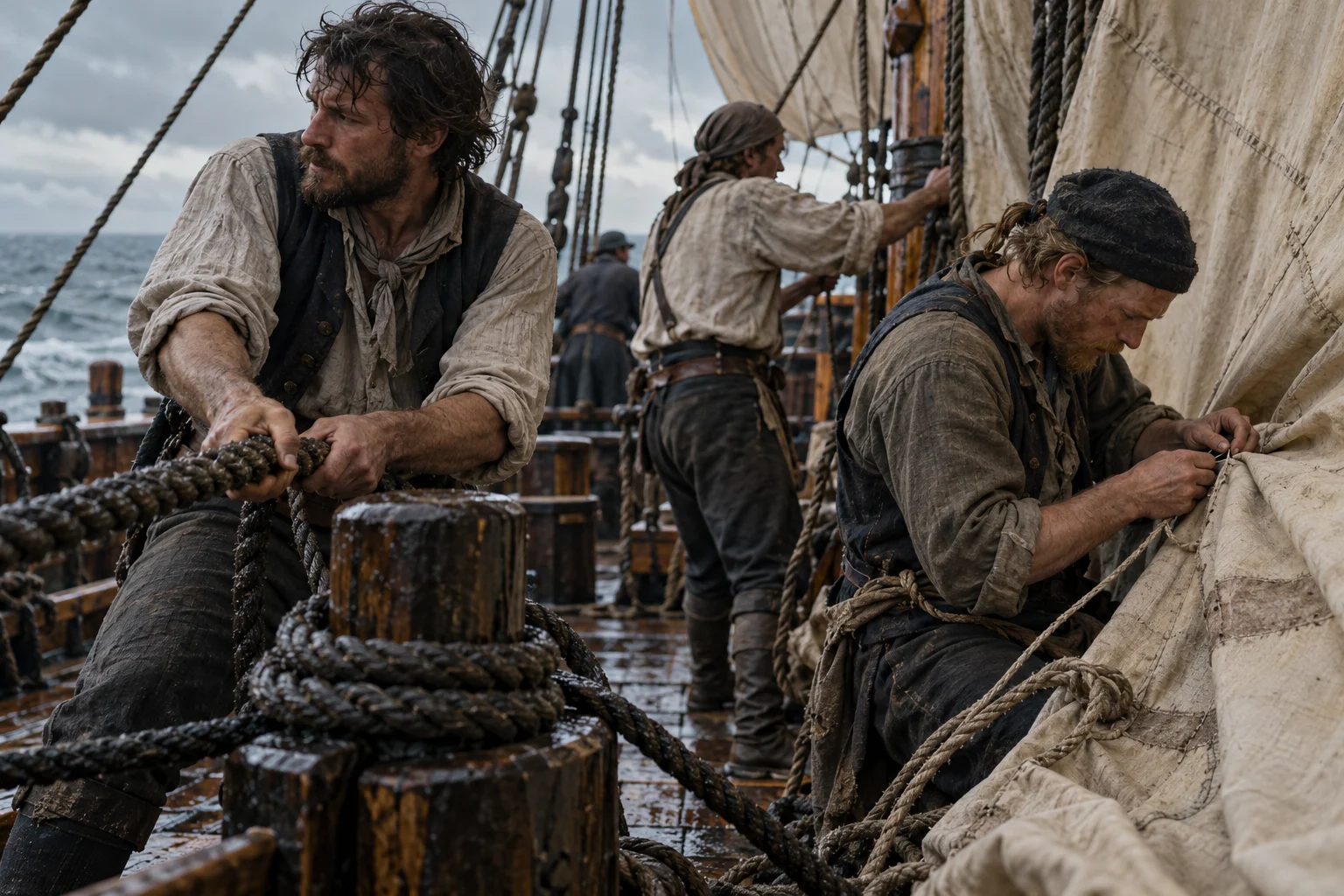
Smith places the trumpeter at occasions including a captain’s arrival or departure, welcoming strangers and actions in a fight. The role was part of a vessel’s organized communication and display, not merely leisure. He also describes the player teaching others to take a part. [1]
The source is a 1627 manual, not a sound recording or a roster for a particular pirate company. It demonstrates that an instrument could have a defined workplace function alongside its capacity to entertain.
A rest clause reveals a demand for labor
The articles attributed to Roberts give musicians rest on the Sabbath while restricting it on other days and nights without special favor. That is a promise within the printed agreement, not proof that all performances were cheerful or that rest was always honored. [2]
The clause makes more sense when the musician is treated as a worker. Other people wanted something from the player, and the agreement addressed when the demand could be suspended.
The proceedings tell another side
The reported Cape Coast proceedings describe four musicians lately forced from merchant vessels. Their confinement was said to have been harsh: instruments and heads were broken when they refused a tune or said they were tired. [2]
This evidence changes the picture supplied by a festive deck scene. Performance could be demanded through violence. A person’s presence as entertainment aboard a pirate vessel did not by itself establish enthusiasm for the company.
A musician could also be a witness
James White, identified through his musical work, appears as a witness concerning another man’s behavior during the encounter with Swallow. His testimony concerned sail handling, gun work and efforts to prevent the ship being blown up. The account gives him a role in reconstructing events, not simply providing their soundtrack. [2]
Such passages help recover the different people through whom a captain’s history reached print. A witness had a position and a purpose; those matter when weighing what the account says.
Do not supply an undocumented soundtrack
A later sea song may be enjoyable without being evidence of what a named early-eighteenth-century crew sang. Identifying a tune, words or work rhythm requires its own dated source. The existence of musicians is not permission to fill every silence with a familiar modern pirate song.
Follow the evidence for coercion, the printed agreements and the company in which these musicians were discussed. Music belongs inside the labor history as well as the cultural image.
Questions, answered.
Did musicians aboard always join voluntarily?
No. The reported proceedings explicitly describe musicians forced from merchant vessels.
Can a modern pirate song be used as evidence for a 1720 crew?
Only with a dated source establishing that connection. Familiarity today does not establish a period performance.
Sources & reading notes
Source checks distinguish an artifact, a reported account and a modern interpretation. They do not constitute independent historian review.
- A Sea Grammar (1627)Open the keyboarded source transcriptionJohn Smith; Early English Books Online / Text Creation Partnership · Seventeenth-century seafaring manual; TCP transcription released under CC0
Chapter VIII, the trumpeter’s assigned occasions and instruction of other players. A prescriptive manual from 1627, not the operating rules of every merchant, naval or pirate vessel. The TCP text preserves gaps and transcription uncertainty. Modernized explanations here do not reproduce its period medical or physical theories as current advice.
- A General History of the Pyrates (1724)Published under the name Captain Charles Johnson · Early printed account; public-domain text
Chapter IX, musicians’ rest in the articles, the four musicians’ reported acquittal evidence and James White’s testimony. The text’s dramatic scenes are attributed accounts. Authorship is disputed. A near-contemporary compilation, not a surviving signed pirate code or a neutral transcript. Cite its claims as reported claims.
 See the details.What did pirates eat and drink?Explore the illustrated guide