

Three kinds of evidence, three kinds of question
Ask what was found, what a written account says and what a modern reconstruction adds. A fragment may establish that an object was present without preserving its complete shape. A narrative may describe the carrying of weapons without listing what every person owned.
The QAR arms overview records artillery, small-arm remains and grenades. Its recovery statistics are explicitly dated, so this chapter does not present them as a live count. The assemblage belongs to one wreck site, not to all pirate vessels. [1]
The distinction between shipboard armament and personal weapons organizes the evidence below. It is not a shopping list, a ranked damage chart or a guide to operating historical weapons.
Blades: avoid drawing a whole sword from a handle
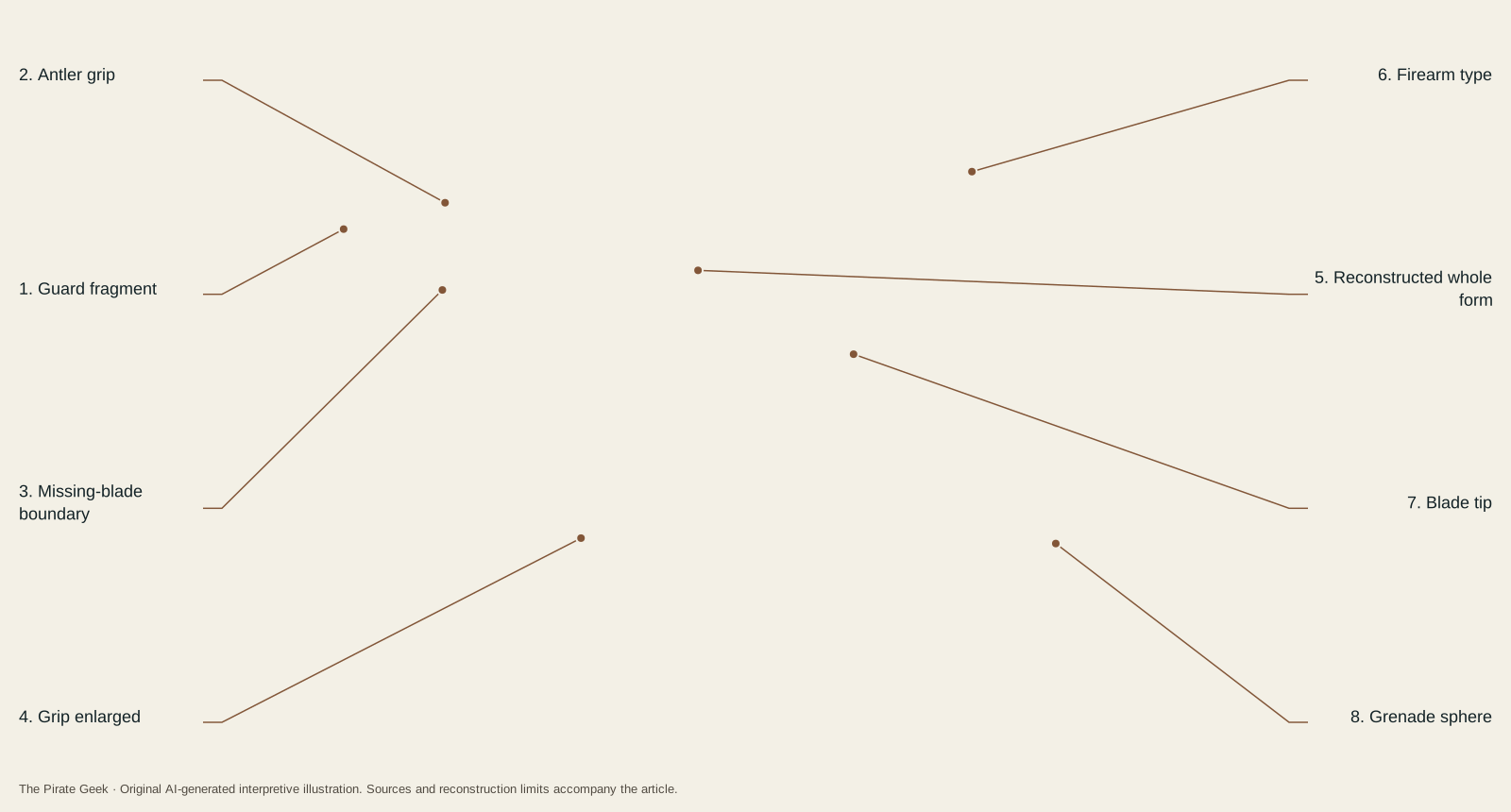
The QAR collection account reports no complete recovered bladed weapons. It describes, among other fragments, a hanger or cutlass grip dated to the 1680s or 1690s and a dirk handle whose blade did not survive. Those are specific observations, not permission to invent the missing blade’s curve or length. [2]
Johnson’s reported Roberts articles require firearms and cutlasses to be kept serviceable, and his description discusses pistols carried on ribbons. That gives us a textual account of care and display. It does not make every modern costume belt a reconstruction. [3]
When comparing a museum fragment with a film prop, first ask whether they are even claiming the same thing: an excavated component, a complete surviving object and an imagined accessory are three different categories.
Material, fittings and missing parts are separate observations. The catalogue identifies an antler hanger grip and other fragments, while explicitly stating that no complete bladed weapons had been recovered in that account.
NC Office of State ArchaeologyGuns and intimidation
Ship weapons belong in a larger story of pursuit, threats, surrender and resistance. In Johnson’s narrative, Roberts expects a vessel to surrender after a warning shot, then discovers it is prepared to fight back. The outcome is not the effortless triumph implied by a pirate silhouette. [3]
A number of guns does not by itself measure effective force. Condition, crew, position and ammunition would matter to a historical reconstruction. The evidence must support each part rather than letting a single number stand for all of them.
Our cannon and ammunition guide separates the objects and their purposes. It also explains why a gun’s pounder rating is not the weight of the gun itself.
Explosive weapons: presence is not routine use
The project identifies hollow iron grenades with fuse plugs among the recovered material. That supports the presence of this weapon category in the assemblage. It does not tell us how often grenades were thrown or what proportion of encounters involved them. [4]
The safe historical lesson is about evidence scale: an object can answer “was this here?” while leaving “how typical was it?” unresolved. A dramatic reconstruction often jumps between those questions without telling the viewer.
This chapter avoids handling, ignition or manufacturing instructions. Understanding the object’s historical role does not require recreating its operation.
A generic external grenade study illustrates a category supported by the catalogue. Presence in one assemblage does not prove routine use by every pirate company.
NC Office of State Archaeology · NC Office of State ArchaeologyCare, labor and the cost of violence
Article V in the Roberts list and a provision in Phillips’s articles emphasize maintaining arms. Johnson also reports penalties for neglecting weapons or duties. Read these as claims about rules and expectations, not a guarantee that every weapon worked at the needed moment. [3]
Weapons also harmed captives and crews. A clear comparison should not confuse an interesting mechanism with an admirable use. Our chapter keeps the people, coercion and commercial setting visible alongside the objects.
For the next layer, examine where equipment fitted into a working vessel, then compare what later pirate stories added. The most useful question is not which weapon looks most fearsome, but what a particular source allows us to say.
Questions, answered.
Did every pirate carry a cutlass and several pistols?
The sources used here do not establish a universal personal kit. They document particular rules, descriptions and recovered fragments.
Does a sword grip prove the full sword’s shape?
No. A grip or guard may help identify a type, but missing portions must not be presented as recovered evidence.
Sources & reading notes
Source checks distinguish an artifact, a reported account and a modern interpretation. They do not constitute independent historian review.
- Arms and armamentNC Office of State Archaeology · Archaeological collection
Arms and armament overview, distinct weapon categories. Recovery counts on this page are dated to 2015; they are not current totals.
- Bladed weaponsNC Office of State Archaeology · Archaeological collection
Bladed weapons entry, March 2018 update; guards, hanger grip and dirk handle, distinguishing fragments from complete weapons. No complete bladed weapon recovered in the cited account; do not invent its missing blade.
- A General History of the Pyrates (1724)Published under the name Captain Charles Johnson · Early printed account; public-domain text
Roberts and Phillips articles on clean serviceable arms; these are reported rules, not a universal inventory. Authorship is disputed. A near-contemporary compilation, not a surviving signed pirate code or a neutral transcript. Cite its claims as reported claims.
- GrenadesNC Office of State Archaeology · Archaeological collection
Grenades entry, March 2018 update; hollow spheres and fuse plugs. Historical interpretation only; no operating instructions.