
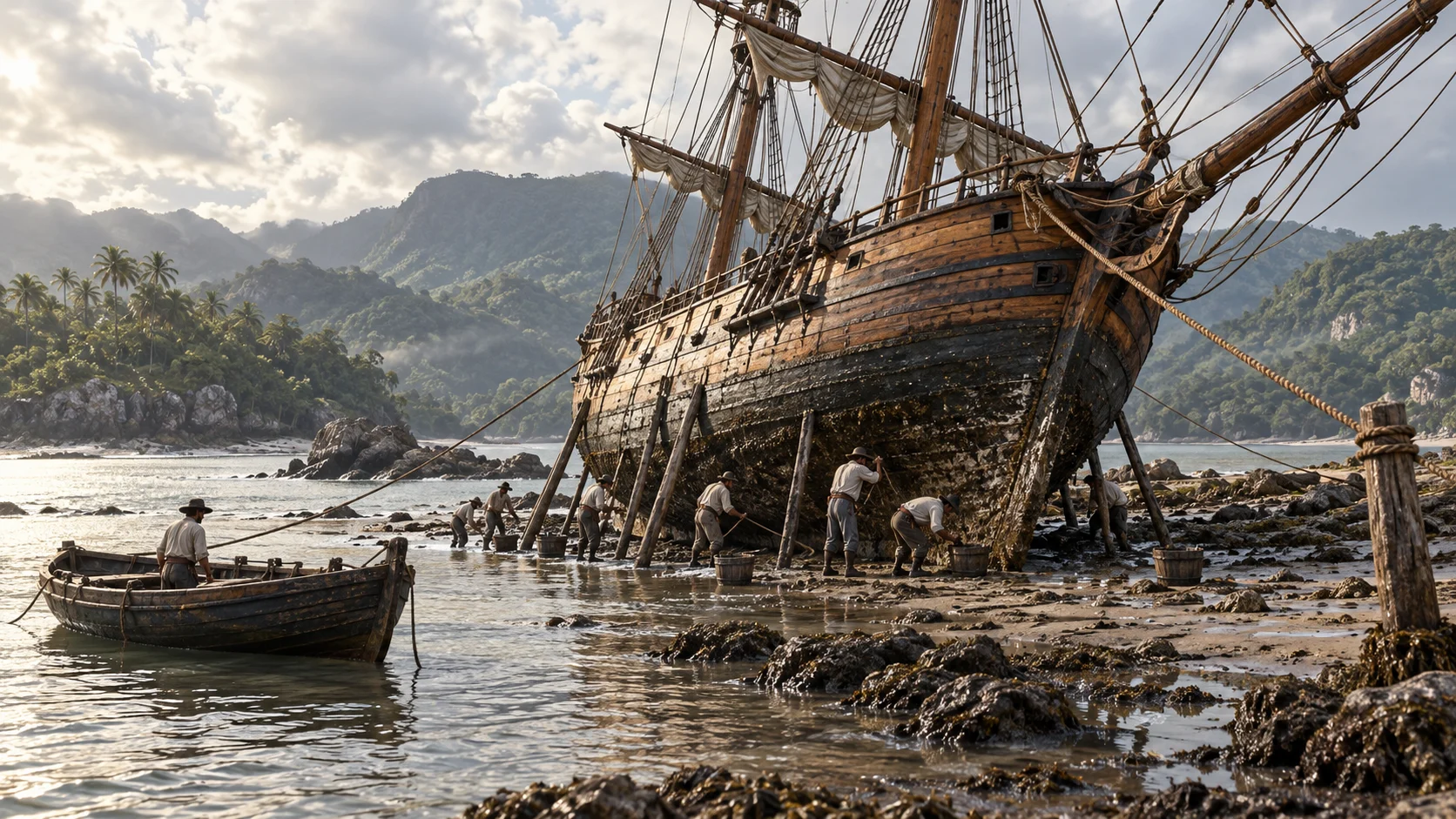
A hull was a collection of dependencies
A sailing vessel’s wooden fabric included much more than the outside planking. Frames, decks, boats, spars and the structures carrying loads all required attention. Smith assigns the carpenter a store of nails, spikes, plates, saws, files and hatchets, along with readiness to caulk, stop leaks and repair masts or yards. [1]
That store joined diagnosis to action. Recognizing a damaged part was not enough: the company needed material, tools, access and someone who knew what kind of repair the situation allowed.
Water exposed a structural problem
Leakage made the condition of the hull immediate. Smith discusses fastenings corroding within planking and the resulting loss of tightness. His particular explanations and remedies belong to the 1627 manual; the larger relationship is straightforward: a connection that fails can also become a route for water. [1]
Pumping and repairing answer different parts of the problem. Removing water already aboard does not, by itself, repair the opening through which more enters. Conversely, a patch may not remove water accumulated during the damage. Both labor and repair capability matter.
Battle repair and the work below
Falconer’s 1769 dictionary describes a carpenter inspecting the lower parts of a warship during battle and stopping shot holes with wooden plugs. This is a later naval reference, not evidence for the exact equipment of Blackbeard’s ship. It illustrates a useful division of attention: while fighting continued above, the vessel’s survival could depend on work out of sight. [2]
The dramatic view of a battle often centers on guns and boarding. The carpenter brings the hull back into the account. Damage has consequences after impact: broken material must still carry loads, exclude water and permit the vessel to move.
Sometimes the repair fixed the ship in place
Bonnet’s company remained at Cape Fear because its vessel was leaky. The General History says a small captured craft was broken up to help mend it. The delay gave an opposing expedition time to find the company. [3]
This is a practical limit on independence at sea. A vessel can be mobile in principle while its condition makes departure unreasonable. Repair material could itself become an object of capture, connecting the maintenance problem to further violence.
Skill could also make a person less free
A sought-after worker did not necessarily enjoy the freedom to leave. In Phillips’s chapter, the carpenter Fern is killed after an attempted departure. The account uses the episode to explain how fear held other men aboard. Valued skill and coercion could coexist. [3]
The carpenter’s history therefore has two sides: technical capability and the conditions under which the work was demanded. Read it beside forced service, maintenance ashore and the work of removing water.
Questions, answered.
Did a ship’s carpenter only build new vessels?
No. The responsibilities described here are largely inspection, maintenance and repair aboard vessels already in service.
Could every broken ship be repaired at sea?
No. Available material, damage, access and working conditions limited what could be attempted. Bonnet’s extended repair stop is one reported example.
Sources & reading notes
Source checks distinguish an artifact, a reported account and a modern interpretation. They do not constitute independent historian review.
- A Sea Grammar (1627)Open the keyboarded source transcriptionJohn Smith; Early English Books Online / Text Creation Partnership · Seventeenth-century seafaring manual; TCP transcription released under CC0
Chapter VIII, carpenter’s tools and responsibilities; Chapter XI, condition, leakage, fastenings and trim. A prescriptive manual from 1627, not the operating rules of every merchant, naval or pirate vessel. The TCP text preserves gaps and transcription uncertainty. Modernized explanations here do not reproduce its period medical or physical theories as current advice.
- An Universal Dictionary of the Marine (1769)William Falconer; Project Gutenberg transcription · Eighteenth-century technical dictionary; public domain in the USA
Headword “Carpenter of a ship,” used as a later 1769 comparison. Published 1769, later than most events in this chapter. Used as a dated terminology comparison, not proof that an earlier pirate carried a particular instrument or followed later naval regulations.
- A General History of the Pyrates (1724)Published under the name Captain Charles Johnson · Early printed account; public-domain text
Chapter IV, Bonnet at Cape Fear, including the small vessel broken up for repair material; Chapter XV, the carpenter Fern and attempted departure. Authorship is disputed. A near-contemporary compilation, not a surviving signed pirate code or a neutral transcript. Cite its claims as reported claims.
 See the details.What did pirates eat and drink?Explore the illustrated guide