

Puná controlled information on the approach
The company secured people and small craft at Puná and tried to prevent warning reaching the town upriver. Rogers also found a Spanish paper ordering coastal vigilance against an expected expedition. The approach was a contest over information as well as distance. [1]
Pilots, tides and the movement of the heavier barks complicated the effort to keep the force together.
An alarm changed the night plan
Near the town, lights, bells and gunfire persuaded the attackers they were expected. The commanders debated landing. Rogers records Dampier advising that buccaneers did not attack a large place after it had been alarmed. The party fell back with the ebb. [1]
This is an explicit moment when experience did not produce unanimous advice. Time and tide narrowed the available choice while the discussion continued.
Negotiation did not end the threat
The commanders discussed payment and trade with the corregidor. The exchange then broke down over terms, timing and security. Rogers reports threats to attack, burn and give no quarter if the demanded settlement was not made. [1]
The language of honor in the negotiation sits beside coercion. Both belong to the encounter, rather than one canceling the other.
Occupation spread the attackers out
After the attack the commanders held separate positions, including churches. Rogers describes houses burned near Dover’s post and the difficulty of protecting a long town with a limited force. Parties searched for valuables and guarded access to the river. [1]
Taking a town created further work and vulnerability. The ships offshore could not directly supervise every detachment in the streets or woods.
Payment and departure were different events
Partial ransom arrived, but the company continued to demand the remainder. When it left, hostages remained aboard and feared being carried to Britain. Their detention continued after the immediate occupation had ended. [1]
Compare the use of hostages, the earlier Portobelo campaign and Rogers’s command. The river geography and unfinished transaction distinguish this operation from a generic buccaneer raid.
Questions, answered.
Did the operation end as soon as the town was entered?
No. The journal records occupation, negotiation, partial payment and continued detention afterward.
Did the attackers approach by sailing their main ships directly to every objective?
The approach involved boats, barks, pilots, tides and river movement.
Sources & reading notes
Source checks distinguish an artifact, a reported account and a modern interpretation. They do not constitute independent historian review.
- A Cruising Voyage Round the World (1712; 1928 reprint)Woodes Rogers; 1928 edition with introduction and notes by G. E. Manwaring; Project Gutenberg · Participant voyage narrative in a later public-domain edition
Entries 20 April–6 May 1709, Puná, the approach and alarm, negotiations, attack, occupation, payments and departure. Use dated entries rather than Manwaring’s later summary. The commander’s self-justification and judgments about defenders remain attributed. Distinguish Rogers’s journal from Manwaring’s 1928 introduction and notes. Rogers writes as a commander accounting for his decisions and profits. Reported medical explanations and national or racial judgments are not adopted as modern science or neutral fact.
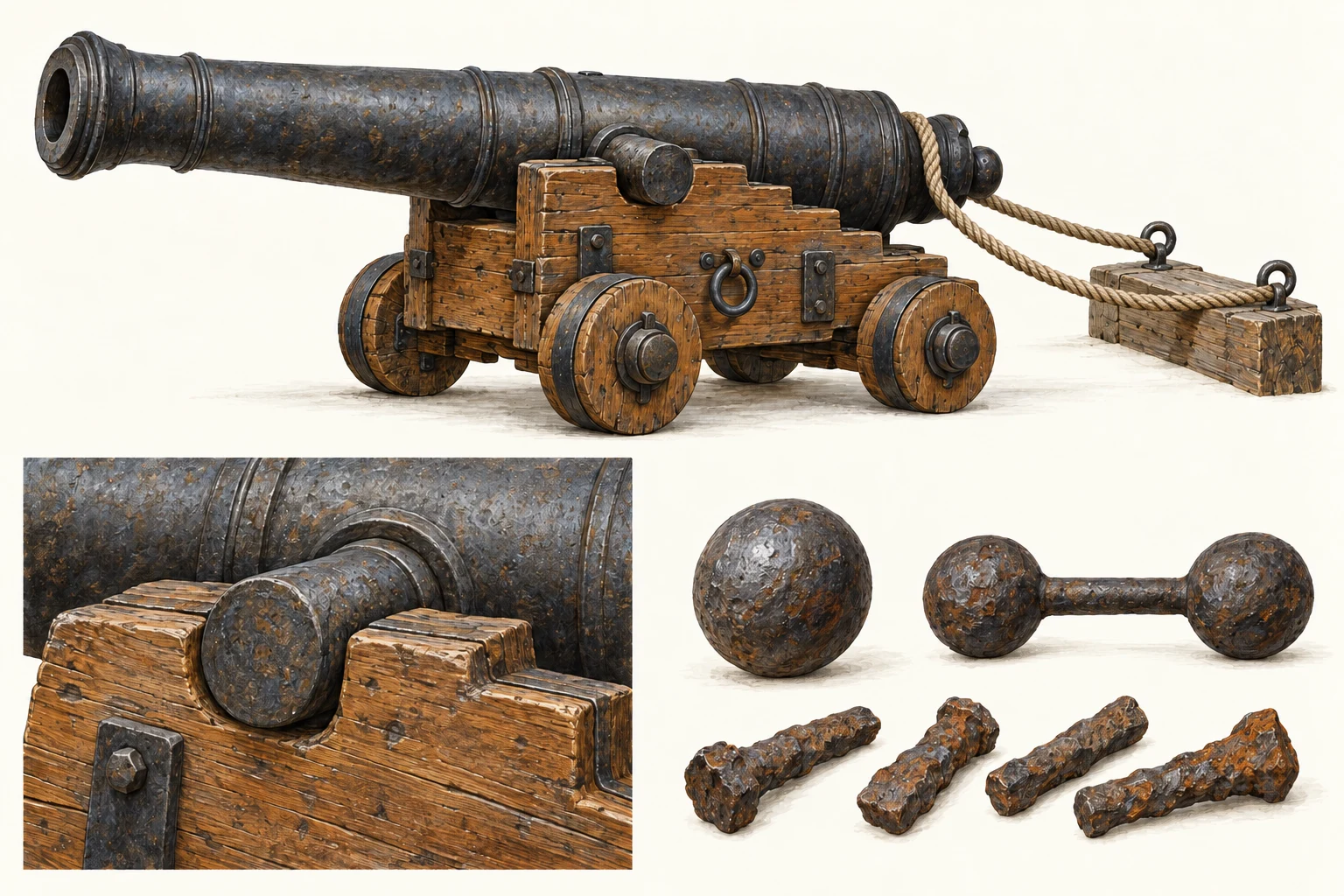 See the details.Cannon, shot and the meaning of a pounder.Explore the illustrated guide