
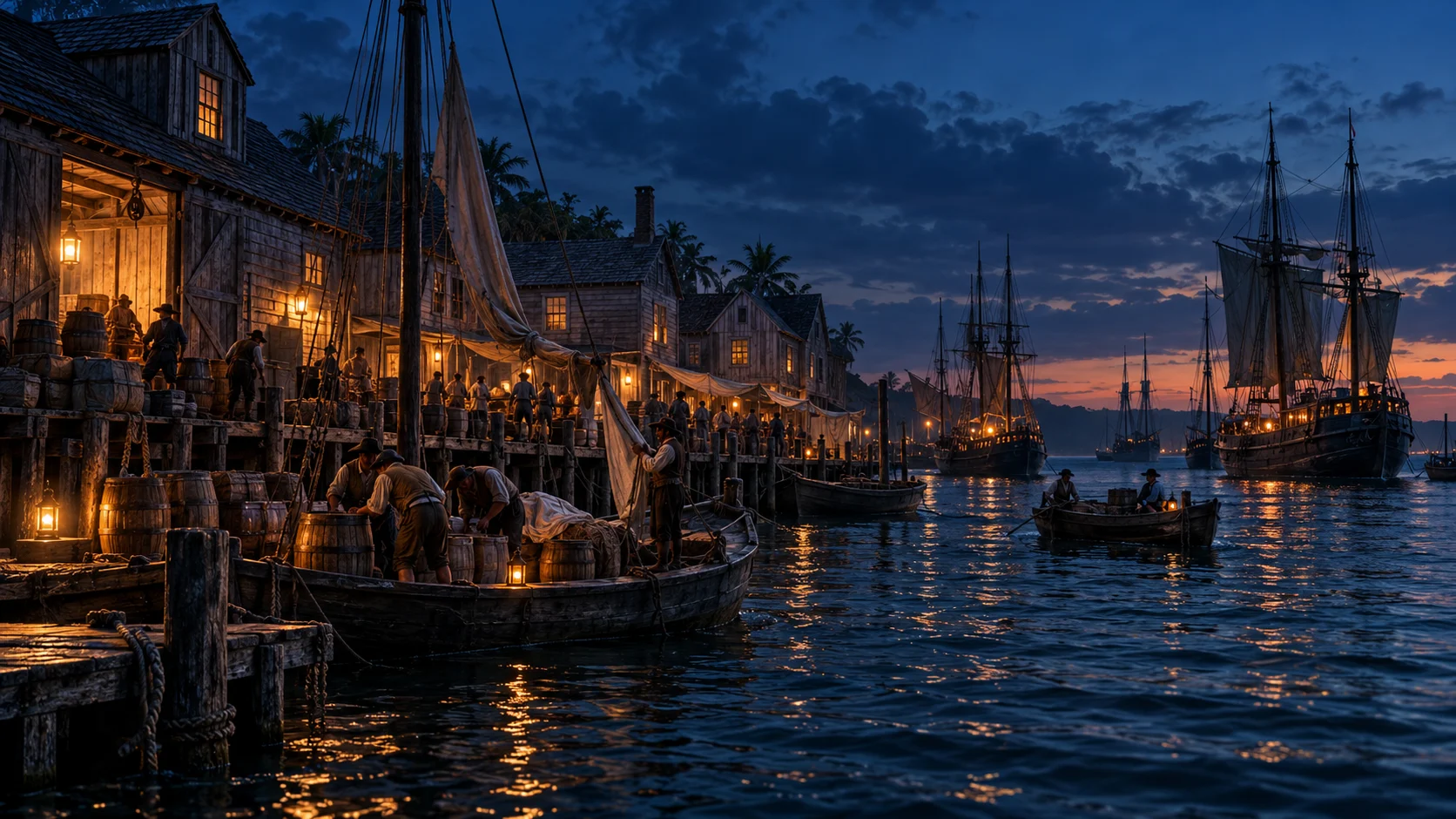
News arrived before the main exchange
When the fleet reached Cartagena, messages traveled to Portobello and across the isthmus toward Panama and the Pacific authorities. Merchants and officials needed time to assemble goods and revenues for transport. [1]
The fair therefore depended on communications as well as ships. A cargo waiting on the wrong side of the isthmus could not become a timely Atlantic shipment simply because the galleons were in port.
Pacific shipping met overland labor
Goods from the southern colonies came through the Pacific network to Panama, then crossed the isthmus on mule trains. At Portobello they met vessels from Spain. Haring’s account emphasizes silver, while also describing the commerce surrounding the royal revenues. [1]
Carriers, animal handlers, warehouse workers and suppliers made the transfer possible. The route was an economic system with many kinds of labor, not just a line connecting two waterfronts.
A temporary crowd transformed the town
Merchants, soldiers and sailors arrived in a place with a much smaller permanent population. Haring uses Gage’s 1637 account to illustrate the resulting accommodation prices and crowding. [1]
Those observations are useful evidence of pressure during a particular visit. They should not become a claim that every room always cost the same amount or that all fairs unfolded to an identical schedule.
Commercial opportunity carried serious risks
The account describes sickness and difficult conditions alongside the exchange. It also presents the fair as regulated commerce, with prescribed prices and procedures rather than an entirely open marketplace. [1]
The profits expected by merchants must be read beside the burdens on workers and inhabitants. A busy port could be lucrative for one participant and dangerous for another.
A trading function explains the port’s attraction to raiders
Portobello’s role in the imperial network helps explain why attackers valued it. That does not mean a raiding party always arrived during a fair or found the whole fleet’s treasure waiting in the streets.
Read Morgan’s separate 1668 attack, the fleet system and the later Panama campaign. The port’s commercial history and its attacks illuminate each other without becoming the same event.
Questions, answered.
Was Portobello directly on the Pacific coast?
No. Its importance lay in connecting Caribbean shipping to Panama and Pacific routes across the isthmus.
Did every attack occur while the fair was underway?
That requires evidence for the particular attack; the existence of the fair does not establish it.
Sources & reading notes
Source checks distinguish an artifact, a reported account and a modern interpretation. They do not constitute independent historian review.
- The Buccaneers in the West Indies in the XVII Century (1910)Clarence Henry Haring; Project Gutenberg transcription · Early twentieth-century historical study; public domain in the USA
Chapter I, pp.16–19, including Haring’s use of Thomas Gage’s 1637 account. Reported prices, mule totals and mortality are attributed observations rather than complete administrative statistics. An older secondary study drawing on colonial records and earlier narratives. Its imperial framing, racial generalizations and claims about national character are not adopted as fact. Not a substitute for current scholarship.
 See the details.How pirate prize shares worked.Explore the illustrated guide